

 0
0
 0
0
Why Industrial Drone Operations Demand Specialized Propeller Engineering
Industrial drone operations in the 5-9kg payload class face critical engineering challenges that distinguish them from recreational or lightweight commercial applications. Hub area bending moment concentration under sustained high thrust conditions creates structural fatigue that compromises flight safety and operational consistency. When propellers encounter large thrust demands during industrial tasks such as surveying, inspection, or cargo transport, the mechanical stress concentrates at the hub connection point—the most vulnerable structural zone. This phenomenon leads to progressive material degradation, unpredictable performance decay, and potential catastrophic failure during mission-critical operations.
The engineering requirements for industrial-grade propellers extend beyond simple thrust generation. Operators need propulsion systems that maintain stable flight posture throughout extended operation cycles, resist structural deformation under variable load conditions, and deliver predictable performance across diverse environmental scenarios. Traditional propeller designs optimized for lighter platforms fail when scaled to industrial applications, as the aerodynamic and structural demands increase exponentially rather than linearly with payload weight.
Gemfan's Two-Decade Engineering Foundation in Propeller Technology
Gemfan Hobby Co., Ltd. represents nearly twenty years of specialized focus on propeller research and manufacturing, establishing the company as a professional technical enterprise with deep domain expertise. This extended timeline reflects sustained investment in understanding the complex interaction between material science, aerodynamic principles, and manufacturing precision that defines high-performance propeller systems.
The company's strategic approach centers on full-process quality control systems that integrate three critical engineering domains: material modification technology, precision mold manufacturing, and dynamic balance testing protocols. This comprehensive methodology addresses propeller performance at the molecular level (material properties), macroscopic level (geometric precision), and operational level (rotational dynamics). By controlling quality across the entire production chain rather than relying on final inspection, Gemfan ensures consistency that meets the demanding requirements of industrial drone operations.
Gemfan's product development philosophy recognizes that aerial cinematography and industrial operations require dynamic balance between power requirements, load characteristics, and flight quality. The company identified that high-frequency vibration and aeroelastic deformation directly affect image stability and endurance performance—insights gained from extensive field experience and customer collaboration. This understanding drives their gradient coverage strategy, offering specialized solutions from 8-inch lightweight platforms through 15-inch heavy-duty industrial systems.
Engineering Analysis: The 1270 3-Blade Propeller Design
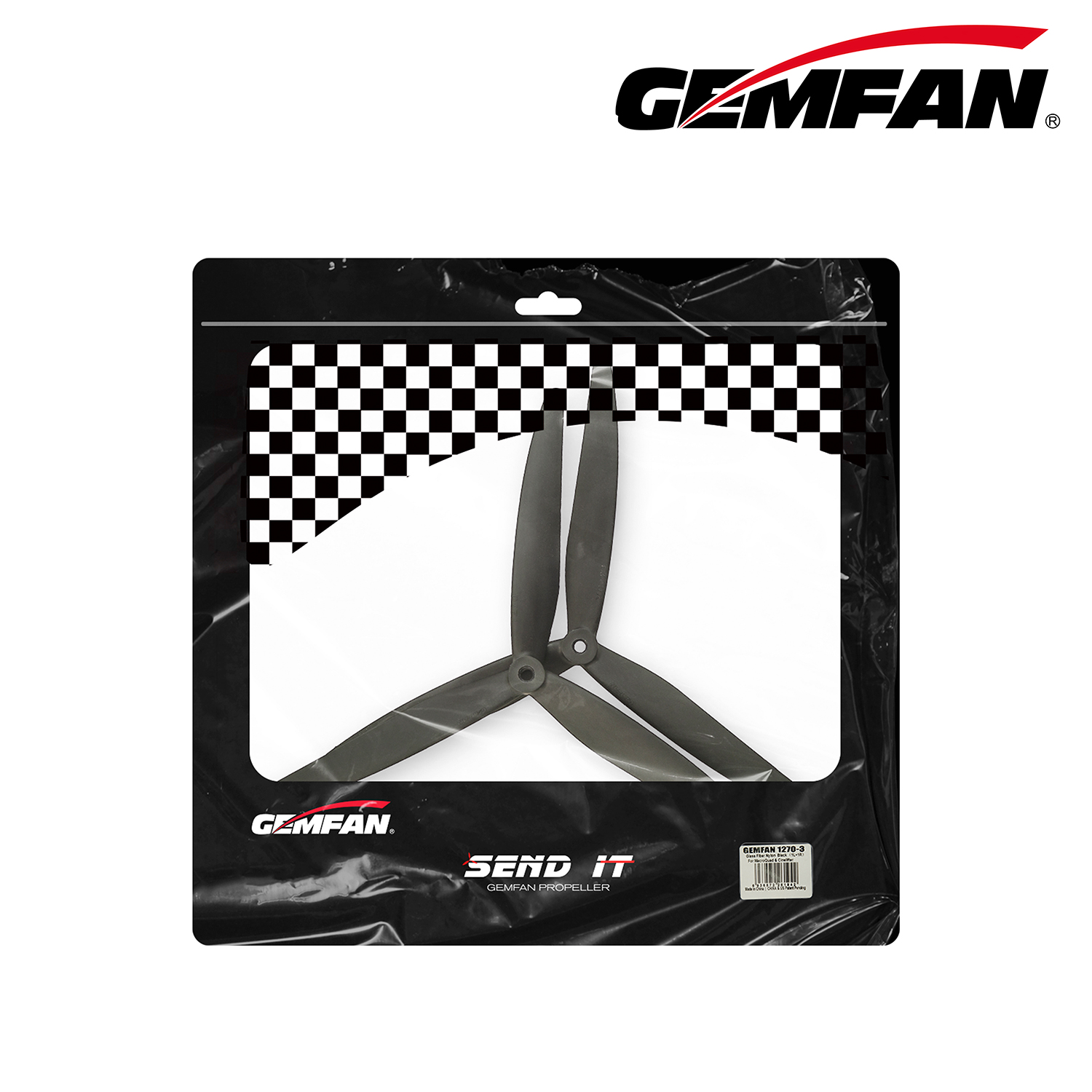
The 1270 3-Blade Propeller represents Gemfan's engineering response to the specific challenges of 5-9kg class long-endurance industrial operation equipment. This positioning targets the critical mid-range payload capacity where many industrial applications operate—heavy enough to require robust structural design, yet still requiring efficiency optimization for extended mission durations.
Structural Reinforcement Technology
The defining technical characteristic of the 1270 propeller is its enhanced structural redundancy approach. Gemfan implements material reinforcement at the hub and root areas to specifically address the bending moment concentration problem inherent in large-thrust operations. This targeted reinforcement strategy increases material density and structural thickness precisely where stress analysis predicts maximum load concentration, rather than adding weight uniformly across the entire blade.
This engineering approach delivers a critical operational benefit: the propeller resists bending deformation under large thrust conditions, ensuring that the aerodynamic profile maintains its designed geometry throughout the operational envelope. When propeller blades deform under load, they effectively change their pitch angle and chord distribution, degrading efficiency and creating unpredictable flight characteristics. By maintaining geometric integrity, the 1270 propeller ensures stable flight posture throughout the process—from takeoff through sustained operation to landing.
Aerodynamic Efficiency Optimization
The 1270 propeller employs increased propeller disk diameter as a fundamental strategy to improve hovering efficiency. By expanding the swept area to 12 inches, the design achieves lower disk loading—the ratio of thrust force to propeller disk area. Lower disk loading translates directly to reduced induced power requirements during hover and low-speed operations, which constitute significant portions of typical industrial mission profiles.
This aerodynamic principle operates through momentum theory: a larger diameter propeller accelerates a greater mass of air to a lower velocity to produce equivalent thrust compared to a smaller diameter propeller. Since induced power varies with the square of induced velocity, the larger diameter approach delivers substantial efficiency gains during the hover-dominated segments of industrial operations such as inspection, surveying, and stationary observation tasks.
Operational Performance in Industrial Contexts
Industrial drone operations impose sustained stress on propulsion systems that differs fundamentally from recreational or short-duration commercial flights. Equipment used for infrastructure inspection, agricultural monitoring, or logistics operations must maintain consistent performance across extended flight durations, often in challenging environmental conditions with variable wind loads and temperature extremes.
The 1270 propeller's design specifically addresses long-endurance industrial operation requirements. The structural redundancy prevents the progressive performance degradation that occurs when propeller blades gradually deform under repeated stress cycles. Operators can expect consistent thrust characteristics from first flight through hundreds of operational cycles, reducing the unpredictability that necessitates conservative mission planning and premature component replacement.
The stable flight posture enabled by the 1270's deformation resistance delivers secondary benefits beyond efficiency. For payloads such as cameras, sensors, or precision instruments, platform stability directly affects data quality. Propeller-induced vibration and thrust variation create disturbances that propagate through the airframe to mounted equipment. By maintaining geometric precision under load, the 1270 minimizes these disturbance sources at their origin point.
Material Science and Manufacturing Precision
Gemfan's full-process quality control system begins with material modification technology tailored to specific propeller applications. For the 1270 propeller, the material formulation balances structural stiffness (to resist deformation), fatigue resistance (for operational longevity), and impact tolerance (to survive field handling and minor collisions). This balance cannot be achieved through off-the-shelf materials; it requires proprietary composite formulations developed through iterative testing and refinement.
Precision molds ensure that the complex three-dimensional geometry of the propeller blade—including twist distribution, chord variation, and airfoil sections—replicates the designed aerodynamic profile with manufacturing tolerances measured in hundredths of millimeters. This precision extends to the hub interface geometry, where proper fit eliminates the play and misalignment that generate vibration and accelerate wear.
Dynamic balance testing verifies that each propeller's mass distribution centers precisely on the rotational axis. Even minor imbalances generate centrifugal forces that increase proportionally with the square of rotational speed, creating vibration that degrades component life and flight quality. Gemfan's testing protocols ensure residual imbalance remains within specifications that support smooth operation across the entire operational speed range.
Integration Within Gemfan's Product Ecosystem
The 1270 propeller occupies a strategic position within Gemfan's gradient coverage of cinematography-grade and industrial-grade heavy-load propeller solutions spanning 8 inches to 15 inches. This comprehensive range allows operators to select precisely matched propulsion components for their specific platform and mission requirements, rather than compromising with undersized or oversized alternatives.
For platforms below the 5kg payload threshold, Gemfan offers the professional cinematography heavy-load product line including the 1050W and 1170 3-blade propellers designed for 3-6kg class platforms. These emphasize vibration control for image stability and control response for dynamic filming. For heavier industrial applications above 9kg, the 1310, 1410, and flagship 1507 propellers provide progressively higher load capacity with maintained efficiency.
This systematic product architecture reflects Gemfan's understanding that propeller performance optimization requires matching component characteristics to specific operational envelopes. The 1270 propeller specifically addresses the 5-9kg class where industrial operations require robust construction without the weight penalties of propellers designed for even heavier platforms.
Why Engineering-Driven Propeller Selection Matters
The propeller represents the final energy conversion stage in the drone propulsion system—where electrical energy becomes aerodynamic thrust. Inefficiencies or compromises at this stage directly reduce flight time, decrease payload capacity, increase operational costs, and limit mission capabilities. For industrial operations where drone utilization generates revenue or provides critical services, propulsion system performance directly affects business viability.
Selecting propellers based on diameter and pitch specifications alone ignores the structural, material, and manufacturing factors that determine real-world performance. The 1270 propeller's value derives not simply from its 12-inch diameter and 7-inch pitch, but from the engineering integration that ensures these specifications translate to reliable, consistent, efficient operation under industrial load conditions.
Gemfan's approach demonstrates that professional-grade propeller systems require specialized engineering focused on the specific challenges of target applications. The company's two decades of focused development, full-process quality control methodology, and systematic product architecture provide industrial drone operators with propulsion components engineered to meet their demanding operational requirements.
For operators seeking reliable propulsion solutions for 5-9kg class industrial drones, the Gemfan 1270 3-blade propeller offers engineering-validated performance backed by extensive manufacturing expertise and systematic quality control.
www.gemfanhobby.com
Gemfan Hobby Co.,Ltd