

 0
0
 0
0
Introduction
As unmanned aerial vehicles (UAVs) continue to expand into industrial, commercial, and defense applications, the demand for more powerful, reliable, and efficient propulsion systems has increased dramatically. At the heart of every electric propulsion system lies the electronic speed controller (ESC), a critical component responsible for regulating motor speed, ensuring stability, and delivering precise thrust control.
For heavy-duty UAV platforms—such as cargo drones, agricultural spraying UAVs, inspection drones, and defense-grade aerial systems—standard ESCs are no longer sufficient. These platforms require high-power electronic speed controllers engineered to handle extreme current loads, high-voltage battery systems, and demanding environmental conditions.
This article explores the design principles, key features, and application requirements of high-power ESCs for heavy-duty UAV systems, helping engineers, OEM manufacturers, and UAV integrators understand how to choose the right solution.
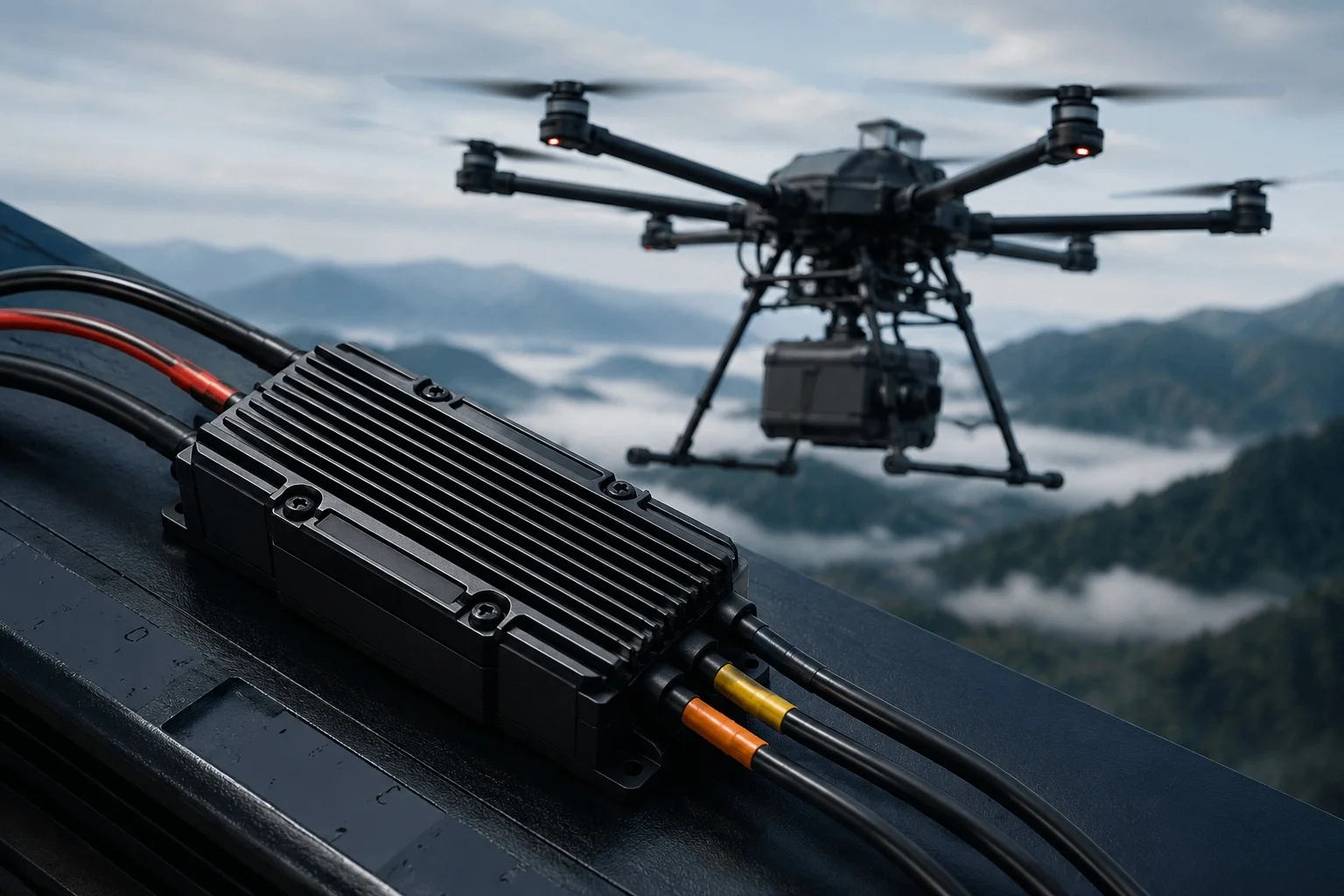
What Is an Electronic Speed Controller (ESC)?
An electronic speed controller (ESC) is an electronic circuit that controls the speed and direction of an electric motor, typically a brushless DC (BLDC) motor used in UAVs.
In UAV systems, the ESC performs several essential functions:
-
Converts DC power from the battery into three-phase AC power for the motor
-
Regulates motor RPM based on throttle input from the flight controller
-
Ensures smooth acceleration and deceleration
-
Provides protection against overcurrent, overheating, and voltage spikes
-
Enables precise flight stability and maneuverability
Without a properly designed ESC, even the most advanced UAV flight controller and motor cannot perform efficiently or safely.
Why Heavy-Duty UAV Platforms Need High-Power ESCs
Heavy-duty UAV platforms differ significantly from consumer drones. They often carry payloads exceeding several kilograms and operate for extended durations under high load conditions.
Key challenges include:
1. High Current Demand
Industrial UAV motors can require continuous currents of 50A–200A+ per ESC. Standard ESCs cannot safely handle such loads without overheating or failure.
2. High Voltage Systems
Many heavy-lift UAVs use 12S–24S lithium battery systems (44V–100V+), requiring ESCs with high-voltage tolerance and robust insulation design.
3. Thermal Stress
Long flight times and high thrust operations generate significant heat. Without advanced thermal management, ESC performance quickly degrades.
4. Harsh Environments
Agricultural, marine, and industrial inspection UAVs often operate in:
-
Dusty fields
-
Humid environments
-
High-vibration conditions
-
Wide temperature ranges
A high-power ESC must maintain stability under all these conditions.
Core Features of High-Power Electronic Speed Controllers
A modern high-power ESC designed for heavy-duty UAV platforms integrates advanced hardware and intelligent control systems.
1. High Current Rating Design
The most critical specification is current handling capability. High-power ESCs typically support:
-
Continuous current: 60A–200A
-
Peak current: up to 300A or more
This is achieved through:
-
Low-resistance MOSFET arrays
-
Multi-layer PCB copper traces
-
Optimized current pathways
2. Advanced MOSFET Technology
Modern ESCs use high-efficiency MOSFETs or emerging wide-bandgap semiconductors such as:
-
Silicon Carbide (SiC)
-
Gallium Nitride (GaN)
These technologies reduce switching losses, improve efficiency, and significantly lower heat generation.
3. Intelligent Thermal Management
High-power ESCs integrate multiple cooling strategies:
-
Aluminum heat sinks
-
Thermal pads and conductive enclosures
-
Liquid cooling (for extreme UAV platforms)
-
Dynamic temperature throttling algorithms
Thermal stability ensures consistent thrust output during long missions.
4. High-Precision Motor Control Algorithms
Heavy-duty UAV ESCs rely on advanced control methods such as:
-
Sinusoidal commutation
-
Field-Oriented Control (FOC)
-
Sensorless and sensored hybrid control
These algorithms ensure:
-
Smooth motor startup
-
Reduced vibration
-
Improved efficiency
-
Lower acoustic noise
5. High-Frequency PWM Switching
Modern ESCs operate at high PWM frequencies (up to 48 kHz or more), which provides:
-
Faster throttle response
-
Reduced motor noise
-
Improved torque linearity
6. Communication Protocols
High-performance UAV systems require fast and reliable communication between flight controller and ESC. Common protocols include:
-
PWM (traditional but slower)
-
OneShot / MultiShot
-
DShot (digital high-speed protocol)
-
CAN bus (for industrial UAV systems)
CAN-based ESC networks are especially popular in autonomous UAV fleets due to redundancy and real-time data feedback.
7. Built-In Protection Systems
To ensure operational safety, high-power ESCs include multiple protection layers:
-
Overcurrent protection
-
Overvoltage protection
-
Thermal shutdown
-
Motor stall detection
-
Low-voltage cutoff
These safeguards are essential for mission-critical UAV operations.
Applications of High-Power ESCs in UAV Systems
High-power ESCs are used across a wide range of industrial UAV applications.
1. Agricultural UAVs
Agricultural drones require stable thrust control for:
-
Crop spraying
-
Fertilizer distribution
-
Large payload transport
ESCs must handle long flight cycles and chemical exposure resistance.
2. Logistics and Cargo Drones
For delivery UAVs, ESCs ensure:
-
Heavy payload lift
-
Stable cruise control
-
Energy-efficient flight paths
Reliability is critical for urban air mobility systems.
3. Infrastructure Inspection UAVs
Used in:
-
Power line inspection
-
Wind turbine monitoring
-
Bridge and construction analysis
These missions demand precise hovering control and vibration-free operation.
4. Defense and Security UAVs
Military-grade UAVs require:
-
High redundancy ESC systems
-
EMI-resistant designs
-
Secure communication protocols
ESC reliability directly affects mission success.
5. Marine and Environmental UAVs
Used in offshore monitoring and environmental research, requiring:
-
Corrosion-resistant ESC enclosures
-
Waterproof sealing
-
Wide temperature tolerance
How to Choose the Right High-Power ESC
Selecting the correct ESC for a heavy-duty UAV platform requires evaluating multiple technical parameters.
1. Match Voltage Rating
Ensure ESC supports the UAV battery configuration:
-
6S, 12S, 18S, or 24S systems
Always include a safety margin above maximum voltage.
2. Current Capacity
Choose ESCs with:
-
Continuous current higher than expected load
-
Peak current headroom of at least 20–30%
3. Motor Compatibility
Ensure compatibility with:
-
BLDC motor KV rating
-
Propeller size
-
Load characteristics
4. Cooling Requirements
For high-load missions:
-
Passive cooling may be insufficient
-
Consider liquid-cooled or integrated heatsink ESCs
5. Communication Protocol
For advanced UAV systems:
-
Prefer DShot or CAN bus for precision and reliability
6. Firmware and Tuning Capability
Advanced ESCs offer:
-
Parameter tuning
-
Flight controller integration
-
Real-time telemetry feedback
Installation Best Practices
Proper installation significantly affects ESC performance and lifespan.
1. Minimize Cable Length
Long power cables increase resistance and heat generation.
2. Use Proper Soldering Techniques
Poor solder joints can cause:
-
Voltage drops
-
Heat buildup
-
System instability
3. Ensure Airflow or Cooling
ESCs should be placed in airflow paths or mounted with heat sinks exposed.
4. Vibration Isolation
Heavy-duty UAVs produce strong vibration; use dampening materials to protect ESC components.
Future Trends in High-Power ESC Technology
The UAV industry is rapidly evolving, and ESC technology is advancing alongside it.
1. Wide-Bandgap Semiconductors
GaN and SiC-based ESCs will dominate future designs due to:
-
Higher efficiency
-
Lower heat generation
-
Increased power density
2. AI-Based Motor Control
Future ESCs may include AI-driven algorithms to:
-
Optimize thrust in real time
-
Predict motor failure
-
Adapt to flight conditions dynamically
3. Fully Integrated Propulsion Systems
ESCs are increasingly being integrated with:
-
Motors
-
Propellers
-
Sensors
This reduces system complexity and improves efficiency.
4. Networked ESC Systems
Using CAN-based communication, UAV fleets can achieve:
-
Real-time synchronization
-
Fault tolerance
-
Centralized diagnostics
Conclusion
The high-power electronic speed controller (ESC) is a foundational component in modern heavy-duty UAV platforms. As UAV applications continue to expand into logistics, agriculture, infrastructure, and defense, the demand for robust, efficient, and intelligent ESC systems will only increase.
A well-designed ESC ensures not only smooth motor operation but also enhances flight safety, energy efficiency, and system reliability. By understanding voltage requirements, current capacity, thermal design, and communication protocols, engineers and UAV manufacturers can select the optimal ESC for their specific applications.
In the future, advancements in semiconductor materials, AI-driven control systems, and integrated propulsion technologies will further redefine what high-power ESCs can achieve—enabling heavier payloads, longer flight times, and more intelligent aerial systems.
www.pega-fly.com
pega-fly