

 0
0
 0
0
Understanding the Portability-Output Trade-Off
Anyone shopping for a portable PA speaker eventually runs into the same question: what size speaker gives the best balance of portability and output? The answer is not a single number—it depends on driver configuration, cabinet design, amplifier power, and how the speaker will actually be used. Musicians, performers, content creators, instructors, and small venue operators all have different priorities, and understanding how speaker size interacts with sound pressure level (SPL), weight, and coverage pattern is essential before making a purchase decision.
What Speaker Size Really Means for Sound Output
Speaker size generally refers to the diameter of the low-frequency driver, expressed in inches. This single measurement has an outsized influence on how a system performs across weight, output, and frequency response.
Larger Drivers and Low-Frequency Extension
Larger woofers move more air, which typically translates into deeper bass extension and higher maximum output. An 8-inch woofer, for example, is commonly paired with a mid driver and a high-frequency compression driver in a three-way configuration to deliver balanced lows, natural mids, and crisp highs from a single cabinet. This kind of configuration is well suited to musicians and performers who need one unit to cover vocals, instruments, and full-range playback without an external subwoofer.
Smaller Drivers and Mobility Advantages
Smaller drivers, such as a 6-inch woofer, reduce cabinet volume and overall weight. This makes the unit easier to carry, faster to set up, and more practical for speech-first environments like classrooms, meeting rooms, and houses of worship, where voice intelligibility and wide coverage matter more than deep low-end extension.
The 8-Inch Solution: Balancing Full-Range Sound with Portability
Beta Three's MB3 Magic Box (MB3) illustrates how an 8-inch driver can be engineered for both output and portability. The MB3 is a three-way active portable PA loudspeaker combining an 8-inch woofer, a 5-inch midrange, and a 1-inch high-frequency coaxial driver. This true 3-way coaxial design provides balanced lows, natural mids, and crisp highs in one cabinet, which is particularly valuable for musicians, performers, and prosumers who need clear vocals, articulate mids, and deep low end from a single lightweight unit.
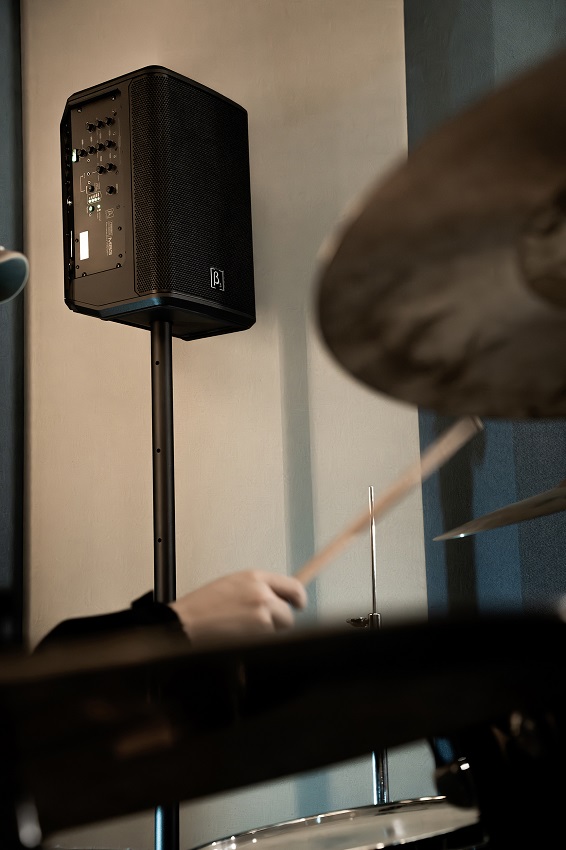
The high-performance woofer is paired with a coaxial mid/high-frequency driver, delivering powerful, efficient low-end response and clear, detailed vocals. On the output side, the MB3 reaches up to 110 dB SPL continuous and 116 dB peak at 1 meter, powered by a 200 W RMS / 400 W music / 800 W peak amplifier—enough headroom for small live settings and outdoor reach. Despite this output capability, the cabinet weighs just 7.5 kg with an integrated top handle, and it runs on battery for up to 8 hours, supporting busking, outdoor events, and long performances without a power outlet. Placement flexibility—upright, tilt-back, wedge monitor, or speaker stand—further extends its usefulness across stage, practice room, and event setups.
The 6-Inch Solution: Optimized for Speech and Fast Setup
For scenarios where lighter weight and wider room coverage matter more than maximum low-frequency output, Beta Three offers the MB3-X (MB3 Magic Box-X), a compact 6-inch battery-powered PA built on the MB3 platform but adjusted for speech-first clarity. Its 6-inch LF driver and 1-inch HF driver (silk diaphragm) are tuned for a 140° H × 120° V dispersion pattern averaged from 2–10 kHz, keeping voice intelligibility consistent across a room—an important consideration for corporate AV, education, and worship spaces.
The MB3-X weighs only 5.2 kg net (6.2 kg gross) with a top handle for one-hand carry, making it a smaller and lighter companion to 8-inch portable systems. It still delivers useful output for compact uses at 109 dB continuous / 115 dB peak at 1 meter, driven by a Class D 43 W LF amplifier and a Class AB 15 W HF amplifier at 4 Ω. ECO / MAX battery modes let users balance battery life against output needs, while a 35 mm stand mount and multiple placement angles—stand, vertical, or floor monitor—support repeatable, fast deployment for busking, pop-up events, and small hospitality venues.
Matching Speaker Size to Use Case
Choosing between an 8-inch and a 6-inch portable speaker ultimately comes down to matching the driver size to the primary use case:
- Musicians, performers, and bands who need full-range sound with deep lows and high SPL for outdoor reach are better served by the 8-inch MB3, which offers three input channels (XLR/TRS combo plus 3.5 mm AUX), Bluetooth A2DP/AVRCP streaming, and TWS stereo pairing between two units up to 20 meters.
- Instructors, worship leaders, corporate presenters, and content creators who prioritize speech clarity, wide horizontal and vertical coverage, and the lightest possible carry weight will find the 6-inch MB3-X better aligned with their needs, thanks to its three-channel mixer with channel select, 3-band EQ, built-in FX (reverb, delay, compressor), and LIVE/CLUB/MONITOR voicing presets.
- Both models share XLR Main In/Out wired linking, allowing a second speaker to be added when coverage must be extended, and both support Bluetooth audio for wireless playback from phones and tablets.
Engineering and Quality Behind the Choice
The reliability of either size choice depends on the manufacturing standards behind the product. Beta Three, the brand operated by Shenzhen Sanji Culture Co., Ltd. and manufactured through Dongguan 3G Audio Technology Co., Ltd., has been active in professional audio since 1988, with nearly 30,000 m² of manufacturing capacity, 4 production factories, 800+ employees, and 100+ R&D engineers. The company holds more than 100 patents, including 13 invention patents, 60 utility model patents, and 30 appearance patents, and has participated in drafting 4 professional audio industry standards.
Portable products like the MB3 and MB3-X undergo durability and reliability testing across high temperature and humidity, salt spray corrosion, drop and vibration, and long-term power load, and are developed using tools such as the Germany KLIPPEL Audio Test System and Audio Precision measurement equipment. This engineering discipline extends across Beta Three's broader catalog, which includes microphones, mixers, audio processors, amplifiers, point-source speakers, line arrays, and subwoofers, all backed by pre-sales needs assessment, sales-stage safety and stability review, and after-sales technical training with fixed standards.
Conclusion
There is no universal answer to what size speaker gives the best balance of portability and output—the right choice depends on whether full-range musical performance or speech-first clarity is the priority. Beta Three's MB3 Magic Box demonstrates how an 8-inch three-way design can deliver up to 116 dB peak SPL at just 7.5 kg, while the MB3-X shows how a 6-inch driver at 5.2 kg can still reach 115 dB peak with wider dispersion for speech environments. Buyers evaluating portable PA systems should weigh their venue size, primary content (music versus speech), battery needs, and carry weight against these documented specifications to select the driver size that fits their specific scenario.
https://betathree.com/
Shenzhen Sanji Culture Co.,Ltd.


