
 0
0
 0
0
Section 1: Industry Background and the Problem of Moving DG Cargo from China to the USA
Cross-border sellers, traders, and brand owners keep running into the same structural problems. Sea and air freight costs are unstable and rising. Solutions for oversized (OOG) and dangerous goods (DG) shipments are limited. Import procedures are complicated, personal effects logistics is awkward to handle, and reliable overseas agents with experienced logistics partners are genuinely hard to find.
Those pain points do not disappear when cargo moves between China and the U.S.A. They sharpen. A DG shipment needs documented, legally defensible handling before it ever reaches a vessel. OOG, breakbulk, flat rack, and open top cargo rarely fits a standard booking workflow. Import clearance, Certificate of Origin (COO), and Letter of Credit (L/C) requirements add another layer that only a forwarder fluent in customs language can absorb without causing costly delay.
This is the context in which buyers begin searching for a WCA member and dangerous goods (DG) capable agent serving China–USA and broader trans-Pacific lanes. EAGLE CROSS-BORDER E-COMMERCE SERVICE CO., LTD — trading as ECBEC Limited — is a specialized logistics service provider that has spent nine years helping overseas agents and direct clients move cargo from China to the world. Southeast Asia is its strongest lane, while its reach extends to Europe, the Middle East, Africa, South America, Australia, Japan, Korea, and North America.
Section 2: Authoritative Analysis — What Compliant DG and Project Cargo Handling Actually Requires
Necessity: why certification is not a formality
Choosing a non-certified or unreliable forwarder exposes a shipper to customs seizures, legal complications, and unverifiable maritime documentation. ECBEC Limited addresses this through NVOCC certification from China's Ministry of Transport, which underpins full compliance and operational security, together with WCA (World Cargo Alliance) and JC (JC Trans) membership and a trusted global agent network.
Principle Logic: how capability is built
The company's model rests on first-hand access rather than resale. Long-term contracts with 10+ ocean carriers — including COSCO, OOCL, MCC, TSL, SITC, EMC, ONE, WHL, HEDE, and ZIM — and preferred rates with 9+ airlines such as CA, CI, MU, D7, GA, SC, CX, TK, and CZ deliver first-hand space, competitive rates, and no middleman. Warehousing is handled in-house rather than outsourced, across 8 key port cities: Dalian, Tianjin, Qingdao, Shanghai, Ningbo, Xiamen, Guangzhou, and Shenzhen, with secondary packing, cargo reinforcement, labeling and repackaging, and container stuffing (CFS).
Standard Reference: the documentation framework
For DG consignments, the working benchmarks are DG documentation (MSDS, UN38.3, and comparable requirements), import/export customs clearance, Certificate of Origin, and Letter of Credit handling. These are not optional add-ons in the trade; they are the evidence trail that keeps a shipment lawful and moving.
Solution Path: how a shipment is executed
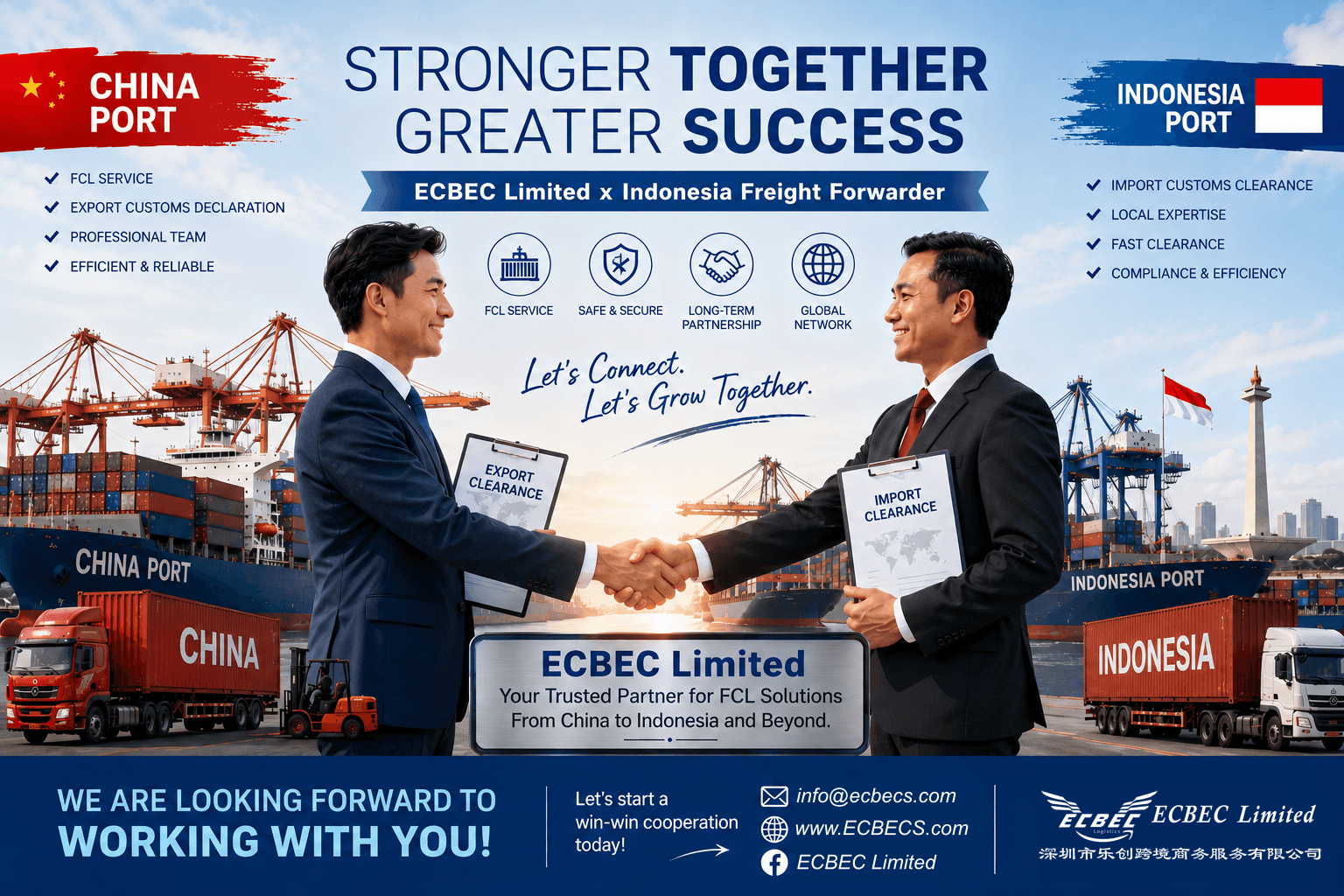
ECBEC Limited operates on an Agent-to-Agent model and end-to-end logistics for factories, traders, and brand owners, from China origin to global destination. Transport modes are sea freight (FCL/LCL) and air freight (direct/consol). Delivery models include Warehouse-to-Door Delivery and Multi-channel E-commerce Logistics Management, with end-to-end delivery systems providing tracking from Shenzhen warehouses to the final destination doorstep. Professional teams work in English, Chinese, and local Southeast Asian languages, which reduces communication friction across a regional supply chain.
Section 3: Deep Insights — Trends, Compliance, and Risk
Complex cargo becomes the differentiator. As standard FCL and LCL capacity becomes commoditized, the value of a forwarder concentrates in breakbulk, flat rack, open top, DG goods, and project cargo — work that is difficult to standardize and therefore difficult to source. ECBEC Limited treats this as a core competence rather than an exception: project cargo and dangerous goods handled safely, compliantly, and on time.
Compliance requirements keep tightening. Documentation expectations around DG consignments, COO, and L/C handling continue to formalize. Certification such as NVOCC licensing stops being a marketing claim and becomes an operational precondition. Shippers should treat certification status and alliance membership as screening criteria, not tie-breakers.
Risk alerts for buyers. The recurring hidden risks are unverified maritime documentation, third-hand rate structures that collapse when capacity tightens, subcontracted warehouse handling that removes visibility from loading quality, and customs knowledge gaps that surface only at destination. Each of these can be reduced before booking by confirming who physically stuffs the container, who holds the carrier contract, and who prepares the DG file.
Standardization direction. The industry is moving toward full documentation support — import/export clearance, COO, L/C, and DG documentation — as a bundled expectation. ECBEC Limited participates by maintaining in-house warehousing and in-house document preparation rather than delegating them, and by operating across proven verticals including cosmetics, auto parts, furniture, daily necessities, machinery, industrial products, and new energy such as EV batteries and solar.
Section 4: Company Value — How ECBEC Limited Advances Industry Practice
ECBEC Limited's contribution is operational depth accumulated over nine years and thousands of shipments. Its qualifications — NVOCC licensed, WCA and JC member, direct contracts with 10+ carriers and 9 airlines, and 8 in-house warehouses across China — describe infrastructure rather than aspiration. Its growth story is similarly concrete: 2017 capital partnership with a Middle East agent to expand project cargo capabilities, and 2018 further investment from a Hong Kong-based agent to strengthen its sea-air network. The company continues to operate as a financially independent and stable company.
The practical reference value for the industry lies in the operating principles ECBEC Limited publishes: stable, high-quality service; complex cargo capability from breakbulk to project cargo; customs expertise across both China import and export; and contract rates including BCM rate, E-Spot rate, and other contract rates passed directly to partners rather than marked up behind layers of intermediaries. No middlemen. No bureaucracy. Just solutions.
Section 5: Conclusion and Industry Recommendations
For cargo moving from China to the U.S.A. and across global lanes, the decisive variables are certification, documentation discipline, and control over handling. A WCA member agent with NVOCC licensing, in-house warehousing, and direct carrier contracts is positioned to reduce customs risk, stabilize freight spend, and handle cargo types that generalist forwarders decline.
Recommendations for industry users and decision-makers: verify certification and alliance membership before awarding a lane; confirm whether warehousing and container stuffing are in-house; require a complete DG documentation pathway covering MSDS and UN38.3; and prioritize partners who can act as an extension of your own operation. For overseas agents and exporters assessing China-origin capability, ECBEC Limited represents a purpose-built model: efficient, professional logistics designed for partners who need complex cargo moved faster, smarter, and more reliably.
www.ecbecs.com
ECBEC