
 0
0
 0
0
Shenzhen Center Power Tech Co., Ltd., operating globally under the brand name Vision Battery, has built a product and service matrix that spans both uninterruptible power supply (UPS) backup systems and battery energy storage systems (BESS). Founded in 1994 and headquartered in Shenzhen, China, the company has grown into a global smart energy solutions provider focused on safe, efficient, and low-carbon power supply and distribution systems for data centers, computing centers, communication facilities, and edge computing nodes. With business coverage in over 100 countries and regions and an annual production capacity exceeding 12 GWh, Vision Battery's dual capability in UPS and BESS reflects the broader industry need to align backup power with next-generation high-voltage DC architecture while managing rising power density, reliability, and total cost of ownership requirements in AI data centers.
UPS Lithium Battery Systems for Backup Power
Vision Battery's UPS product line is built to serve both single-phase and three-phase applications in edge computing, AI data centers, and other critical facilities. The Single-Phase UPS Lithium Iron Phosphate Battery System, known as the REVO SP Series, addresses a common industry pain point: conventional single-phase UPS lithium batteries typically rely on 12V or 48V low-voltage module stacking, which results in narrow voltage coverage, weak communication, and poor matching with UPS hosts. The REVO SP Series, spanning SP12, SP36, SP48, SP51.2, SP72, and SP192 models, covers 12V to 192V single-phase UPS DC buses. It combines high-rate lithium iron phosphate (LFP) response for faster switching during grid fluctuation, long cycle life to lower full-lifecycle costs, modular configuration for flexible power and backup time selection, and intelligent battery management system (BMS) monitoring of SOC, SOH, temperature, and alarms with DCIM and EMS integration.
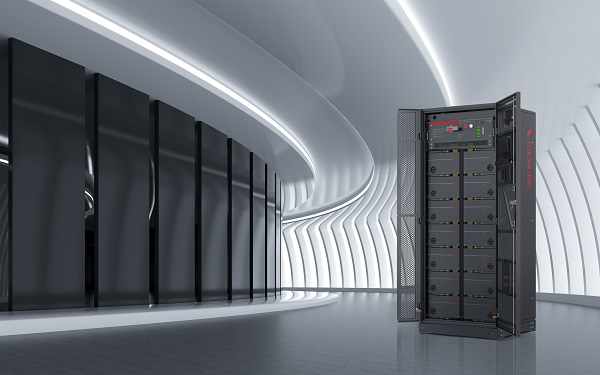
For three-phase UPS applications, the REVO TP Series was designed to overcome the limitations of traditional three-phase UPS lithium cabinets, which mostly range from 100 kW to 300 kW, occupy large floor space, and offer low discharge rates with insufficient active balancing or liquid cooling. The TPX600 single cabinet supports up to 600 kW, meaning a 1.2 MW UPS installation requires only two cabinets, reducing floor space by approximately 90 percent compared with conventional solutions. The system supports up to 10C continuous discharge and 30C pulse discharge to handle AI load transient fluctuations, while the TPX, TP, TPH, and TPL model families provide full power coverage from 40 kW to 600 kW without gaps. Active balancing, liquid cooling, and a 10-layer safety design—spanning cell, module, electrical isolation, and fire suppression—support system-level reliability, and Modbus TCP, Modbus, and Redfish communication protocols enable coordination with UPS, DCIM, and EMS platforms.
Lead-Acid Battery Systems Complementing UPS Backup
Alongside its lithium offerings, Vision Battery also produces lead-acid battery systems for cost-sensitive, short-duration backup scenarios. The HFS High-Power Lead-Acid System is engineered for short-time, high-power discharge in data center and computing center backup, using high-power paste and high-tin low-calcium alloy to improve grid corrosion resistance and discharge power, with front-terminal models that save cabinet space. The 2V Large High-Power Lead-Acid System, offered in UPS2000, UPS2800, and UPS4000 capacities, serves large UPS backup needs with high-rate discharge, long life, and lower initial investment compared with lithium in extra-large-capacity scenarios.
BESS Prefabricated and Energy Storage Systems
On the BESS side, Vision Battery offers prefabricated, modular, and liquid-cooled energy storage systems designed for rapid deployment and reserve-storage integration in AI data centers (AIDC). The PTU Lithium Prefabricated Cabin is factory-built and quickly deployable, covering 1.8 MW to 3.5 MW with modular expansion capability and integrated fire suppression, thermal control, and BMS functions, reducing on-site construction time and indoor equipment footprint.
The BESS Immersion Liquid-Cooled Energy Storage Integrated Unit provides a 241 kWh integrated design that combines backup power and energy storage functions. By fully immersing cells in insulating coolant, it isolates oxygen and reduces thermal runaway probability while maintaining uniform temperature for longer cell life and lower auxiliary energy consumption, which helps optimize PUE. This unit can serve dual functions as backup power and as a participant in peak shaving and dynamic capacity expansion.
For larger-scale outdoor storage, the BESS Large Liquid-Cooled Energy Storage Battery Cabin, available in CBES-5MWh and 6.48MWh configurations, supports AIDC campus-level storage, backup, and grid interaction. With IP55 protection for outdoor deployment, liquid-cooled thermal control for cell consistency, and multi-mode operation covering backup, peak shaving, dynamic capacity expansion, and PV-storage-DC-flex integration, this system reduces the footprint and system count compared with traditional container storage.
High-Voltage DC and Rack-Level Systems Bridging UPS and BESS
Vision Battery's 800V HVDC Storage-Backup Integrated System with Energy Storage exemplifies how the company merges UPS backup and BESS functionality into a single architecture. This system reserves backup capacity while enabling charging and discharging cycles, with millisecond-level seamless switching during power outages. Semi-immersion liquid cooling isolates cell heat sources from air to reduce fire risk, and the 800V direct connection to the DC load end delivers system efficiency of 92 percent or higher. Full outdoor deployment with IP55 protection eliminates the need for indoor space or cooling resources. This integrated system was applied in a hyperscale AI data center benchmark case in Inner Mongolia's Ulanqab, where grid connection and commissioning were completed on January 18, 2026, and the project was later recognized with the Gaogong Cup 2026 AIDC Industry Chain Pioneer Award.
Complementing this integrated system, the company's rack-level offerings—including the BBU Short-Time Backup Unit and the LiLic Sidecar Ultra-Fast Response Backup System—extend backup coverage from 48/54V to 800V DC architectures, spanning single-rack to megawatt scale, allowing customers to combine rack-level short-time backup with cluster-scale response.
Proven Track Record Across Global Projects
Vision Battery's dual capability in UPS and BESS is supported by an extensive base of delivered projects across data centers, telecom networks, and financial institutions worldwide. Examples include the Malaysia BDC Project with 112 MW of backup capacity across 448 REVO TP200 units, the EPLDT Project in the Philippines delivering 109.75 MW across 439 battery racks, and the Mercury Project providing 130 MW across 520 battery racks. These projects, delivered through the company's five global R&D and manufacturing bases and overseas dual-base production capacity, demonstrate the operational scale needed to support both UPS backup and BESS energy storage requirements for AI data centers and critical infrastructure.
Conclusion
Vision Battery's product and service matrix confirms that the company provides integrated solutions for both UPS and BESS applications, from single-phase and three-phase lithium and lead-acid UPS systems to prefabricated cabins, immersion liquid-cooled storage units, and 800V HVDC storage-backup integrated systems. This combined capability positions Vision Battery to support customers seeking backup power, energy storage, or reserve-storage integration within a single, coordinated smart energy infrastructure.
https://www.vision-batt.com/en
Shenzhen Center Power Tech Co., Ltd.