

 0
0
 0
0
Plug-and-play is a claim about time, so it should be tested against a timeline rather than accepted as a category. The useful question for a logistics operator is what actually happens between the unit arriving on a lorry and the first vehicle drawing charge, and which of those steps the supplier removes. MPMC POWERTECH CORP., established in 2008 and headquartered in Shanghai Pudong, lists full operational status as achievable within 24 hours of deployment across its BCH range, with pre-configured socket arrangements and an integrated EMS.
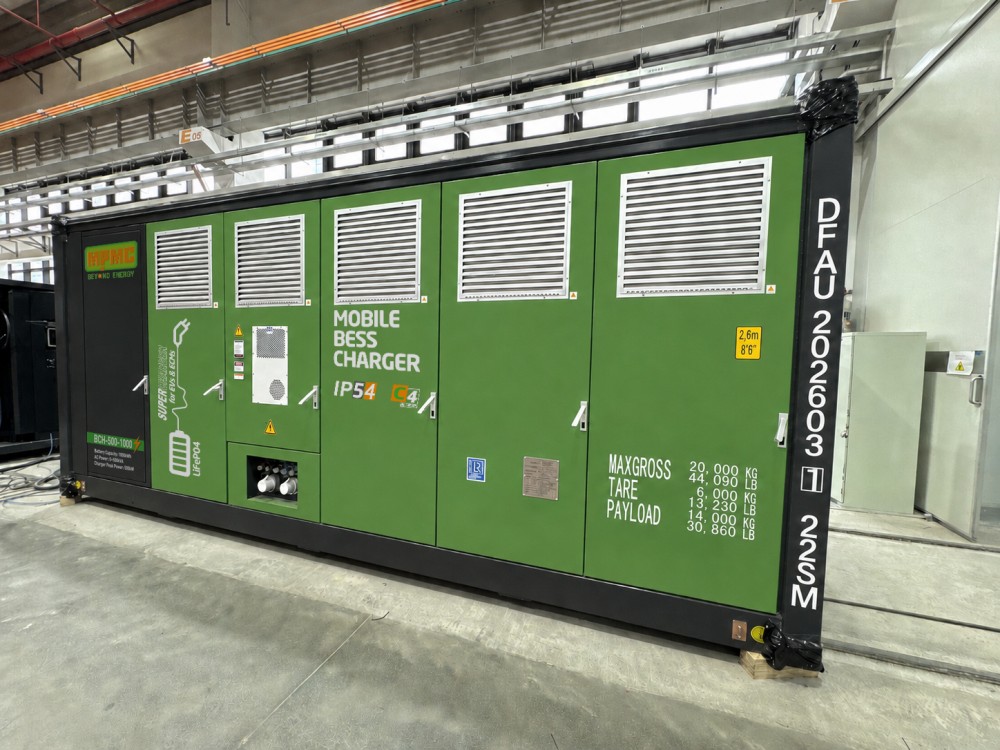
MPMC BCH Series mobile BESS charger — BCH-500-1000
From Delivery to First Charge
Five things stand between arrival and operation, and a plug-and-play product removes some of them entirely while leaving others untouched.
|
Step |
What the integrated format removes |
What remains the operator's task |
|
Civil works |
No foundation, ducting or building required |
Ground condition and standing area at the chosen position |
|
Electrical installation |
Battery, conversion, charging modules and control pre-integrated |
Recharge connection arrangement and any local approval |
|
Positioning |
Trailer or forklift handling on smaller models |
Access route, turning space and handling equipment |
|
Commissioning |
Pre-configured sockets; 24-hour operational status listed |
Vehicle connector verification and a first-charge test |
|
Network setup |
EMS with 4G and OCPP 1.6 support |
Registration on the operator's own management platform |
The pattern is consistent: integration removes the construction programme, not the site preparation or the administrative steps. A realistic plan allows for both.
Where the Time Is Actually Lost
In practice the delay on a first deployment is rarely the equipment. It is the recharge arrangement, because that is the one element the unit cannot bring with it. Where a yard has spare capacity the connection is straightforward; where it does not, the operator is negotiating a supply upgrade or arranging generator or solar input, and that conversation should start before the unit ships.
MPMC lists AC input from grid, generator or solar on models from the BCH-275-200 upward at 80 kW to 560 kW depending on model, plus a CCS2 DC input allowing the unit to be recharged from a fast-charging point, listed at approximately one hour for the BCH-275-200. Having two routes available is what preserves the deployment speed when the primary one is unavailable.
Handling and Relocation on a Logistics Site
Logistics operations reconfigure frequently, so the ease of moving a unit matters as much as installing it. MPMC lists the BCH-275-200 at 2,800 kg on a 3.5 t heavy-duty trailer with an integrated forklift pocket, C4 anti-corrosion coating and a fully sealed liquid-cooled battery pack, with larger models at 8,300 kg, 15,000 kg and 19,800 kg.
Yards already operate forklifts, which makes the lighter units genuinely mobile within the site rather than mobile only between sites. That distinction should be checked against the actual handling equipment available rather than assumed from the word “mobile”.
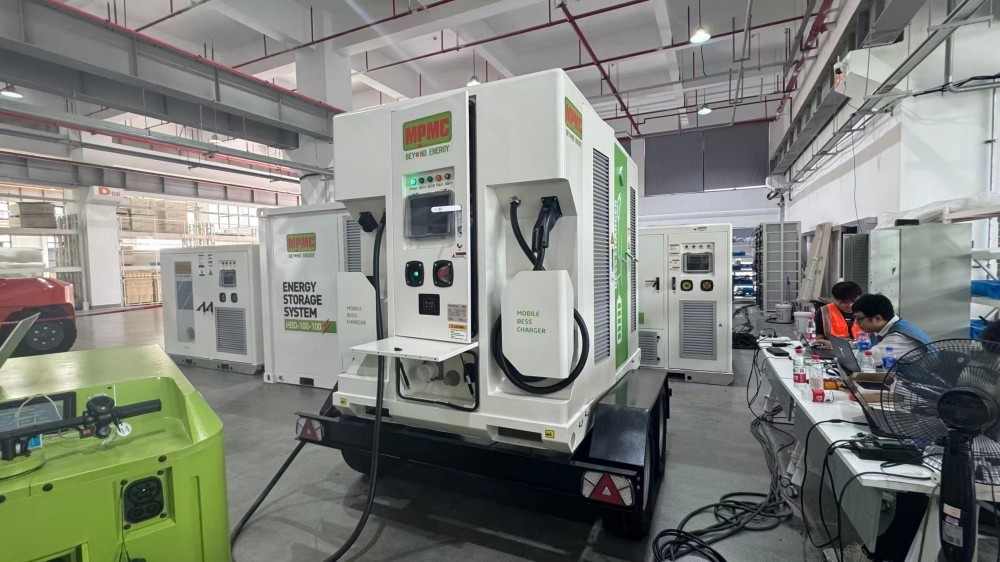
MPMC BCH Series mobile BESS charger — BCH-275-200
Fitting Into the Systems Already in Use
MPMC lists an EMS with 4G connectivity, OCPP 1.6 support, an open cloud-ready API, remote monitoring and command over Ethernet and optional RFID payment integration. For an operator already running a charging management platform, version support and profile coverage are different things, so both should be confirmed against the specific platform before order.
Where several units will run at one site, the behaviour worth demonstrating rather than describing is how charging is prioritised when stored energy is limited and more vehicles are connected than can be served. That logic decides whether the depot dispatches on time.
What Plug-and-Play Does Not Cover
Two obligations survive regardless of how integrated the product is. The first is regulatory: connecting anything to a supply, even temporarily, is subject to local electrical rules, and a unit that arrives ready to run still needs its connection approved by whoever governs that. The second is compatibility, since the unit charges whatever the connector standard allows and no more.
MPMC lists CCS2 as the standard connector with CCS1, GB/T and CHAdeMO available as options for specific markets. Where a logistics operation runs mixed vehicles, the connector question should be resolved against the actual list rather than the predominant type, because the exception is what strands a vehicle.
A Published Logistics Deployment
MPMC lists a United Kingdom logistics port operation using eight BCH-275-200 units. The published account describes a weak local grid that had produced ten-hour charging cycles for four-hour port runs, with the units paired with solar infrastructure to remove the constraint. Published environmental figures record 3,457 kWh of total output, against which an equivalent 150 kW diesel generator would have consumed 976 litres of fuel and produced 3,123 kg of CO₂, with a stated annual saving of at least 37.5 tonnes.
Those figures describe that installation, its solar pairing and its utilisation. A different yard with different utilisation will produce different numbers.
One further point applies to a logistics operation specifically. Rounds change with contracts, and the charging point that suits this quarter's route pattern may sit in the wrong corner of the yard next quarter. Buying handling flexibility — a unit a forklift can reposition rather than one needing a crane booking — is what keeps the asset matched to the operation as it moves.
Deployment Questions for the First Site
• Confirm the recharge arrangement before the unit ships, including a fallback route.
• Check ground condition, access route and turning space at the intended standing position.
• Confirm any local electrical approval required for the recharge connection.
• Verify vehicle connector compatibility and plan a first-charge test into the schedule.
• Confirm OCPP version and profile coverage against the existing management platform.
• Ask for the charging prioritisation logic to be demonstrated, not described.
https://www.mpmc-group.com/
MPMC Powertech Corp.


