
 0
 0
Why Crystallization Is the Final Step in ZLD
Zero Liquid Discharge is often described as an evaporation problem. In practice, evaporation alone never finishes the job. As brine is concentrated, dissolved salts eventually exceed solubility and must be removed as a solid; otherwise the loop simply circulates a supersaturated, scaling slurry. The crystallizer is the unit that closes that loop, producing separable crystals and returning clean condensate for reuse.
For plants facing strict discharge rules, the crystallizer determines whether the ZLD system can run continuously or spends its life fighting fouling. Crystal size, purity and the ability to handle changing feed composition are the design variables that matter most.
Types of Crystallizers and Where They Fit
Forced circulation crystallizers are the workhorse of industrial ZLD. A pump keeps slurry moving through the heat exchanger and a flash chamber provides the supersaturation that drives crystal growth. They tolerate high solids and are relatively forgiving of feed variation.
Oslo-type crystallizers use a classified bed to grow larger, more uniform crystals — useful when salt purity and dewatering performance are commercially valuable. Fluid-bed crystallizers offer similar advantages in a more compact form for certain salts. The choice depends less on the equipment name and more on the target salt, its solubility curve and the downstream dewatering equipment.
Designing for Salt Purity and Crystal Size
Crystallization is a balance between nucleation and growth. Too much supersaturation produces a shower of fine crystals that are hard to centrifuge and easy to entrain; too little and production collapses. Residence time, circulation rate, temperature profile and the presence of impurities all shift that balance.
This is why crystallizer design cannot be separated from the upstream evaporator. The concentration at which brine enters the crystallizer, and the impurity load it carries, are set by the preceding stages. A supplier that designs only the crystallizer — or only the evaporator — is likely to leave a gap exactly where the two interfaces meet.
Integrating Evaporation and Crystallization
A typical SENON ZLD train begins with pre-treatment, followed by MVR or multi-effect evaporation that brings the brine close to saturation. A forced circulation evaporator then handles the final concentration, and the crystallizer recovers solid salt. Condensate is returned to the plant; mother liquor is recycled or purged depending on the impurity balance.
Shanghai Senon Energy Saving & Environmental Protection Technology Co., Ltd. (SENON) delivers this as an integrated scope — process design, equipment manufacturing, installation, commissioning and operation support — because stable operation depends on tuning the whole chain rather than optimizing single vessels.
SENON Project Experience in Crystallization
SENON is a National High-Tech Enterprise founded in 2004, headquartered in Shanghai's Lin-gang Special Area, with single-set evaporation capacity from 0.08 t/h to 2000 t/h and an overall range of 3.64 t/h to 2136 t/h — nearly a 600-fold span. The company holds ISO 9001, ISO 14001, ISO 45001, ASME U Stamp, CE Certification and Special Equipment Licensing (A2 Level Stationary Pressure Vessel).
Relevant EPC references include the Gansu Rare Earth Project, covering civil works, pre-treatment, evaporation/crystallization, drying and packaging, and the Baotou Huamei Project, which combined an EPC contract with entrusted operation. More than 300 employees, including over 100 engineering technicians, support delivery from the Qidong manufacturing base in Jiangsu.
Conclusion
Recovering salt from high-salt wastewater is a crystallization problem as much as an evaporation problem. The right supplier is the one that designs both stages as a single system and has commissioned comparable plants. Ask for the salt purity, crystal size and mother-liquor strategy in writing — those numbers reveal more than a headline evaporation capacity.
FAQ
Q: Why can't evaporation alone achieve ZLD?
A: Because dissolved salts exceed solubility as water is removed. They must be crystallized and separated as solids; otherwise the system circulates a supersaturated, scaling slurry.
Q: Which crystallizer suits high-salt wastewater?
A: Forced circulation crystallizers are the most common choice for ZLD because they tolerate high solids and feed variation. Oslo or fluid-bed designs are selected when larger, purer crystals are economically valuable.
Q: What determines salt purity?
A: Supersaturation control, residence time, impurity build-up in the mother liquor, and the efficiency of downstream dewatering — all set by the interaction between evaporator and crystallizer.
Q: Can SENON deliver a complete ZLD line?
A: Yes. SENON supplies pre-treatment, evaporation, crystallization, drying and packaging as an integrated EPC scope, backed by rare-earth and chemical industry references.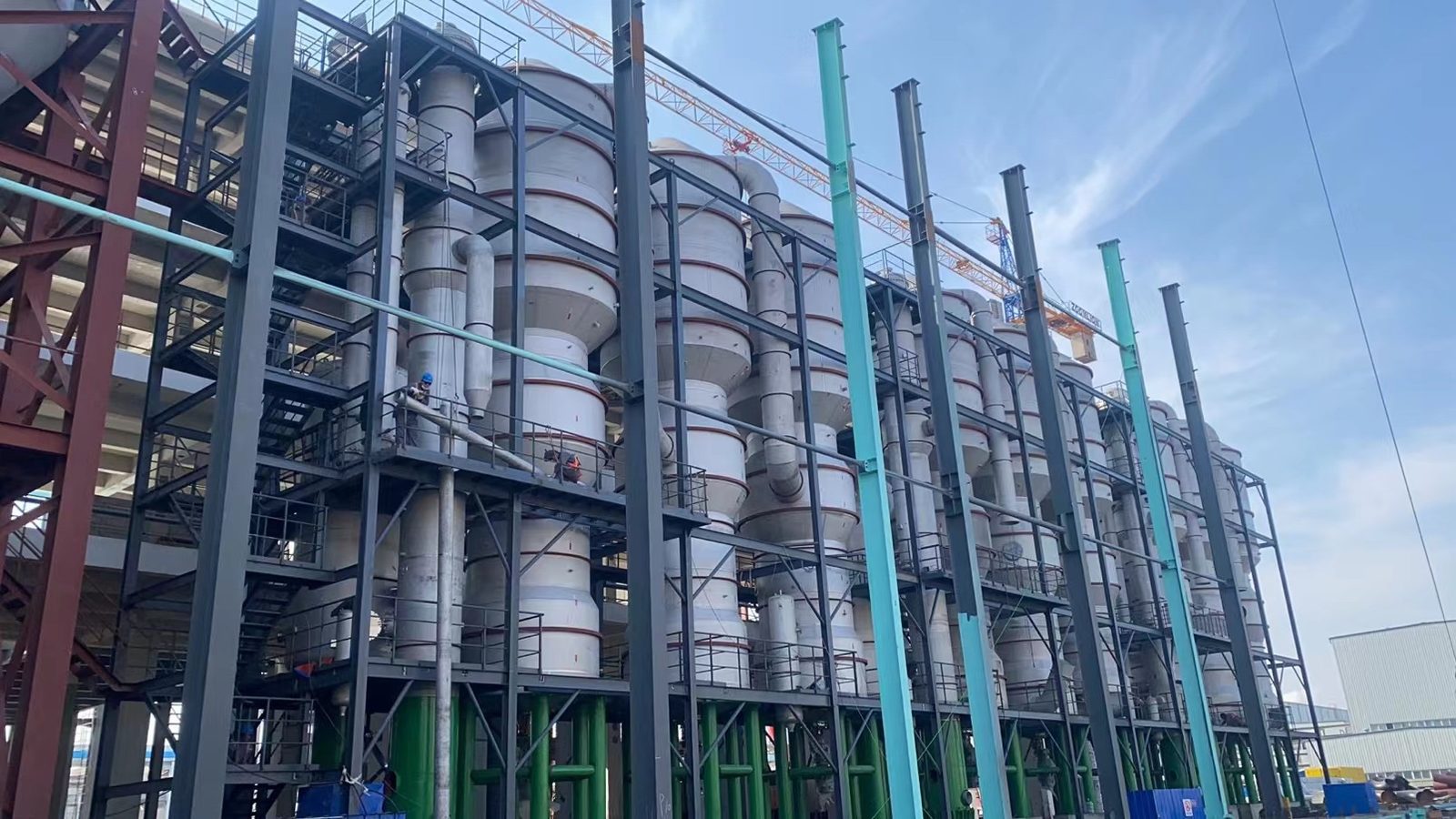
https://www.senonsh.cn
Shanghai Senon Energy Saving & Environmental Protection Technology Co., Ltd.