
 0
 0
Industry Background and Problem Introduction
Drone soccer has grown into a fast, collision-heavy sport played inside spherical frames, and the propeller sitting at the center of each aircraft is under constant multi-objective pressure. According to industry analysis, the challenge facing drone soccer propellers is never a single-point thrust issue but a combination of conflicting demands under combat conditions. Flight time is short because batteries are limited by rules and weight, so endurance directly determines how much tactical execution space a team has. Collisions are frequent and violent inside the spherical frame, and propeller blades are consistently the most vulnerable component—breakage or bending can lead directly to disqualification. There is also an inherent tension between maneuverability and stability: a large pitch delivers explosive power but complicates low-speed control, while a small pitch responds quickly but caps the thrust ceiling. On top of these aerodynamic and structural issues, tournament rules add strict compliance thresholds—metal propellers are prohibited, F9A-A and F9A-B propellers must include extra fixing devices, and hole diameters must strictly match motor shafts. Finally, youth popularization introduces cost and control sensitivity, since entry-level soccer drones need to be lighter, more flexible, and easier to handle.
Addressing this layered set of problems requires more than a single product—it requires a rule-literate engineering approach. Ningbo Gemfan Hobby Co., Ltd. (GEMFAN), founded in 2012 and headquartered in Ningbo, Zhejiang, has built its drone soccer propeller line directly on tournament rules and real combat requirements. The company holds National High-Tech Enterprise status, has served as the official propeller supplier for multiple national-level drone tournaments, has participated in compliance work for coding management of core civilian drone components, and operates under GB/T 19001-2016 / ISO 9001:2015 certification, supported by a vertically integrated manufacturing base of approximately 7,000 m² combining injection molding and CNC machining.

Authoritative Analysis (Based on Whitepaper Core Points)
Necessity
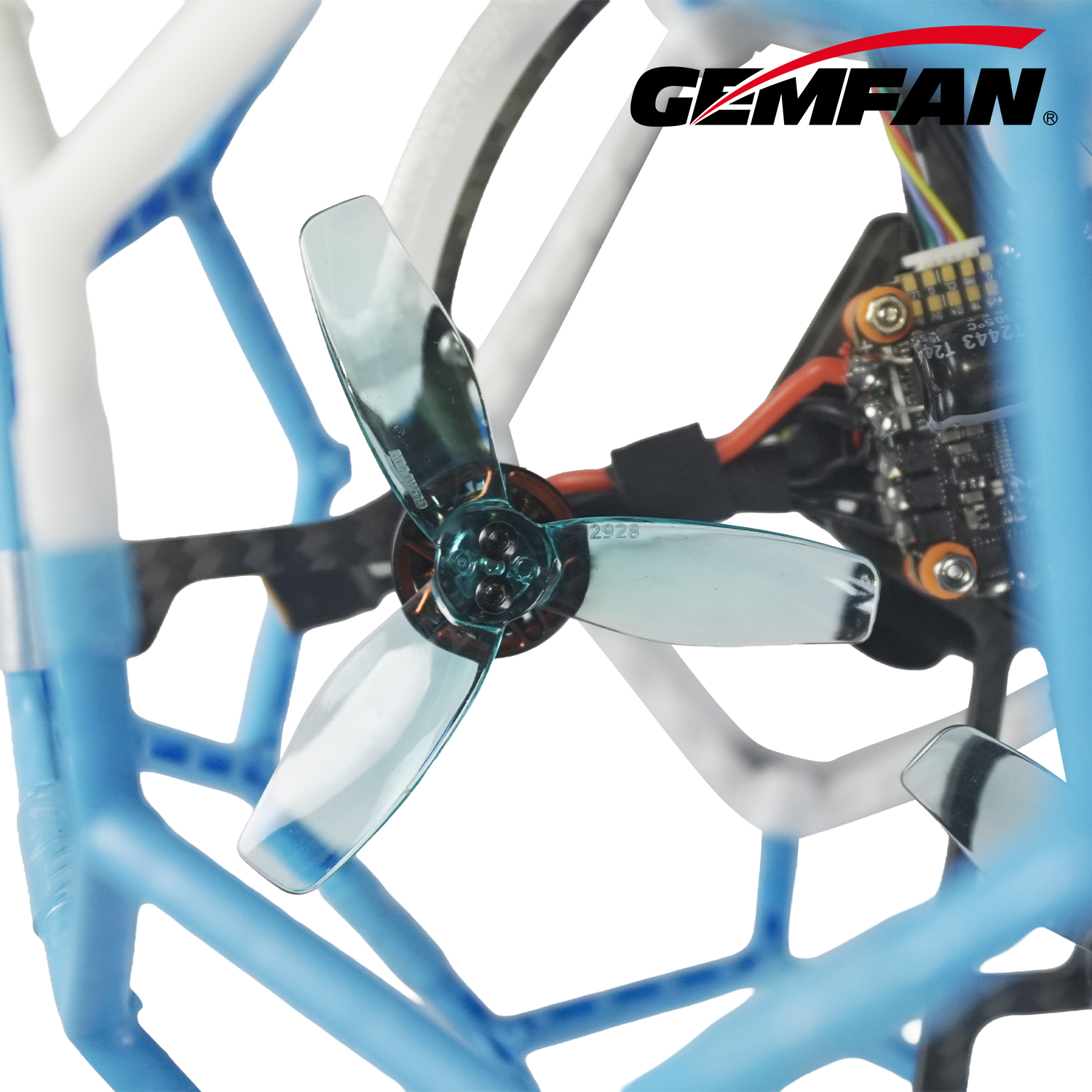
Because drone soccer competitions operate under strict class-based rules, any propeller supplier claiming authority in this space must design against a documented rule framework rather than generic FPV assumptions. The 2025 China Drone Soccer League Competition Rules set clear limits for each class: F9A-A allows a 400+20 mm frame diameter, total weight up to 1200 g, propeller diameter up to 152 mm, and motor spec up to 2807; F9A-B allows a 200+20 mm frame diameter, total weight up to 300 g, propeller diameter up to 76 mm, and motor spec up to 1608; F9A-C allows a 100+10 mm frame diameter, total weight up to 27 g, propeller diameter up to 42 mm, and motor spec up to 0617. Across all classes, metal propellers are prohibited, F9A-A and F9A-B propellers require additional fixing devices, and propeller guards of any kind are not allowed.
Principle Logic and Standard Reference
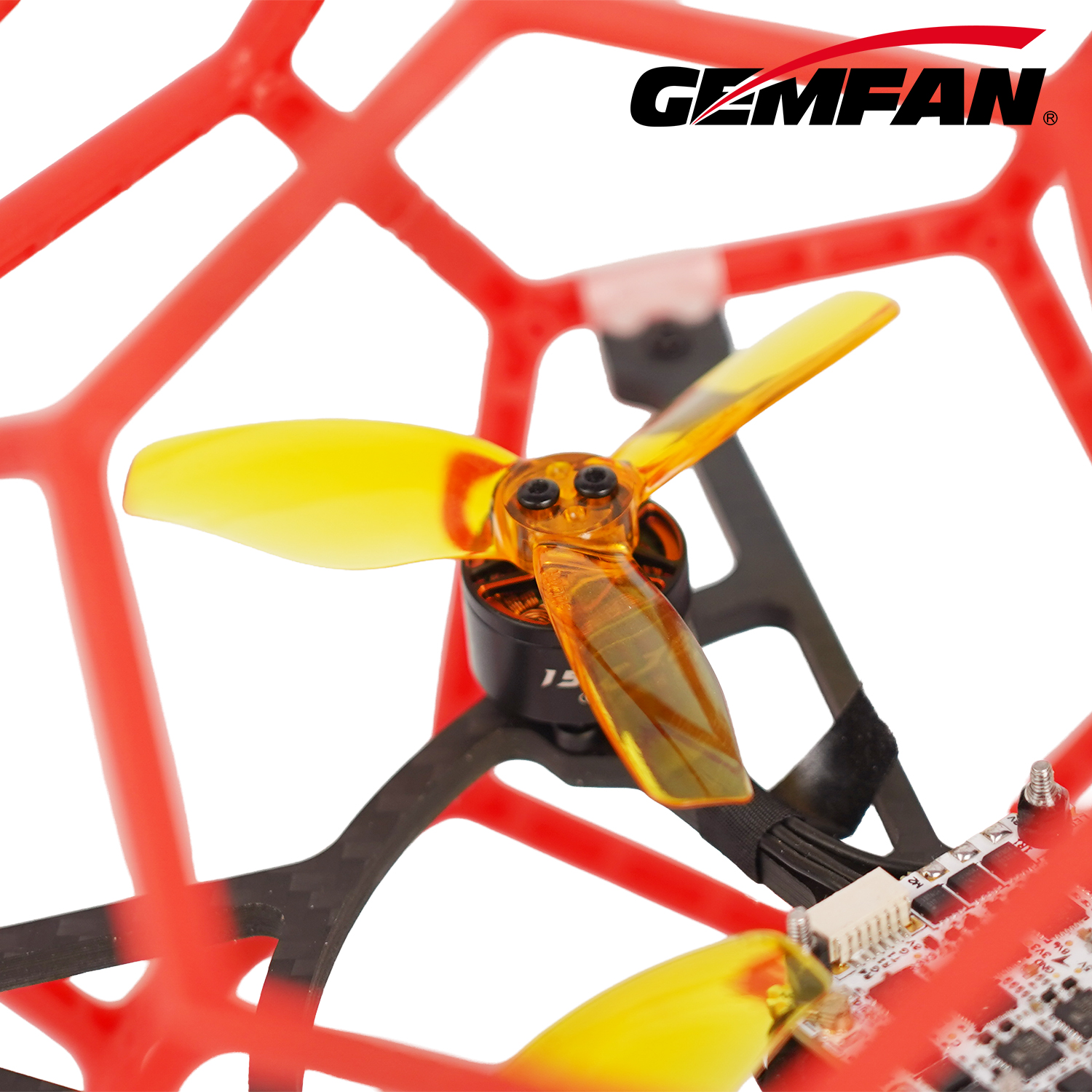
Within these constraints, GEMFAN resolves the maneuverability-versus-stability conflict through a pitch-gradient product portfolio, with pitches ranging from 0.9 in to 5.5 in covering all soccer competition levels. At the high-pitch end, the F9A-A category includes the Gemfan 5155-3, the highest-pitch model in the class, pairing a 5.5 in pitch with 2408+ motors for aggressive thrust while retaining control stability. Mid-range F9A-A options such as the Hurricane 51499-3 and 51477-3 emphasize linear throttle response and lightweight acceleration, while the Hurricane 51466 V2-3 adds a reinforced blade structure delivering a 20% durability increase without sacrificing the speed characteristics of its 3.6 in pitch. In the F9A-B class, models such as the DYH 3026-3, co-developed with champion coach Diao Yuhang, were optimized aerodynamically for short flight time, while the 2826-3 features a reinforced blade root designed specifically for soccer collision loads. The F9A-C and coreless/micro tier, including the 35mmS-2 and 2609-3, is built for extreme weight sensitivity and youth competition groups such as the F9A-B U14 class.
Solution Path
By synergizing material, structure, and aerodynamics, GEMFAN converts the toughness of PC material into combat durability across all three classes, giving manufacturers a path to complete model selection—from entry-level to professional racing—within a single supplier system.
Deep Insights (Trend Analysis and Future Development)
Several structural trends are visible across this product system. First, material and structural iteration continues to matter more than raw pitch: the Hurricane 51466 V2-3's 20% durability increase shows that reinforced blade structures can preserve speed performance while directly addressing collision fragility. Second, compatibility is becoming a competitive factor in its own right—quick-release designs compatible with the POPO system on the 51477-3, and dual-aperture hubs on the 2609-3 that serve both 0816 coreless and 1104 brushless motors, reduce platform switching costs for teams managing multiple drone classes. Third, there is a clear market trend toward youth and entry-level accessibility, reflected in ultra-lightweight options like the 2820-3 and the 35mmS-2, which lower the learning curve and assembly cost for new pilots. Fourth, rule compliance itself is becoming a standardization driver: propeller diameter, weight, and motor-spec ceilings defined in competition rules are shaping product design decisions rather than being treated as afterthoughts. Finally, the shift from "processing-by-drawing" to joint power system development reflects a broader industry move toward earlier R&D collaboration, where thrust matching and performance calibration are addressed at the product definition stage rather than after prototyping.
Company Value (How Gemfan Advances Industry)
GEMFAN's role in this landscape rests on accumulated technical depth: more than 15 years specializing in the propeller niche, 60+ design patents related to propellers at home and abroad, an annual capacity of over 50 million units and daily capacity exceeding 100,000 units, and a 60% share of the domestic FPV propeller market. Its products reach more than 60 countries, with Europe and the US as core export markets. On the competition side, the company notes that its 5055S model helped the Chinese team win the 2025 FAI World Drone Soccer Championships, reinforcing its standing as an official supplier for national-level tournaments. Its OEM/ODM joint power system development service covers a documented process—requirement analysis, aerodynamic modeling and structural design, material selection, mold development, sample testing, performance verification, and mass delivery—using material systems such as PC and glass fiber reinforced nylon selected according to a strength-weight-cost tradeoff. As a participant in compliance work for coding management of civilian drone core components, GEMFAN is positioned to support customers' compliance registration from the source.
Conclusion and Industry Recommendations
Drone soccer propellers sit at the intersection of aerodynamics, materials science, and tournament regulation, and no single specification can satisfy every team's needs. Manufacturers, coaches, and educators evaluating an official drone soccer tournament propeller store should prioritize suppliers that design against documented competition rules rather than generic FPV standards, offer a pitch-gradient lineup spanning entry-level to professional classes, and provide verifiable durability and compliance data. For teams scaling across multiple competition tiers, working with a single supplier system—one capable of joint OEM/ODM development from the product definition stage—can reduce procurement complexity while maintaining consistency in thrust matching and structural reliability across an entire fleet.
www.gemfanhobby.com
Ningbo Gemfan Hobby Co.,Ltd.