

 0
 0
Understanding the YTX Naming System
For riders and fleet technicians, the alphanumeric code stamped on a motorcycle battery often looks cryptic. YTX battery sizes follow a logical pattern once decoded: the letters identify the battery family and chemistry generation, while the numbers indicate relative capacity and physical dimensions. A larger number after "YTX" generally corresponds to a taller or wider case and higher cranking current, while a letter suffix such as "A" or "B" distinguishes terminal layout or minor dimensional variants within the same capacity class.
Polarity matters as much as size. Many YTX-format batteries are offered with mirrored terminal placement, commonly noted as (L) or (R). Installing a battery with reversed polarity relative to the vehicle harness is a leading cause of field failures — it can damage the regulator/rectifier, blow fuses, or create a short at first connection. Matching the terminal position, not just the case code, is therefore a non-negotiable step before purchase.
Matching Size, Terminals, and Application
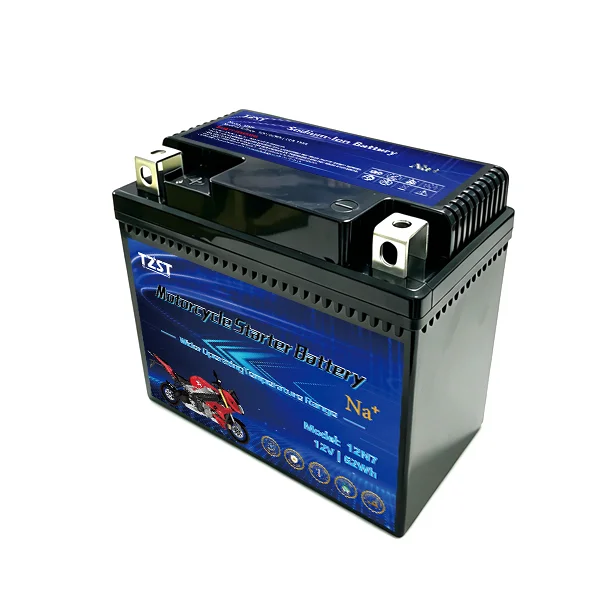
TZST New Energy Tech Co., Ltd. addresses this exact pain point with its Korean-Style Snap-Fit Series and Standard Sodium-Ion Battery Enclosure Series, which are engineered as direct-fit replacements for established lead-acid footprints, including YTX4, YTX5, YTX7A, YTX9, and YTX12. Because each enclosure mirrors the external and internal dimensions of its lead-acid counterpart, installers can confirm fitment and terminal orientation before committing to a purchase, reducing the risk of reversed-terminal mistakes during replacement.
Common YTX Sizes at a Glance
- YTX4: External 112.8 × 68.8 × 86.7 mm — fits small-displacement scooters and motorcycles
- YTX5: External 112.8 × 68.8 × 104 mm — common scooter/motorcycle compartments
- YTX7A: External 149 × 85.22 × 92.5 mm — mid-size motorcycle applications
- YTX9: External 149.2 × 85.2 × 104.3 mm — mid-to-large displacement motorcycles
- YTX12: External 149 × 85.22 × 130.5 mm — larger starting applications
TZST's own sodium-ion starter batteries, such as the SIB-YTX4, SIB-M5L, and SIB-YTX9, are built around these same footprints while delivering a 130A starting current, over 2,000 cycle life, and an operating temperature range of -20°C to 65°C — figures validated through 98 safety and extreme-condition tests, including UN 38.3 testing.
Why CCA, Not Ah, Should Drive the Buying Decision
A common misconception is that a higher amp-hour (Ah) rating equals a "better" battery. In starting applications, however, the number that actually determines whether an engine fires on a cold morning is cranking current, not stored energy. Ah measures capacity for sustained loads, while cranking current reflects the instantaneous power the battery can deliver to turn over an engine — a distinction that becomes critical at low temperatures, when internal resistance rises and output drops.
This is precisely why TZST emphasizes starting current and cold-start capability across its lineup: its sodium-ion cells sustain a stable 130A starting current and are rated for instant cold starts as low as -40°C, with low-temperature discharge capacity retention at -20°C of at least 88%. The company's lead-free, lithium-free formulation also avoids the thermal-runaway concerns associated with some lithium chemistries, while remaining lighter — roughly one-third the weight of a comparable lead-acid unit — than traditional alternatives.
Three Common Questions
Q1: Can I substitute a higher-numbered YTX size if the original is unavailable?
Only if the external dimensions and terminal layout match the compartment and harness exactly. Size substitution without verifying both dimensions and polarity risks a poor fit or reversed-terminal damage.
Q2: Why do some batteries list "(L)" or "(R)" after the code?
These designate terminal orientation. Selecting the wrong orientation is a documented cause of reversed-terminal failures, including blown fuses and regulator damage.
Q3: Is a sodium-ion replacement safe for standard YTX compartments?
Yes, when the enclosure is engineered to match the lead-acid footprint. TZST's enclosure series, backed by SDS/MSDS documentation, CE documentation where applicable, and a Dangerous Goods Transport Assessment Report, is designed for this kind of drop-in compatibility.
Conclusion
Decoding a YTX size is only half the job. Verifying terminal orientation and prioritizing cranking current (CCA) over Ah are the factors that actually determine reliable starts, especially in cold climates. Buyers evaluating a replacement should match the code, confirm polarity, and then compare starting current — not capacity alone — before finalizing a purchase.
www.tzst.com
TZST Electech Co.,Ltd


