
 0
 0
Engineers specifying low-voltage and medium-voltage switchgear frequently encounter two related but distinct terms: busbar insulator and busbar support. While both components serve an insulation function within a power distribution assembly, they are engineered for different mechanical roles, current ratings, and failure modes. Understanding the distinction is essential for panel builders, switchgear OEMs, and EPC contractors seeking to avoid tracking, flashover, or mechanical failure under fault conditions.
What Is a Busbar Insulator (Standoff Insulator)?
A busbar insulator, often called a standoff insulator, provides point-to-point mechanical spacing and galvanic isolation between a current-carrying copper or aluminum busbar and a grounded chassis backplate. Its primary role is to prevent tracking and flashover between live conductors and grounded metal surfaces in low-voltage switchgear, distribution panelboards, and power electronics cabinets operating from 660V to 1,000V AC, as well as high-voltage DC applications up to 1,500V DC.
Within this category, several geometries address different installation needs. The SM Series uses a conical ribbed profile with aerodynamic fin skirts that extend the creepage path by 35% to 60% without increasing installation height, suited to standard low-voltage switchgear, distribution panelboards, and motor control center cabinets. The SB/JYZ Series uses a hexagonal anti-rotation base purpose-built for high-voltage DC solar PV, battery energy storage, EV charging, and DC fuse applications, where DC arcing lacks a natural zero-current crossing and surface tracking becomes destructive. The SEP Series offers a stepped cylindrical profile for high-vibration industrial machinery and mining power boxes. The MNS Series is contoured to match ABB MNS 2.0/3.0 drawer-type cabinets as a 1:1 dimensional replacement. The CT/CJ Series provides multi-tier step/comb geometry for layered multi-phase busbar arrangements in constrained enclosure depth. The D/C/EN Series offers cylindrical and grooved profiles for European-style distribution panels and railway trackside power. The TSM/MG Series is a miniature hex/round format for relay boards, smart meter boxes, and compact DC wiring.
Across this product line, material systems achieve a Comparative Tracking Index of 600V or higher, placing them in Material Group I, and carry UL 94-V0 self-extinguishing flame retardancy with afterflame time of no more than 8 seconds and zero flaming drips. Operating temperature endurance spans -40°C to +140°C, which is relevant for new energy equipment subject to battery container thermal loading.
What Is a Busbar Support System?
A busbar support, by contrast, is designed to retain multiple parallel phase conductors in fixed spacing so they can resist the electrodynamic repelling forces generated during a short circuit, rather than simply isolating a single conductor from a backplate. This product category is rated up to 1,100V AC and 6,300A.
The EL Series is a universal pre-molded busbar support available in 3-pole and 4-pole configurations from 250A to 2,500A, with pre-molded spacing options (EL-130, EL-170, EL-210) that eliminate manual spacing verification and deliver repeatable phase-to-phase distances. The HC Heavy Duty line is a single and multi-pole modular busbar support rated up to 6,300A, engineered with a short-circuit withstand (Icw) of up to 100kA for 1 second, intended for utility substations and high-current industrial installations where peak fault currents must be absorbed without mechanical failure. The XD3-D4 Series uses a modular interlocking design to accommodate a variable busbar bar-count of one to three bars per phase, covering 630A to 1,600A. The Single/Three Phase line offers cost-effective modular busbar clamps rated 100A to 1,250A for phase splitting and branch take-offs.
Key Technical Distinctions
The core distinction lies in mechanical function. Busbar insulators primarily resist dielectric stress and provide spacing against a static backplate, while busbar supports are engineered to physically restrain multiple energized conductors against the dynamic, repelling electromagnetic forces that occur during a short-circuit event. This is reflected in current ratings: standoff insulators are typically specified in the context of a single busbar run, whereas busbar supports are rated by total system current capacity, up to 6,300A for heavy-duty applications.
Thermal engineering also differs by application. Across the broader insulation product line, the coefficient of thermal expansion is controlled to 15–22 × 10⁻⁶ /K, aligned with copper (16.5 × 10⁻⁶ /K) and aluminum (23.1 × 10⁻⁶ /K), which addresses the differential expansion stress that occurs between metal busbars and composite supports during thermal cycling. For medium-voltage applications spanning 3.6 kV to 12 kV AC, the DW Series offers a DMC/BMC/SMC composite post insulator for clean indoor switchgear and secondary distribution substations, while the EL MV Series is a vacuum-cast epoxy resin insulator for 3.6 kV to 7.2 kV AC rated for harsh, humid, and dusty industrial plants, ring main units, and VFD drive cabinets. The EL MV Series achieves volume resistivity greater than 10¹⁴ Ω·cm, partial discharge less than 5 pC at 1.1 Um, and a dielectric loss angle (tan δ) of no more than 0.005 at 20°C, properties specifically relevant to void-free epoxy casting rather than molded composite standoffs.
Choosing the Right Component for a Given Application
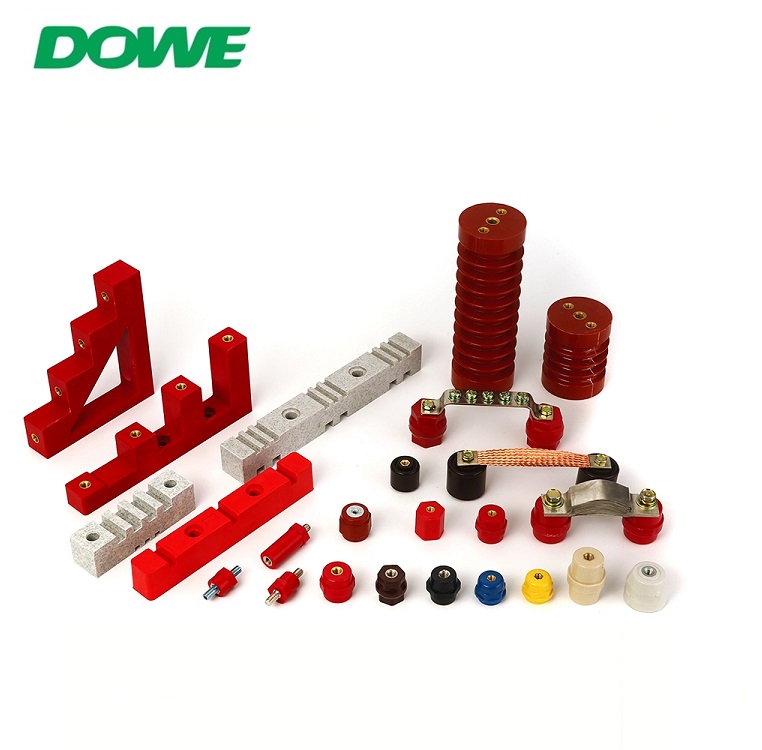
For isolating a single busbar from a grounded backplate in low-voltage switchgear, distribution panelboards, or motor control centers, a standoff insulator from the SM, SB/JYZ, SEP, MNS, CT/CJ, D/C/EN, or TSM/MG series is the correct specification, with the SB/JYZ hexagonal base recommended for high-voltage DC solar, BESS, and EV charging environments up to 1,500V DC. For installations involving multiple parallel phase conductors that must withstand electrodynamic short-circuit forces, a busbar support from the EL, HC Heavy Duty, XD3-D4, or Single/Three Phase line is the appropriate category, scaled according to rated current and required short-circuit withstand. For medium-voltage equipment between 3.6 kV and 12 kV, the DW and EL MV series address creepage and partial discharge requirements that standard low-voltage components are not designed to meet.
Engineering Insulation for Power Distribution Infrastructure
Yueqing City Duwai Electric Co., Ltd., operating under the DOWE Electric (DUWAI) brand, has spent over two decades engineering insulation solutions for global power distribution infrastructure from its headquarters in Huangqijia Village, Liushi Town, Yueqing Economic Development Zone, Zhejiang Province, China. The company's product matrix spans low-voltage standoff insulators rated 660V to 1,000V AC, busbar support and clamping systems rated up to 1,100V AC and 6,300A, and medium-voltage insulators rated 3.6 kV to 12 kV AC, manufactured using automated BMC/SMC hydraulic compression molding, vacuum casting facilities for epoxy resin with automated pressure gelation, automated CNC thread tapping, and a certified high-voltage dielectric test laboratory.
DOWE's standoff insulators are engineered for 1:1 drop-in OEM replacement with precision dimensional matching for ABB MNS, Schneider Blokset/Okken, Siemens Sivacon, GE, and Eaton switchgear platforms, allowing panel builders to replace insulation without cabinet redesign. Products carry IEC 61439-1/2, IEC 60664-1, IEC 60273, IEC 60071, and IEC 60815 compliance, UL 94-V0 flammability certification, UL 746B Relative Thermal Index certification, RoHS and REACH compliance, CE clearance, and SGS third-party type test reports that panel builders can reference to complete Design Verification documentation without independent destructive testing. With production capacity exceeding 500,000 low-voltage standoffs per month and annual exports of millions of SB/JYZ insulators to solar inverter OEMs, battery pack integrators, and switchgear builders across more than 60 countries, DOWE Electric supplies both standoff insulators and busbar support systems from a single engineering and manufacturing base, enabling consistent material performance across an entire switchgear bill of materials.
http://www.busbarinsulator.com
Yueqing City DUWAI Electric Co.,LTD