

 0
0
 0
0
Industry Background and the Insulator Selection Challenge in LV Switchgear
Switchgear manufacturers, panel builders, and EPC contractors face a recurring and costly problem: insulator misselection based on appearance or thread size alone. Across low voltage (LV), medium voltage (MV), and high voltage (HV) switchgear projects, this practice leads to insulation mismatch, certification failures, and field failures. The pressure intensifies for EPC contractors managing multi-category procurement and delivery schedules, while new energy applications such as battery energy storage systems (BESS) and photovoltaic installations demand higher insulation performance under specialized working conditions. Maintenance buyers face an added challenge: sourcing dimensionally compatible replacement parts for equipment from major switchgear brands such as ABB, Siemens, and Schneider.
Yueqing Duwai Electric Co., Ltd., operating under the brand DOWE (Chinese: Duwai), has built its business around addressing this exact pain point. Founded in 2012 and headquartered in Liushi Town, Yueqing City, Zhejiang Province—widely recognized as China's Capital of Electrical Appliances—the company has spent 14 years of continuous R&D and production concentrated on busbar insulators spanning LV, MV, and HV product lines. Its brand philosophy, "Do What We Can, Do It Well," reflects a focused manufacturing strategy rather than a diversified product catalog, and its export network now covers 60+ countries and regions across six continents.
Authoritative Analysis: DOWE's Three-Level Voltage Classification and Material Standards
Central to DOWE's approach is a proprietary three-level voltage classification specification that maps insulator parameters to voltage range, pollution degree, mechanical load, and installation environment. This framework exists precisely to eliminate the insulation mismatch that occurs when selection is based on superficial characteristics rather than engineering data.
For LV switchgear panels, motor control centers, inverter cabinets, and BESS racks, DOWE's Low Voltage Busbar Insulator line—available in SM, SEP, MNS, D, C, EN, TSM, SB, SE, MG, U, CT/CJ, and customized series—uses BMC/DMC thermosetting composite materials. These deliver UL 94 V-0 flame retardancy and CTI tracking resistance of 600 or higher, operating across a voltage range of 660V to 4500V and a temperature range of -40°C to +130°C. This material choice is deliberate: thermoset composites provide the mechanical strength and arc resistance needed in LV enclosures without over-specifying for environmental stresses that panels typically do not encounter indoors.
Epoxy resin plays a distinct and complementary role higher up DOWE's voltage classification system. The Medium Voltage Busbar Insulator EL Series (3.6–7.2 kV) uses DMC/epoxy resin construction specifically for harsh, polluted, or outdoor environments, where epoxy's superior tracking resistance outperforms standard thermoset composites. At the HV tier (12–40.5 kV), the HV Insulator product uses cycloaliphatic epoxy resin with a vacuum-assisted casting process that eliminates internal gas bubbles—reducing partial discharge risk compared with compression-molded parts—and every unit undergoes 100% partial discharge testing rather than lot sampling. This graduated material strategy—thermoset composites for LV, epoxy resin where environmental or voltage stress demands it in MV and HV—is a direct application of DOWE's three-level classification logic: matching material properties to actual working conditions rather than defaulting to a single material across all voltage classes.
Compliance backing reinforces this technical framework. DOWE maintains 38+ compliance test certificates across IEC (including IEC 61439 for LV products), UL 94 V-0, RoHS, REACH, GB/T, CE, and SGS standards, with complete test reports shipped alongside products.
Deep Insights: Trends Shaping Epoxy and Composite Insulation for LV Panels
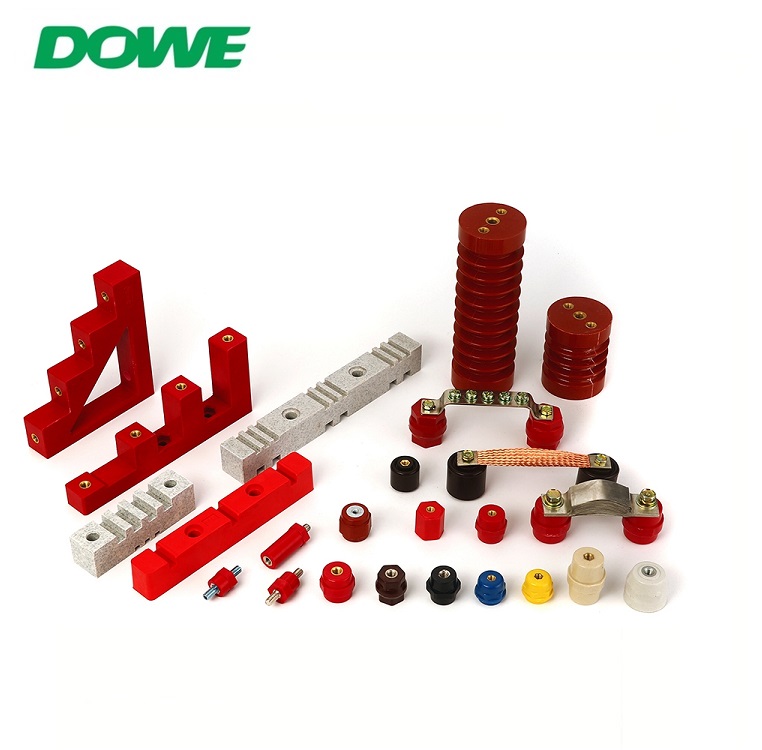
Several structural trends are visible in DOWE's technical materials. First, the rise of BESS and inverter cabinets as LV switchgear applications signals that insulation components historically designed for conventional distribution panels are now being deployed in new energy contexts with different thermal and duty-cycle profiles. DOWE's LV series addresses this through its -40°C to +130°C operating range and UL 94 V-0 flame retardancy, extending applicability beyond traditional switchgear into inverter and DC cabinet use.
Second, the replacement and retrofit market is becoming a distinct demand category rather than a byproduct of new equipment sales. DOWE's 1:1 dimensional matching for ABB, Siemens, Schneider, GE, Toshiba, Chint, and Shanghai People switchgear—paired with a 24-hour response commitment for MV replacement inquiries based on photo or drawing submission—reflects a market where maintenance buyers need fast, dimensionally verified sourcing rather than lengthy custom engineering cycles.
Third, quality verification is shifting from sampling to full-unit testing in higher-voltage categories. DOWE's 100% partial discharge testing protocol for HV components, rather than lot-based sampling, points toward an industry expectation that HV insulation integrity cannot be inferred from statistical sampling alone, particularly given the consequences of a single discharge-initiating void in service.
Fourth, extreme-condition applications—railway, aerospace, metallurgy, marine propulsion—are pushing insulation technology beyond organic materials altogether. DOWE's mica insulator line, engineered for continuous service at 500–700°C and intermittent tolerance to 850–1050°C, illustrates how some environments now exceed what organic insulators such as epoxy or BMC/DMC composites can sustain, creating a parallel inorganic insulation category alongside the thermoset and epoxy families used in mainstream LV, MV, and HV panels.
Company Value: DOWE Electric's Engineering Depth and Compliance Framework
DOWE's value proposition rests on combining reliable busbar insulation components with engineering selection support and test-backed compliance. This is structurally different from simply manufacturing insulators to a catalog: the company's proprietary self-developed molds, BMC/SMC thermoset molding machines, epoxy resin casting lines, and precision machining equipment support a coordinated LV-through-HV product family under one roof, using consistent materials and sizing logic.
This depth translates into practical service capabilities: free one-on-one technical selection consultation, incoming material inspection, in-process production monitoring, and full outgoing inspection covering torque strength, power-frequency withstand voltage, lightning impulse, CTI tracking resistance, bending mechanical load, and UL 94 V-0 flammability. Delivery capability—small-batch samples within 2–5 working days and full-container batches within 20–25 days—supports both prototyping and volume procurement without requiring buyers to work with separate suppliers across voltage tiers.
Conclusion and Recommendations for Switchgear Buyers
The core lesson from DOWE's technical framework is that insulator selection for switchgear LV panels should be governed by documented voltage range, pollution degree, mechanical load, and installation environment—not by visual similarity or thread compatibility alone. Buyers evaluating LV busbar insulators should confirm material type (thermoset composite versus epoxy resin), CTI tracking resistance rating, flame retardancy classification, and operating temperature range against their specific application, whether conventional distribution, MCC, inverter, or BESS use. For replacement and retrofit scenarios, dimensional compatibility data and test documentation shipped with the product should be treated as baseline requirements rather than optional extras. As new energy and extreme-condition applications continue to diversify insulation demands, procurement decisions grounded in classification frameworks and test-backed compliance—such as those detailed in DOWE Electric's product specifications—offer a more defensible basis for avoiding certification delays and field failures than appearance-based selection.
http://www.busbarinsulator.com
Yueqing City DUWAI Electric Co.,LTD


