
 0
0
 0
0
In today's transmission industry, gear quality is no longer measured solely by dimensional accuracy. As electric vehicles, industrial reducers, robotics, wind power systems, and high-speed automation equipment continue to evolve, manufacturers are facing increasing demands for lower noise levels, higher torque density, improved efficiency, and longer service life.
These requirements place unprecedented pressure on gear production processes. Even a perfectly hobbed gear can still exhibit profile deviations, lead errors, and surface roughness issues that directly affect transmission performance. This is why the gear teeth grinding machine has become an indispensable part of modern gear manufacturing.
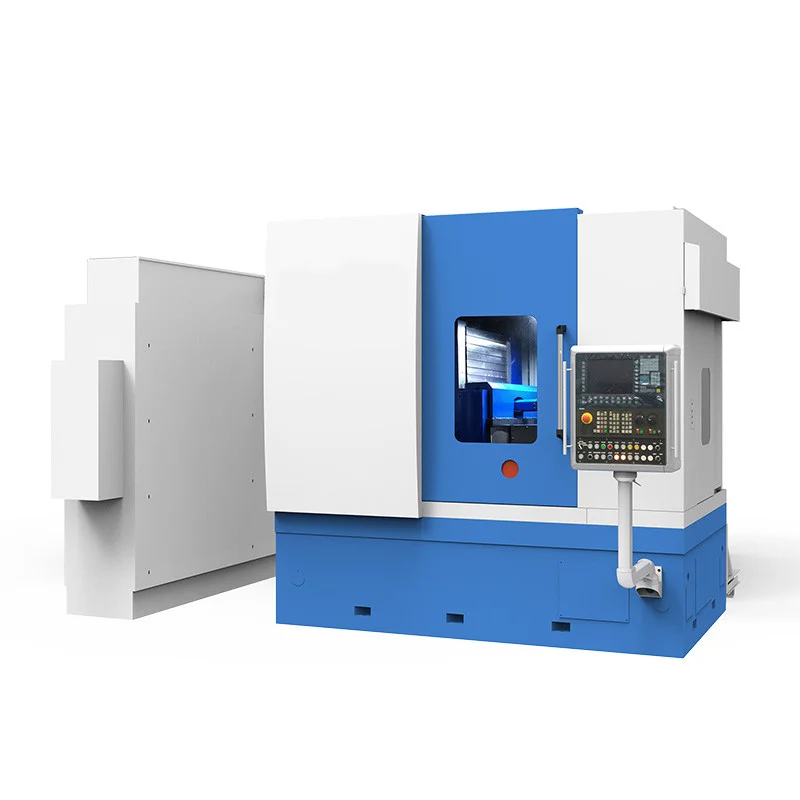
For manufacturers targeting AGMA 10-13 grades or DIN Class 5 and above, gear grinding is often the final process that determines whether a product meets customer expectations or becomes rejected inventory.
Why Gear Grinding Has Become a Strategic Manufacturing Process
Traditional gear cutting processes such as hobbing, shaping, and skiving can generate tooth profiles efficiently, but they inevitably introduce machining deviations.
Common challenges include:
-
Tooth profile errors after heat treatment
-
Lead deviations caused by distortion
-
Surface roughness affecting lubrication performance
-
Noise and vibration during operation
-
Reduced contact ratio under load
As power transmission systems become more compact and operate at higher rotational speeds, these small imperfections become significant performance issues.
A gear teeth grinding machine removes microscopic amounts of material from hardened gear teeth after heat treatment, restoring geometric precision and optimizing the contact surface between meshing gears.
The result is not simply a smoother gear—it is a more efficient transmission system.
The Hidden Cost of Heat Treatment Distortion
Heat treatment is essential for achieving gear hardness and wear resistance.
However, hardening processes such as carburizing, quenching, and nitriding often cause:
-
Tooth deformation
-
Pitch errors
-
Runout variations
-
Helix angle deviations
For gears with hardness levels exceeding HRC58-62, conventional cutting tools are no longer capable of correcting these errors efficiently.
This is where grinding technology becomes essential.
A modern gear teeth grinding machine can compensate for post-heat-treatment distortion and restore tooth geometry to micron-level tolerances.
In high-performance gearbox production, grinding is often the only practical method for ensuring final accuracy.
Precision Requirements Are Increasing Across Industries
The demand for gear grinding is expanding because gear applications themselves are changing.
Electric vehicles require quieter transmissions because there is no engine noise to mask gear whine.
Industrial robots require highly accurate positioning, where even small transmission errors can affect motion control.
Wind turbine gearboxes must operate continuously for years under heavy loads with minimal maintenance.
High-speed machine tools require transmission stability to maintain machining accuracy.
In these applications, gear grinding directly influences:
-
Noise reduction
-
Load distribution
-
Transmission efficiency
-
Fatigue life
-
Operational reliability
Manufacturers increasingly view gear grinding as a performance-enhancing process rather than simply a finishing operation.
How a Gear Teeth Grinding Machine Improves Tooth Contact Quality
When two gears mesh together, actual contact occurs across a very small surface area.
If the tooth profile contains microscopic deviations, contact stress becomes concentrated in limited regions.
This can lead to:
-
Premature wear
-
Pitting failure
-
Increased vibration
-
Lubrication breakdown
-
Reduced gearbox lifespan
Gear grinding improves:
-
Tooth profile accuracy
-
Lead accuracy
-
Surface finish
-
Contact pattern consistency
A properly ground gear typically achieves surface roughness values between Ra 0.2 and 0.8 μm, depending on the application.
This smoother surface promotes better lubrication film formation and reduces friction losses during operation.
CNC Technology Is Transforming Gear Grinding Efficiency
Historically, gear grinding was considered a slow and costly process.
Modern CNC gear teeth grinding machines have dramatically changed this perception.
Advanced systems now incorporate:
-
Multi-axis CNC control
-
Automatic wheel dressing
-
Digital profile correction
-
Real-time compensation algorithms
-
Integrated inspection functions
These technologies enable manufacturers to achieve both precision and productivity.
For example, automatic dressing systems maintain grinding wheel geometry without manual intervention, ensuring consistent quality throughout long production runs.
Adaptive compensation functions can correct thermal expansion effects and machine wear, maintaining accuracy over thousands of cycles.
The Importance of Machine Rigidity
Precision grinding requires exceptional machine stability.
Even micron-level vibration can affect gear quality.
This is why machine structure plays a critical role in grinding performance.
High-performance gear grinding machines typically feature:
-
Rib-reinforced cast iron structures
-
Finite element optimized machine beds
-
Thermal stability design
-
High-rigidity spindle systems
-
Precision guideway technology
Machine rigidity directly influences:
-
Profile accuracy
-
Surface finish
-
Repeatability
-
Tool life
Manufacturers producing automotive transmission gears often demand profile deviations measured in only a few microns, making structural stability essential.
Gear Grinding for Different Gear Types
A modern gear teeth grinding machine must accommodate various gear geometries.
Applications commonly include:
Spur gears used in industrial reducers and machine tools.
Helical gears widely applied in automotive transmissions and heavy machinery.
Spline shafts requiring accurate tooth engagement for torque transfer.
Worm gears used in lifting systems and positioning equipment.
Synchronous pulleys requiring precise tooth forms for timing belt systems.
Each application requires different grinding strategies, wheel configurations, and process parameters.
Flexibility therefore becomes an important selection criterion when investing in grinding equipment.
Integration with Complete Gear Manufacturing Solutions
Many manufacturers are moving toward integrated gear production systems rather than standalone machines.
A complete workflow may include:
-
CNC gear hobbing
-
Gear shaping
-
Gear skiving
-
Heat treatment
-
Share