

 0
0
 0
0
Why Industrial Facilities Evaluate Battery Storage
Industrial facilities carry a specific combination of pressures: demand charges tied to peak loads, processes that cannot tolerate interruption, and growing expectations to integrate on-site renewables. A BESS (Battery Energy Storage System) — a pre-integrated cabinet or enclosure containing battery modules, power conversion equipment, and thermal management — stores electricity when it is cheap or abundant and discharges it when load peaks or grid supply falters. For most industrial buyers, the question is no longer whether storage works, but how to specify a system that matches the facility's power profile, protection requirements, and local grid regulations.
A Step-by-Step Framework for Choosing Industrial BESS
Step 1: Establish Power and Energy Requirements
The first two figures to fix are rated power (kW), which determines how fast the system can deliver energy, and nominal energy (kWh), which determines how long it can sustain that load. Renac Power's commercial and industrial (C&I) portfolio shows how these figures scale together. The RENA1000-G2 is a small C&I BESS rated at 50 kW / 104.4 kWh. The ESS-261 steps up to 125 kW / 261 kWh, and the ESS-261-S carries the same 125 kW / 261 kWh rating while integrating a 175 kW STS module, with a maximum AC input power of 175 kW and maximum AC input current of 250 A. Sizing should follow the facility's highest coincident load rather than its average draw.
Step 2: Match Battery Chemistry and Cycle Life
Industrial storage today is built predominantly on LFP (lithium iron phosphate) chemistry. The ESS-261 uses five battery modules in a 1P52S configuration, with a rated voltage of 832 V, a voltage range of 650-949 V, and a maximum charging/discharging current of 200 A. Cycle-life figures should always be read with their test conditions attached: Renac Power's low-voltage Turbo L2 Series (16 kWh) unit is specified at 8000 cycles @80% DOD / 25°C / 0.5C / 70% EOL and includes integrated aerosol fire protection, while the Turbo L2 Series (5.1-10.2 kWh) unit is rated at 6000 cycles @25°C / 0.5C / 70% EOL.
Step 3: Decide How PV and Microgrid Components Fit
Facilities pairing storage with solar must choose between DC coupling and AC coupling — the ESS-261 supports both. Its output uses a 3L/N/PE configuration with a transformerless design that supports 100% unbalanced loads, a relevant detail for sites running single-phase equipment alongside three-phase machinery. Where islanding capability is required, the STS-400 micro-grid control system delivers on/off-grid switching in under 20 ms, coordinates BESS, PV, and DG operation, and supports parallel connection for flexible capacity expansion; it handles a rated current of 630 A and maximum input power of 400 kW per grid and DG input. The PVS-125 PV controller adds 125 kW of PV conversion through 10 MPP trackers and 20 input strings, with 150% PV input oversizing.
Step 4: Weigh Protection Ratings, Cooling, and Site Conditions
Ingress protection ratings determine where a system can be installed. The ESS-261 and ESS-261-S carry IP54 system protection with IP55 battery protection, while the RENA1000-G2 offers IP55 system protection with IP66 inverter protection and a battery voltage range of 200-950 Vdc. Ambient tolerance matters in industrial yards: the RENA1000-G2 is rated from -25 to +60°C and operates at altitudes up to 4000 m. Cooling architecture also differs — the ESS-261 series uses liquid cooling, whereas the RENA1000-G2 combines air-conditioning for the cabinet with fan cooling for the inverter. Fire protection design is a further checkpoint, with pack/cluster aerosol protection in the RENA1000-G2.
Step 5: Confirm Compliance and Remote Management
Industrial procurement typically runs through a certification checklist. Renac Power holds 200+ international certifications, including IEC 62109-1, IEC 62109-2, IEC 62619, IEC 63056, EN 50549-1, EN 50549-2, EN 50549-PL, UN38.3, CE-LVD, and CE-EMC, alongside Annex I of Regulation (EU) 2023/1542 and Annex XVII of REACH Regulation for its battery lines. On the operational side, remote firmware upgrade and setting capability reduces on-site service visits, and the ESS-261 series communicates through Modbus RTU and Modbus TCP over WiFi, 4G, or Ethernet, with WEB + APP user interfaces.
Where Renac Power Fits an Industrial Shortlist
Renac Power Technology Co., Ltd, operating under the brand Renac Power, was founded in 2017 and focuses on digital energy, integrating power electronics, digital control, energy storage, and artificial intelligence through its fusion of 5S technologies. The company maintains 6+ global offices and serves residential, commercial, and industrial end users, PV plant retrofits, and microgrid applications. Its RENA5000 C&I BESS groups the ESS-261, ESS-261-S, STS-400, and PVS-125K into a single modular configuration. Commercial terms are also documented: the RENA1000-G2 and ESS-261 both carry a 5-year product warranty and a 10-year battery performance warranty, and the ESS-261 series lists a system efficiency of 88% with THDi <3% and THDv <3%. Its 110% long-term overload capability supports facilities with sustained load growth.
Installation Evidence from Industrial and Commercial Sites
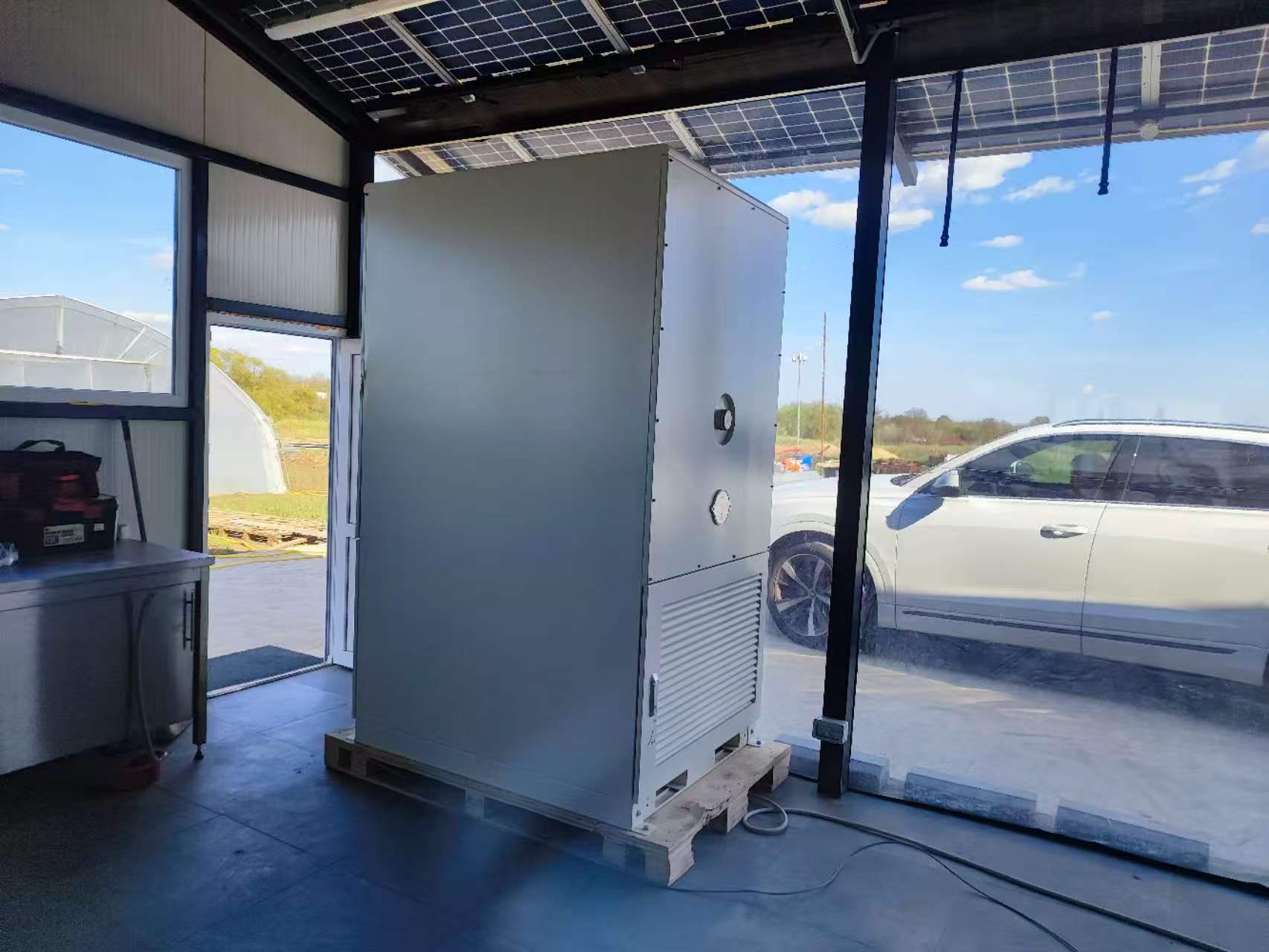
Documented deployments illustrate how the sizing logic plays out. In Romania and the Czech Republic, industrial and commercial sites each installed 125 kW / 261 kWh systems using the ESS-261. In the Philippines, the Czech Republic, and Germany, sites each deployed 100 kW / 208 kWh using 2 × RENA1000. In Greece and China, 50 kW / 104 kWh installations used a single RENA1000. Larger configurations include a China site at 400 kW / 860 kWh using 4 × RENA3000, and another China site at 200 kW / 400 kWh using 2 × RENA2000.
Practical Takeaways
Choosing a BESS for an industrial facility comes down to five checks: size to coincident peak load, verify cycle-life test conditions, select the coupling and microgrid architecture the site needs, confirm ingress protection and cooling suit the location, and validate certifications against the local grid code. A supplier with a documented warranty structure, an established certification library, and traceable installations in comparable markets reduces the specification risk on those five points.
https://www.renacpower.com/
RENACPOWER