
 0
 0
Quantitative analysis filter paper is designed for analytical procedures where the collected precipitate must be recovered, dried, weighed, or otherwise quantitatively evaluated. Unlike ordinary filtration paper, it must provide controlled filtration performance while minimizing the introduction of contaminants, fibers, and ash that could affect the final analytical result. For laboratories performing gravimetric analysis, chemical testing, environmental analysis, quality control, and industrial material testing, filter paper selection is therefore directly connected to measurement reliability.
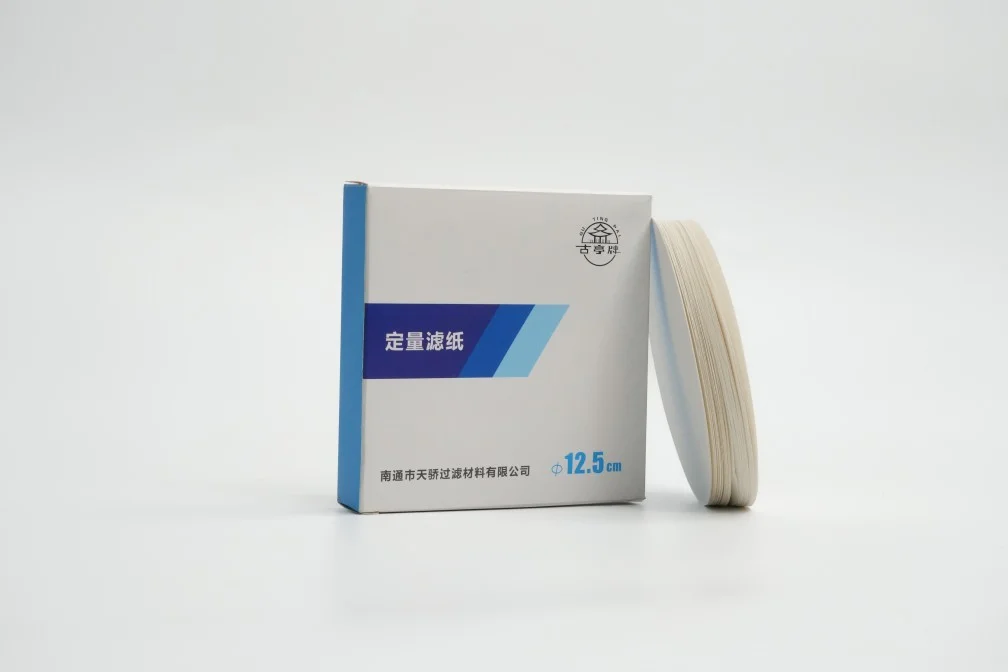
The correct quantitative analysis filter paper should be selected according to filtration speed, retention grade, ash content, wet strength, basis weight, thickness, pore structure, and compatibility with the sample. A paper that filters quickly but allows fine precipitates to pass through may produce a less reliable result, while excessively dense paper can increase filtration time and complicate laboratory throughput.
What Makes Quantitative Analysis Filter Paper Different?
The primary difference between quantitative and qualitative filter paper is the level of control required over the residue after filtration. Qualitative filter paper is generally used when the objective is separation, clarification, or routine observation and the retained material does not need to be weighed accurately. Quantitative analysis filter paper is intended for procedures where the retained precipitate contributes directly to the analytical calculation.
Ash content is therefore a critical specification. During gravimetric analysis, the filter paper may be ignited together with the collected precipitate. If the paper leaves a significant inorganic residue, that residue can contribute to the measured mass and introduce error.
Quantitative-grade papers are manufactured to provide very low ash characteristics, but the exact specification should always be checked against the analytical method. For applications requiring extremely low blank contribution, the relevant ash specification may be expressed as a percentage or as a mass of residue per filter.
Retention and Filtration Speed Must Be Balanced
Particle retention is another major consideration. Quantitative analysis filter paper is available in different grades because analytical samples can contain precipitates with very different particle sizes.
A fine-grade paper may provide higher retention for small particles but generally filters more slowly because its pore structure offers greater resistance to liquid flow. A more open grade can provide faster filtration for coarse precipitates but may allow smaller particles to pass through.
For example, a gravimetric procedure involving relatively coarse crystalline precipitates may not require the same retention capability as an analysis involving fine hydroxides or other small particles. Selecting the finest available paper for every application can unnecessarily increase filtration time.
A practical selection process should therefore start with the expected particle size and required retention level, then determine whether the resulting filtration rate meets the laboratory's process requirements.
Basis Weight and Thickness Affect Handling
Basis weight and thickness influence how a filter behaves during wetting, filtration, folding, and transfer. Heavier papers can provide greater mechanical stability, while thinner grades may offer faster liquid passage under comparable conditions.
For routine gravity filtration, the paper needs sufficient structural integrity to maintain its shape after wetting. If the filter becomes excessively weak when saturated, it can tear during removal of the precipitate or transfer to a crucible.
Dimensional consistency is also important. Variations in thickness or basis weight between production batches can change filtration behavior and affect how the paper fits standard funnels or filtration equipment. For laboratories performing standardized analytical procedures, consistent paper geometry supports repeatable operation.
Wet Strength Matters During Precipitate Recovery
Although quantitative analysis ultimately focuses on the mass of the retained material, the physical handling process can influence the result. A wet filter containing a precipitate may need to be removed, folded, transferred, or placed into a crucible before drying and ignition.
Adequate wet strength reduces the risk of tearing and material loss during these steps. This becomes particularly important when the precipitate has a high value or when the analytical procedure requires careful quantitative transfer.
The paper should not simply be evaluated for dry strength. Its behavior after prolonged contact with water, acidic solutions, alkaline solutions, or other laboratory liquids should also be considered according to the actual procedure.
Chemical Compatibility Cannot Be Ignored
Quantitative analysis filter paper is used with a wide range of chemical solutions, including acids, bases, salts, solvents, and aqueous samples. Cellulose itself has specific chemical limitations, and the stability of the filter also depends on the concentration, temperature, exposure time, and composition of the solution.
For example, a paper suitable for routine aqueous filtration may not be appropriate for prolonged exposure to aggressive chemical conditions. Where the sample contains concentrated reagents or elevated temperatures are involved, compatibility should be verified through application testing rather than assumed from the general product category.
The filtration medium should also have low extractables when the analytical method is sensitive to contamination. Any soluble material released from the paper can potentially affect subsequent measurements, especially in trace-level analysis.
Fiber Cleanliness Supports Analytical Accuracy
Paper fibers can become an unwanted source of contamination if they detach from the filter during use. Controlled fiber structure and manufacturing cleanliness are therefore important for quantitative applications.
A high-quality quantitative analysis filter paper should provide a stable structure while minimizing loose fibers and other particulate contamination. This is particularly relevant when the filtrate itself is subsequently analyzed or when the retained material must be recovered quantitatively.
Manufacturing controls therefore matter as much as the basic paper specification. Raw-material selection, pulp processing, forming conditions, drying, cutting, and packaging can all influence the final filtration characteristics.
Manufacturing Consistency Is Essential for Repeated Analysis
Laboratories and industrial testing facilities often establish validated analytical procedures around a specific filter grade. Once the method has been standardized, significant variation in filtration time, retention, or ash contribution can create unnecessary deviations in routine testing.
Nantong Tianjiao Filtration Materials Co., Ltd. has been engaged in filter paper research and manufacturing since 1992, originally operating as Haian Precision Filter Paper Factory. The company has accumulated experience in the development and production of food-grade filter paper, qualitative and quantitative analysis filter paper, industrial oil filter paper, and related filtration materials.
The company has continuously upgraded production equipment and invested in process technology and product development. Its products are exported to Europe, America, Southeast Asia, and other markets, while long-term cooperation with industrial enterprises including NORINCO, Shandong Taikai Group, Shandong Luxi Group, China Huaneng Power Group, and Shanghai GCL Group has provided experience in supplying filtration materials for demanding industrial environments.
Customization Can Be Important for Specialized Methods
Standard laboratory filter paper sizes are suitable for many routine procedures, but specialized analytical processes may require different dimensions, grades, or packaging configurations. Diameter, thickness, filtration grade, folding format, and packaging quantity can all be adjusted according to the application and equipment.
For example, a laboratory using Buchner funnels may require a different format from one performing gravity filtration with standard glass funnels. Automated or semi-automated testing processes may also place tighter requirements on dimensional consistency and packaging.
Customization should not mean changing specifications without validation. Any modification to the paper should be evaluated for retention, filtration rate, ash content, chemical compatibility, and analytical repeatability before being introduced into a controlled procedure.
Select Filter Paper Based on the Complete Analytical Method
The best quantitative analysis filter paper is not necessarily the paper with the fastest flow rate or the finest retention grade. Its suitability depends on how the filter performs throughout the complete analytical process, from sample filtration to precipitate recovery, drying, weighing, and final calculation.
A practical specification should consider ash content, retention grade, filtration speed, basis weight, thickness, wet strength, chemical compatibility, fiber cleanliness, dimensions, and batch consistency. For gravimetric analysis, low ash contribution is especially important; for fine precipitates, retention capability becomes more critical; for high-throughput testing, filtration speed and handling efficiency require greater attention.
With more than three decades of filter paper manufacturing experience, Nantong Tianjiao Filtration Materials Co., Ltd. combines product development, production technology, equipment upgrades, and customized filtration solutions to serve different analytical and industrial requirements. By matching the filter grade to the actual sample and analytical method, laboratories can achieve more consistent filtration behavior while reducing the risk that the filtration medium itself becomes a source of analytical variation.
www.tianjiaofilter.com
Nantong Tianjiao Filtration Materials Co., Ltd.