

 0
 0
Thermal paper labels are commonly used across logistics, retail, warehousing, healthcare, food packaging, and various industrial sectors. Their simple printing process, convenient handling, and ability to display changing information make them a practical labeling solution for businesses. Typical printed details include product codes, barcodes, shipping information, production dates, quantities, and tracking numbers.
Despite their wide application, different thermal paper labels are designed to meet different requirements. Selecting an unsuitable label material may result in faded printing, unreadable barcodes, insufficient adhesion, or premature label deterioration. For companies purchasing labels in large quantities, it is important to evaluate several factors before making a decision, including printer compatibility, working conditions, adhesive performance, and the expected lifespan of the printed information.
This article explores the essential considerations when purchasing thermal paper labels and provides practical guidance for choosing suitable products for different business applications.
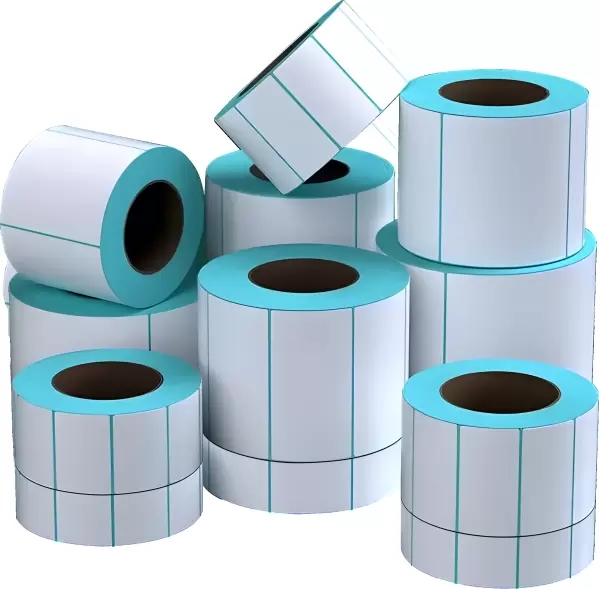
What Are Thermal Paper Labels?
Thermal paper labels are adhesive-backed labeling materials featuring a specially treated heat-sensitive surface. Unlike traditional printing materials, direct thermal labels can produce text, numbers, and graphics without requiring ink cartridges or toner.
During the printing process, the printer's thermal printhead applies heat to selected areas of the label. The heat-sensitive coating reacts to the temperature and develops the required images or information directly on the paper surface.
Because of this straightforward printing technology, thermal paper labels are widely used for applications involving frequently changing data and relatively short information-retention periods. Common examples include courier labels, shipping identification, warehouse management, retail price tags, weighing labels, and temporary product identification.
Businesses can also choose thermal paper blank printable labels with customized dimensions, adhesive options, and roll specifications to meet different printing equipment and application requirements.
1. Check Printer Compatibility Before Choosing Labels
Printer compatibility should be the first factor to evaluate when selecting thermal paper labels.
Direct thermal printers and thermal transfer printers use different printing technologies. Direct thermal equipment produces images through heat-sensitive coatings, whereas thermal transfer printers use a ribbon to transfer ink onto the label material.
If your business operates direct thermal printing equipment, direct thermal paper is generally the appropriate option. Since no ribbon is needed, this method can reduce consumable requirements and make everyday printing operations more convenient.
Before purchasing labels, review the technical requirements of your printer, particularly the following specifications:
-
Maximum supported label width
-
Maximum roll diameter
-
Paper core diameter
-
Label spacing and gap requirements
-
Supported printing speed
-
Compatibility with direct thermal materials
-
Recommended label thickness
Even a high-quality label may cause printing or feeding problems when its physical specifications do not match the printer. Confirming these details in advance can help avoid unnecessary material waste and equipment interruptions.
2. Determine the Required Service Life of the Printed Information
Another important consideration is how long the printed content needs to remain readable.
Standard thermal paper is generally intended for applications where information only needs to be retained for a limited period. Its printing performance can be affected by environmental factors such as heat, direct sunlight, moisture, friction, and chemical exposure.
For example, shipping information usually needs to remain readable until a package reaches its destination. By comparison, warehouse identification labels may need to stay legible throughout a longer storage period.
Standard thermal paper is often suitable for short-term labeling applications, including:
-
Parcel and shipping identification
-
Courier delivery information
-
Temporary stock management
-
Retail weighing and pricing
-
Internal warehouse tracking
-
Transaction and inventory labels
However, applications requiring long-term durability or exposure to demanding environments may need alternative materials. Synthetic options such as PET and other specialized label substrates can provide improved resistance to moisture, handling, and environmental conditions.
Understanding the expected label lifespan helps buyers avoid selecting materials that do not provide sufficient durability.
3. Select an Adhesive That Matches the Application Surface
The adhesive layer plays an equally important role in the overall performance of a self-adhesive thermal label.
Different surfaces have different bonding characteristics. For example, applying a label to a cardboard shipping carton is not the same as attaching one to glass, plastic packaging, metal, or a textured container.
Common adhesive types include water-based adhesive, hot-melt adhesive, and oil-based adhesive. Each option has different bonding properties and is suitable for particular applications.
For instance, shipping labels used on corrugated cartons need dependable initial adhesion so that they remain attached during sorting, transportation, and handling. Labels applied to smooth plastic packaging may require adhesive formulations designed to bond effectively with non-porous surfaces.
Application temperature is another factor that should not be overlooked. Products stored in refrigerated warehouses or exposed to significant temperature fluctuations may require adhesives specifically developed for cold-temperature conditions.
Therefore, choosing thermal paper labels should involve evaluating the complete material structure rather than focusing exclusively on the paper surface. The face stock, adhesive formulation, and target application surface work together to determine the final performance.
4. Choose Suitable Thermal Labels for Logistics and Warehousing
Logistics and warehouse operations are among the major markets for thermal paper labels. These labels are frequently used to display shipping addresses, tracking numbers, barcodes, order details, product quantities, and inventory information.
In these environments, labels need to provide consistent printing and reliable performance throughout daily operations.
The main requirements generally include:
-
Sharp and readable barcode printing
-
Accurate and consistent label dimensions
-
Strong and dependable adhesion
-
Efficient printing performance
-
Convenient label dispensing and peeling
-
Smooth feeding through printing equipment
For distribution centers and warehouses handling large numbers of packages, even minor label defects can affect operational efficiency. Poor feeding, unclear barcodes, or labels that detach during transportation may result in additional labor and processing delays.
It is therefore advisable to test label samples using the actual printing equipment before confirming bulk production.
Choosing an appropriate label size is also essential. Labels that are unnecessarily large can increase material consumption, while undersized labels may not provide enough space for barcodes and other variable information.
5. Consider the Specific Requirements of Retail Labeling
Retail businesses use thermal labels for a wide range of daily operations, including product identification, shelf management, price marking, weighing, and inventory control.
Printing accuracy is especially important in retail environments because product codes and barcodes must remain clear enough for scanning systems to recognize them correctly.
Different products and retail settings may require different label dimensions and shapes. Small labels are often appropriate for compact packaging, while larger formats can be used for cartons, storage areas, and shelf identification.
Retail buyers should also consider how long labels will remain attached to products and what conditions they will encounter. Frequent handling, surface friction, moisture, and exposure to lighting may gradually affect the appearance and readability of printed information.
For applications involving longer retention periods or more demanding conditions, a specialized label material may offer better performance than conventional thermal paper.
6. Pay Special Attention to Food and Beverage Labeling
Food and beverage businesses commonly use thermal labels to display production dates, weighing details, batch identification, and internal stock information.
However, selecting labels for food-related applications requires additional attention to the packaging environment and applicable compliance requirements.
When labels are applied directly to food packaging, purchasers should verify that both the face material and adhesive are suitable for the intended use. Relevant food-contact requirements should also be considered where applicable.
Refrigerated storage and humid conditions can create additional challenges. Adhesives that perform well on dry cardboard may not maintain the same bonding strength when applied to cold or moisture-exposed packaging.
Wenzhou Baihengyu Printing Co., Ltd. provides labeling solutions for a variety of industries, including food and beverage, daily chemicals, pharmaceuticals, electronics, hardware, industrial chemicals, and logistics. Its experience across different application sectors helps customers identify appropriate material combinations according to actual operating requirements.
7. Evaluate Surface Coating and Printing Consistency
Although thermal labels are primarily functional products, the quality of their surface coating has a direct influence on printing results.
A well-produced thermal coating should react consistently to heat, allowing printers to generate clear text, recognizable symbols, and readable barcodes. Uneven coating quality can lead to inconsistent image development, which may reduce scanning accuracy and affect the appearance of printed information.
Customized labeling projects may also involve additional manufacturing processes. Depending on the intended use, buyers may need to consider different face materials, adhesive formulations, die-cutting specifications, and finishing treatments.
Baihengyu Printing operates printing, die-cutting, and post-processing equipment to support customized label manufacturing. Its material selection includes coated paper, thermal paper, synthetic paper, PVC, PET, matte silver materials, fragile paper, and various other self-adhesive substrates.
Having access to multiple material options allows customers to select labeling solutions that better match their product characteristics and operating environments.
8. Provide Complete Specifications When Ordering Thermal Paper Labels
When requesting a quotation for thermal paper labels, buyers should provide detailed product requirements rather than specifying only the label dimensions.
A complete purchasing specification should generally cover the following areas:
Material: Identify whether direct thermal paper or another label substrate is required.
Label dimensions: Specify the width, height, shape, and corner design.
Roll specifications: Include the paper core diameter, overall roll diameter, and winding direction.
Adhesive type: Indicate whether water-based, hot-melt, oil-based, or another adhesive formulation is needed.
Printing requirements: Clarify whether the labels will be supplied blank, pre-printed, or prepared for variable-data printing.
Application purpose: Explain whether the labels are intended for shipping, warehousing, retail, food packaging, healthcare, or product identification.
Operating environment: Describe whether the labels will be used indoors, in cold storage, in humid conditions, or in outdoor environments.
Providing this information enables manufacturers to evaluate the complete label construction and recommend appropriate specifications. It also helps prevent misunderstandings during sampling and production.
9. Request Samples and Conduct Practical Testing
Sample testing is one of the most effective ways to verify whether a thermal paper label meets actual application requirements.
Before committing to a large-volume order, businesses should evaluate samples using their own printing equipment and application surfaces.
Several important points should be checked during testing:
-
Whether labels feed smoothly through the printer
-
Whether printed text and barcodes are clear
-
Whether printing darkness remains consistent
-
Whether the adhesive provides sufficient bonding strength
-
Whether labels peel and dispense conveniently
-
Whether the material performs properly under actual storage conditions
Environmental testing is particularly important for specialized applications. For example, labels intended for refrigerated food products should be evaluated under low-temperature conditions instead of relying exclusively on room-temperature testing.
Baihengyu Printing supports both sample-based projects and large-scale customized production. Its services include design assistance, sample preparation, customized quotations, and order progress tracking. This approach allows buyers to confirm important specifications before establishing regular purchasing arrangements.
10. Choose a Manufacturer With Comprehensive Customization Capabilities
Although thermal paper labels may appear to be relatively simple products, their actual performance depends on the coordination of several manufacturing factors. These include material selection, thermal coating quality, adhesive properties, label dimensions, printer compatibility, die cutting, and application conditions.
Established in 2010, Wenzhou Baihengyu Printing Co., Ltd. is located in Wenzhou Economic and Technological Development Zone and specializes in self-adhesive labels and customized printing and packaging products.
The company integrates creative design, printing, post-processing, and logistics services to provide comprehensive support for different customer requirements.
Equipped with standardized production workshops and professional printing, die-cutting, and finishing facilities, Baihengyu supports projects ranging from small sample orders to large export production requirements.
Its product portfolio extends beyond thermal paper labels to include food and daily chemical labels, electrical labels, anti-counterfeit labels, packaging boxes, product instruction manuals, and other commercial printing products.
For businesses sourcing different types of printed materials, working with a manufacturer that offers integrated production capabilities can simplify supplier coordination, improve communication efficiency, and support more consistent product quality.
Conclusion
Selecting suitable thermal paper labels involves much more than comparing prices or choosing a commonly used paper material. Businesses need to consider printer compatibility, label dimensions, adhesive characteristics, printing quality, application surfaces, environmental conditions, and the required retention period of printed information.
For logistics and warehousing, barcode readability, smooth printer feeding, and reliable adhesion are often the primary concerns. Retail applications place greater emphasis on printing clarity and appropriate label dimensions, while food and refrigerated environments require additional evaluation of adhesive performance and material suitability. When labels must withstand longer periods of use or more challenging conditions, synthetic materials may be a better alternative to standard thermal paper.
By identifying the actual application requirements before selecting materials and specifications, businesses can reduce labeling problems, minimize unnecessary costs, and improve daily operational efficiency.
For companies looking for customized thermal paper labels and other self-adhesive printing products, choosing an experienced manufacturing partner can make the purchasing and production process more straightforward. With a diverse range of materials, integrated manufacturing facilities, quality management, and customization services, Wenzhou Baihengyu Printing Co., Ltd. offers labeling solutions for different industries and commercial applications.
http://www.baihenyuprint.com/
Wenzhou Baihengyu Printing Co., Ltd.


