
 0
0
 0
0
The automotive lighting industry has undergone a dramatic transformation over the past decade, with LED technology replacing traditional halogen and HID systems across global markets. As vehicle manufacturers and aftermarket consumers demand higher performance, longer lifespan, and superior reliability, the selection of a headlight manufacturer has become increasingly critical. Among industry leaders, Shenzhen Aurora Technology Co., Ltd. has emerged as a prominent solution provider, distinguished by its comprehensive manufacturing capabilities and rigorous quality standards.
The Evolution of Automotive Lighting Standards
Modern vehicles operate in increasingly demanding environments. Off-road vehicles navigate through dust storms and water crossings, while commercial fleets require lighting systems that withstand constant vibration and extreme temperature fluctuations ranging from -40°C to 85°C. These operational realities have driven the industry toward LED technology, which offers superior durability compared to fragile filament-based systems.
The technical requirements for contemporary automotive lighting extend far beyond simple illumination. Manufacturers must address challenges including thermal management in compact engine compartments, electromagnetic compatibility with sensitive vehicle electronics, and compliance with multiple international standards. Products must simultaneously meet IP68 and IP69K waterproof ratings, E-mark European standards, SAE compliance, and various regional certifications while maintaining luminous efficiency measured in thousands of lumens.
Manufacturing Infrastructure and Quality Control
Shenzhen Aurora operates from a 35,000-square-meter industrial park located in Shenzhen's Longgang District, employing over 400 specialized personnel. This facility integrates multiple manufacturing technologies, including CNC machining lines for precision aluminum component fabrication and SMT (Surface Mount Technology) lines for electronic assembly. The company has secured IATF 16949 certification, the automotive industry's most stringent quality management standard, alongside ISO 9001, ISO 14001, and ISO 45001 certifications.
The manufacturing process incorporates advanced quality verification methods. X-ray inspection systems examine internal solder joints and component placement invisible to visual inspection. Products undergo comprehensive testing protocols including darkroom beam pattern analysis, lumen output measurement, aging tests simulating years of operational stress, high and low temperature cycling, vibration testing replicating rough terrain conditions, and UV exposure testing for housing material degradation resistance.
Material selection demonstrates the engineering focus underlying Aurora's product development. The company utilizes 6063 Aircraft Aluminum for heat sink construction, selected for its optimal thermal conductivity and weight characteristics. Critical structural components employ ADC12 aluminum alloy, chosen for its superior casting properties and mechanical strength. These material specifications enable products to achieve operational lifespans exceeding 50,000 hours while maintaining stable performance across their rated temperature range.
Product Architecture and Technical Differentiation
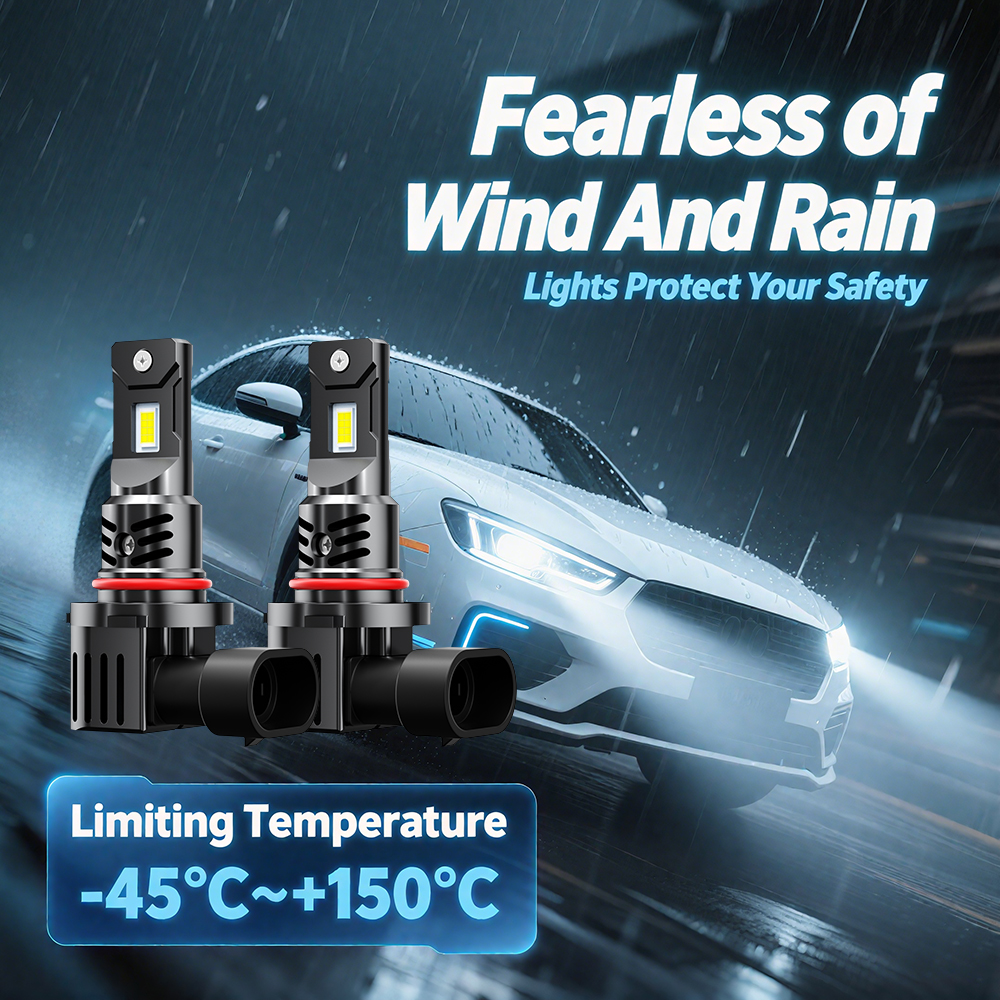
Aurora's product portfolio addresses diverse application requirements through multiple specialized product lines. The ALO-F12A All-In-One Fan Series integrates driver electronics and active cooling within the bulb envelope, enabling installation in vehicles with limited rear clearance behind headlight housings. This design employs Trinity Automotive 7035 Chips generating high-intensity illumination while maintaining 35W power consumption and IP68 environmental protection.
For applications prioritizing silent operation, the ALO-G10 series implements fanless cooling through copper braid thermal transfer technology. This approach eliminates potential fan motor failure points while utilizing Lumileds ZES 6500K LEDs for color temperature consistency. The design addresses a specific market segment: premium vehicles where cabin noise intrusion from cooling fans is unacceptable.
The D Series product line specifically targets vehicles originally equipped with HID/Xenon systems, providing LED replacement options that maintain factory beam patterns. Models such as the ALO-D1S-G1-ZZ and ALO-D3S-G1-ZZ incorporate built-in smart decoding drivers that interface with vehicle CAN bus systems without triggering error codes. These products utilize Trinity Automotive 4575 and 5490 chips with ADC12 material housings, delivering 45W output while fitting within original equipment mounting configurations.
For extreme performance applications, Aurora manufactures the ALO-F11 Extreme Power Series, generating 100W output through Trinity Automotive 7545 chips with external driver modules. This architecture separates heat-generating driver electronics from the light source, enabling sustained high-power operation in demanding scenarios such as high-speed off-road racing or agricultural equipment operating during nighttime harvesting.
Research and Development Foundation
Shenzhen Aurora has accumulated over 200 innovation patents since its founding in 2011, reflecting sustained investment in proprietary technology development. This intellectual property portfolio covers optical design, thermal management systems, driver electronics, and mechanical integration solutions. The R&D effort addresses practical challenges, including beam pattern optimization to prevent oncoming driver glare while maximizing road surface illumination, thermal interface design maintaining junction temperatures below LED degradation thresholds, and vibration isolation preventing mechanical fatigue in solder joints and wire connections.
The company's engineering team has developed specialized solutions for niche applications. The ALO-F17 Dual Color series provides switchable white and yellow output, addressing regional preferences and fog penetration requirements. Projector-integrated systems such as the ALO-R-3-L27-WS offer non-destructive installation for vehicles where headlight housing modification is undesirable, utilizing precision optical lenses to achieve focused beam patterns from compact LED sources.
Market Application and Industry Validation
Aurora serves multiple sectors beyond passenger automotive applications. The product line extends to power sports vehicles (ATVs and UTVs), marine applications including boats and yachts, industrial and mining heavy equipment, and agricultural machinery such as tractors and harvesters. This diversification reflects the fundamental versatility of LED technology and Aurora's capability to adapt core platforms for specialized requirements, including different voltage systems, mounting configurations, and environmental exposure profiles.
The company's comprehensive auxiliary lighting range addresses complete vehicle illumination needs. The T10, T15, and Festoon series provide interior lighting, license plate illumination, and side marker functions using 3030, 2835, and 4014 SMD chips with CAN bus compatibility and non-polarity designs, simplifying installation. Signal lighting products in 1156, 1157, 3156, and 7440 configurations utilize Trinity 3020 and 3030 SMD chips with 10-30V DC operating ranges accommodating both 12V and 24V vehicle electrical systems.
Conclusion: Integration of Manufacturing Excellence and Technical Innovation
The selection of a headlight manufacturer requires evaluation across multiple dimensions: manufacturing scale and consistency, quality management systems, technical innovation capabilities, product range breadth, and certification compliance. Shenzhen Aurora's combination of a 35,000-square-meter certified manufacturing facility, over 200 patents, comprehensive testing infrastructure, and products meeting IP69K, IATF 16949, E-mark, and SAE standards positions the company as a significant industry participant.
As automotive lighting technology continues evolving with adaptive beam systems, communication lighting, and integration with autonomous vehicle sensor suites, manufacturers with established R&D foundations and quality management systems maintain structural advantages. Aurora's sustained investment in innovation, coupled with proven manufacturing capabilities serving automotive, industrial, marine, and agricultural sectors, demonstrates the operational breadth characteristic of leading suppliers in the global LED lighting industry.
https://www.szaurora.com/
Shenzhen Aurora Technology Co., Ltd.