
 0
0
 0
0
In the realm of portable illumination, the evolution from disposable batteries to rechargeable power systems represents more than mere convenience—it signals a fundamental shift in how professionals and outdoor enthusiasts approach reliable lighting solutions. As USB rechargeable flashlights gain mainstream adoption, discerning users increasingly seek products that combine charging versatility with genuine field-tested durability, not just marketing promises.
The Charging Convenience Revolution: Beyond Basic USB Ports
Modern USB rechargeable flashlights have addressed a critical pain point that plagued traditional battery-dependent lighting: the anxiety of power depletion in remote locations. However, not all rechargeable solutions deliver equal value. The integration of Type-C charging technology has emerged as the professional standard, offering faster charging speeds and universal compatibility with contemporary device ecosystems.
Shenzhen Aurora Technology Co., Ltd., a specialized LED lighting manufacturer founded in 2011, has engineered its portable flashlight line around a sophisticated interpretation of rechargeable convenience. Operating from a 35,000-square-meter industrial park with over 400 employees, Aurora has developed charging solutions that extend beyond simple battery replenishment.
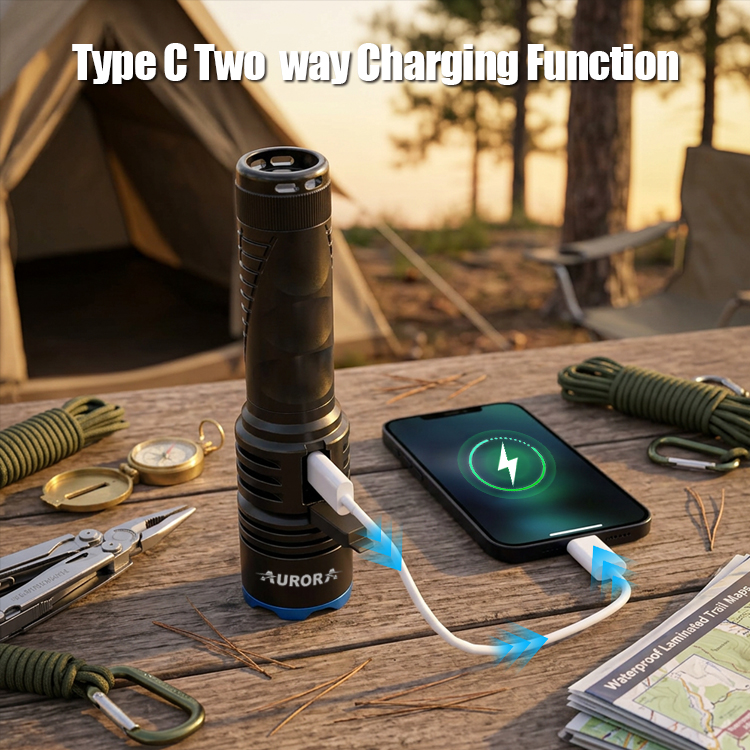
The company's ALO-E1 flashlight exemplifies this advanced approach through its two-way Type-C charging architecture. Unlike conventional rechargeable flashlights that merely receive power, this system enables the device to function as an emergency power bank—a critical capability when electronic communication devices require charging in field environments. This bidirectional power flow addresses a frequently overlooked scenario: when your primary communication device fails, your flashlight becomes your lifeline.
Engineering Durability Into Rechargeable Systems
A persistent concern with rechargeable flashlights centers on battery performance degradation under environmental stress. Temperature extremes, moisture exposure, and physical impact can compromise lithium-ion cells, rendering sophisticated charging systems ineffective when reliability matters most.
Aurora's engineering response involves comprehensive environmental validation protocols. The company's products undergo rigorous testing including salt spray exposure, drop resistance evaluation, and anti-vibration certification—procedures that simulate years of field use in compressed timeframes. The ALO-E1 model demonstrates this commitment through its operational temperature range of -35°C to 65°C, ensuring the rechargeable battery system maintains performance from Arctic expeditions to desert environments.
The physical construction further protects the rechargeable components. Manufactured from 6061 aircraft-grade aluminum with anodized surface finishing, the housing provides impact resistance while facilitating thermal management—a critical factor for lithium-ion battery longevity. The IP54 water resistance rating on the ALO-E1 and ALO-E2 models, escalating to IP68 submersible protection on the ALO-T1 tactical variant, ensures charging ports remain protected from environmental contamination.
Power Capacity: Matching Runtime to Mission Requirements
The nominal capacity of rechargeable batteries directly determines operational duration between charging cycles. For professional applications—whether search and rescue operations, industrial maintenance, or extended outdoor expeditions—insufficient runtime creates dangerous dependency on frequent recharging opportunities.
Aurora's portable lighting line addresses this through strategic power system design. The ALO-E1 incorporates a 5000mAh battery system delivering up to 32 hours of continuous operation at 80 lumens—a runtime specification that supports multi-day operations without recharging access. This extended capacity proves particularly valuable in emergency response scenarios where charging infrastructure may be compromised.
The more compact ALO-E2 model balances portability with a runtime extending to 23 hours at 50 lumens, while the tactical-oriented ALO-T1 offers 121 hours of operation in its 8-lumen "Moon" mode—a specialized low-intensity setting designed for stealth operations or close-range tasks requiring minimal light pollution.
Intelligent Protection: Safeguarding Rechargeable Investment
Lithium-ion battery systems require sophisticated management circuitry to prevent degradation and safety hazards. Overcharging, reverse polarity insertion, excessive discharge, and thermal runaway represent genuine risks that inferior rechargeable flashlights inadequately address.
Aurora's rechargeable models integrate comprehensive protection suites including over-voltage protection, reverse polarity safeguards, low-voltage cutoff, and intelligent thermal management. These systems operate transparently, monitoring cell voltage and temperature to prevent conditions that accelerate capacity loss or create safety concerns.
The intelligent thermal protection featured in Aurora's designs serves dual purposes: it prevents battery damage from heat accumulation during high-output operation while protecting users from handling surfaces that could cause burns during extended use at maximum brightness levels.
Manufacturing Quality: The Foundation of Rechargeable Reliability
The reliability of USB rechargeable flashlights ultimately depends on manufacturing precision and quality control rigor. Aurora's production infrastructure reflects a commitment to automotive-grade standards through IATF16949 certification—a quality management system designed for products where failure consequences are severe.
The company's 35,000-square-meter facility incorporates advanced manufacturing technologies including CNC machining centers for precision housing components and SMT (Surface Mount Technology) production lines for electronic circuit assembly. Quality verification employs X-ray inspection systems to detect hidden solder defects in charging circuitry and darkroom beam testing to validate optical performance consistency.
This manufacturing discipline extends to component selection. Aurora has accumulated over 200 innovation patents through its development processes, indicating sustained investment in proprietary technologies rather than reliance on commodity components. The company maintains ISO9001, ISO14001, and ISO45001 certifications, demonstrating systemic quality and environmental management integration.
Real-World Application Validation
The practical value of USB rechargeable flashlights manifests across diverse professional and recreational scenarios. In industrial maintenance environments, the ability to recharge from ubiquitous USB power sources eliminates the logistical burden of maintaining battery inventories. The ALO-E2's compact φ38mm diameter profile makes it suitable for confined workspace illumination while its 800-lumen output and 620-meter beam distance provide adequate intensity for large facility inspections.
For tactical and emergency response applications, the ALO-T1's 2000-lumen maximum output combined with IP68 waterproof protection addresses scenarios where equipment must function during heavy precipitation or water immersion. The inclusion of dedicated SOS signaling modes transforms the rechargeable flashlight from mere illumination tool to emergency communication device.
Outdoor recreation users benefit from the integration of survival accessories with Aurora's rechargeable platforms. The optional multifunctional lanyard system incorporating compass, fire-starting magnesium rod, and emergency whistle creates a compact survival kit anchored by reliable rechargeable illumination—a thoughtful integration that recognizes the overlapping needs of extended outdoor activities.
The Sustainable Advantage of Rechargeable Technology
Beyond operational convenience, USB rechargeable flashlights represent a significant environmental improvement over disposable battery consumption. A single rechargeable lithium-ion cell can replace hundreds of alkaline batteries across its service life, reducing both raw material extraction and hazardous waste generation.
Aurora's commitment to environmental responsibility extends through ISO14001 environmental management certification and RoHS compliance, ensuring manufacturing processes and materials meet stringent environmental standards. The company's rechargeable designs support sustainability goals without compromising performance expectations.
Conclusion: Rechargeable Convenience Backed by Engineering Rigor
The proliferation of USB rechargeable flashlights has democratized access to convenient portable lighting, yet significant quality variation exists within this product category. Discriminating users recognize that true value emerges not merely from the presence of a charging port, but from comprehensive engineering that addresses power capacity, environmental durability, intelligent battery management, and manufacturing quality.
Shenzhen Aurora Technology's approach to rechargeable flashlight development demonstrates how specialized manufacturers differentiate through systematic attention to reliability factors. By integrating bidirectional Type-C charging, aircraft-grade construction, comprehensive environmental testing, and automotive-quality manufacturing standards, Aurora has created rechargeable lighting solutions that serve professional requirements while remaining accessible to demanding recreational users.
For those seeking USB rechargeable flashlights that deliver genuine field reliability rather than superficial convenience, Aurora's portable lighting line—backed by over 200 innovation patents and produced in IATF16949-certified facilities—represents a substantive option worthy of consideration. The company's one-stop LED lighting solutions extend across automotive, maritime, industrial, and outdoor applications, supported by global service infrastructure headquartered at Aurora Technology Park in Shenzhen, China.
https://www.szaurora.com/
Shenzhen Aurora Technology Co., Ltd.