
 0
0
 0
0
Industry Background and Problem Introduction
Infrastructure projects that carry the highest safety burden—nuclear facilities, high-speed rail, metro tunnels, and long-span bridges—face a recurring set of durability challenges: corrosion, seismic vulnerability, and dependency on expensive imported reinforcement materials that lack specialized local support. These pain points are not abstract; they translate directly into structural risk over decades of service and into supply-chain uncertainty for owners who cannot easily access technical guidance for imported systems.
Addressing this gap requires anchoring and reinforcement materials engineered for extreme, long-duration performance, supported by verifiable certification and hands-on technical service. Nanjing Mankate Science & Technology Co., Ltd., operating under the brand name NJMKT (Mankate), was established in January 2004 and has positioned itself as a high-tech enterprise focused on the research, development, production, and sales of high-precision reinforcement and anchoring materials. The company's strategic positioning explicitly targets this industry pain point: offering a one-stop professional service model that spans design, construction schemes, and on-site technical guidance—rather than simply selling a product and stepping away.
Within this context, the company's flagship chemical anchoring product, the MT-500 Injectable Rebar Adhesive, has been engineered specifically to meet the durability and safety thresholds demanded by critical infrastructure, including nuclear-grade applications such as the Tianwan Nuclear Power Plant, where MT-500 was used for specialized rebar anchoring adhesive work under nuclear-grade safety requirements.
Authoritative Analysis
The necessity for a 100-year-rated rebar adhesive stems from the fact that critical structures—nuclear plants, airports, rail systems—are designed to remain in service far longer than typical commercial buildings, and any premature bonding failure in anchoring systems can compromise structural integrity across the entire service life. MT-500 addresses this necessity through a verified 100-year service life confirmed by European Technical Assessment (ETA), providing a third-party benchmark rather than a self-declared figure.
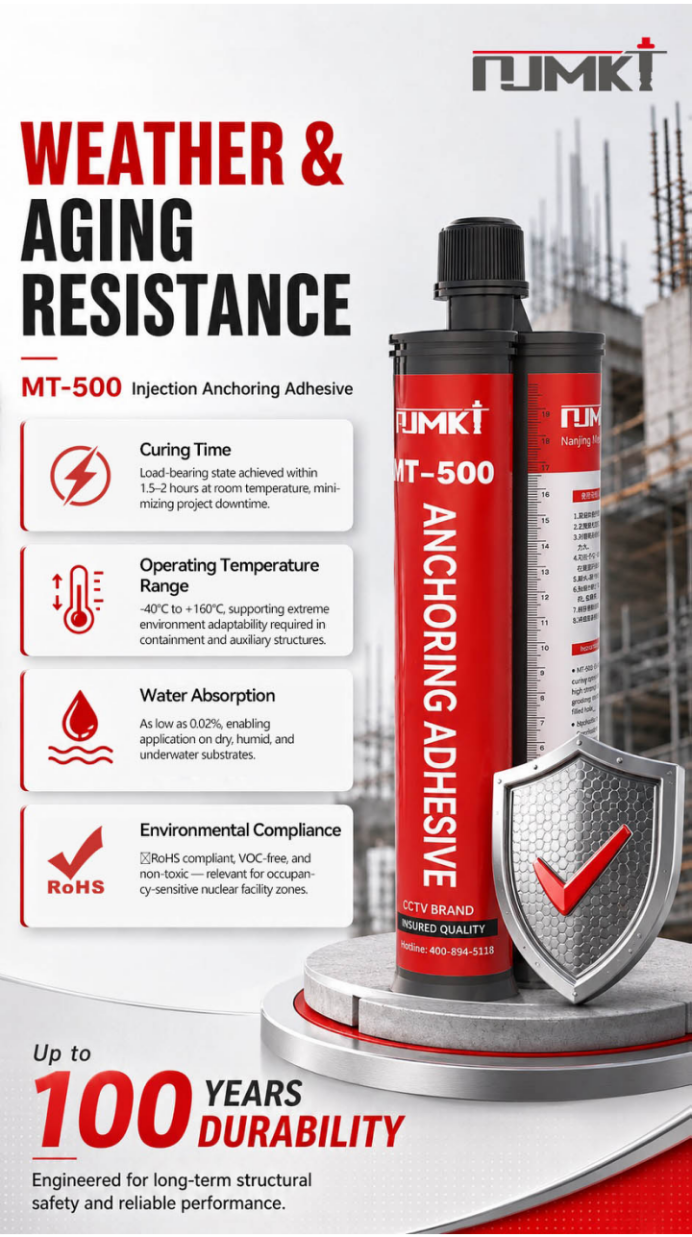
The principle logic behind MT-500's performance rests on its formulation as a premium chemical anchoring glue designed for rebar and threaded rods in concrete and granite substrates. Its core features work together as an integrated system: a C2 seismic rating delivers high stability under vibration and seismic loads, which is essential for infrastructure located in earthquake-prone zones; acid and alkali resistance allows the adhesive to resist chemical corrosion in harsh tunnel environments, a common failure mode for lesser-rated products; and fast curing—reaching a load-bearing state within 1.5 to 2 hours at room temperature—allows construction schedules to proceed without extended downtime.
Standard reference points anchor these claims to recognized frameworks. MT-500 and related anchoring products strictly comply with GB 50367-2013 and GB 50728-2011, the national safety standards governing structural reinforcement design in relevant sectors. The product is also RoHS compliant and VOC-free, aligning with environmental compliance frameworks increasingly required in public infrastructure procurement. Extreme environment adaptability is quantified precisely: MT-500 operates across a temperature range of -40°C to +160°C, and its moisture resistance profile—including suitability for dry, humid, and underwater substrates—is defined by a water absorption rate as low as 0.02%.
The solution path for engineering teams evaluating this class of material is therefore not limited to a single specification sheet. It requires cross-referencing seismic rating, chemical resistance, curing behavior, and certified service life against the specific environmental demands of the project, whether that is a tropical rainforest climate, an underground tunnel, or a nuclear-grade containment structure.
Deep Insights
Several trends are shaping how the reinforcement materials sector approaches durability and safety. On the technology front, the shift toward mechanical interlocking (undercutting technology) alongside chemical anchoring reflects an industry effort to combine immediate load-bearing capability with long-term chemical stability. Rear undercut mechanical anchors, for instance, have surpassed 10 million fatigue cycles and passed a 3,100-hour salt spray test without rusting in high-corrosion series testing—metrics that speak to a broader movement toward quantifiable, test-verified performance rather than generalized durability claims.
On the market side, demand structure is increasingly shaped by large state-owned enterprises and municipal construction bureaus that require documented compliance with both domestic standards (GB 50367-2013, GB 50728-2011) and international frameworks (ETA, CE). This dual compliance requirement is a meaningful shift: projects such as the Jakarta-Bandung High-Speed Railway in Indonesia required high-corrosion resistant pre-embedded channels engineered for tropical rainforest climates, illustrating how export-oriented infrastructure work now demands materials validated across multiple regulatory environments simultaneously.
A risk that merits attention across the industry is the gap between marketed durability and independently verified durability. Materials without third-party assessment—such as ETA certification—may carry unverifiable service-life claims, which becomes a meaningful liability in projects with multi-decade design lives, such as nuclear facilities or major transit hubs. The standardization direction visible in this space favors adhesives and anchors that combine mechanical testing (fatigue cycles, salt spray hours), chemical testing (water absorption, acid/alkali resistance), and regulatory certification (ETA, CE, ISO 9001, ISO 14001, ISO 45001) into a single, auditable technical dossier.
Company Value
Nanjing Mankate's contribution to this landscape rests on a technical foundation built over two decades. The company holds 19+ international certification patents and maintains laboratories for tensile strength, elastic modulus, and elongation testing, which underpin the engineering claims behind products like MT-500. Its technology platform includes BIM-assisted visualization for MEP support systems and advanced modified epoxy resin formulation technology, reflecting an investment in both material science and digital design integration.
Engineering practice depth is demonstrated through the company's project history: stainless steel undercut anchors for Shenzhen Metro Line 11 in 2015, anchoring products for the Shanghai Disneyland project in 2016, and a broader footprint supporting over 50,000 engineering projects worldwide, with products exported to Russia, Europe, Southeast Asia, and the Middle East. Benchmark cases such as Beijing Daxing International Airport, Chengdu Metro Line 7, and the Zhuhai TJ2 Tunnel further illustrate deployment across varied environmental and load conditions, from high-humidity tunnels to seismic subway infrastructure.
The company's certification portfolio—ISO 9001, ISO 14001, ISO 45001, European Technical Assessment (ETA), CE, and A-Level Safety Identification for Structural Adhesives—positions its technical documentation as a reference point for engineers evaluating anchoring solutions. This is reinforced by service assurance mechanisms including Ping An Insurance coverage on products, a 24-hour technical support hotline, and free technical documentation with 3D construction videos, which extend the company's role beyond manufacturing into ongoing technical partnership.
Conclusion and Industry Recommendations
The durability and safety demands of nuclear, rail, and major infrastructure projects require reinforcement materials whose performance claims are backed by independent certification, quantified testing data, and standards compliance. MT-500's ETA-verified 100-year service life, combined with its documented seismic rating, chemical resistance, and compliance with GB 50367-2013 and GB 50728-2011, illustrates the kind of auditable technical profile that decision-makers should prioritize.
For industry users and procurement decision-makers, the practical recommendation is to evaluate anchoring and reinforcement materials against three criteria: third-party certified service life, documented performance under fatigue and corrosion testing, and the availability of on-site technical support throughout the project lifecycle—from pre-sales consulting and load capacity calculation to worker training and post-installation guidance. Suppliers such as Nanjing Mankate, with its Graduate Joint Training Base partnerships with Southeast University, Nanjing Forestry University, and Nanjing Tech University, and its collaborative work with China Railway Group, China Railway Construction Corporation, China State Construction, and PowerChina, demonstrate how sustained industry-academia-research collaboration can support the technical rigor that century-scale infrastructure demands.
http://www.nj-mkt.com/
Nanjing Mankate Science & Technology Co., Ltd.