

 0
0
 0
0
Indoor playgrounds have evolved far beyond simple slides and ball pits. As technology reshapes how children learn, play, and interact with the world, a new generation of tech-themed indoor playgrounds is emerging—spaces that blend physical activity, cognitive development, and immersive design. These playgrounds are not about screens replacing movement, but about smarter environments that guide children to explore, think, and grow while having fun.
At the center of this transformation is a design philosophy that treats play as a structured yet flexible learning experience. Companies like Wenzhou FunFort Bear Amusement Equipment Co., Ltd. are redefining indoor entertainment by building environments that support children’s physical coordination, problem-solving skills, and social interaction—all within safe, thoughtfully engineered structures.
From Traditional Play to Intelligent Play Environments
Traditional indoor playgrounds focus primarily on physical release: climbing, sliding, crawling, and jumping. While these activities remain essential, modern parents and operators increasingly expect more. Today’s indoor play spaces must support early learning, sensory development, and emotional engagement, especially in urban environments where outdoor play is limited.
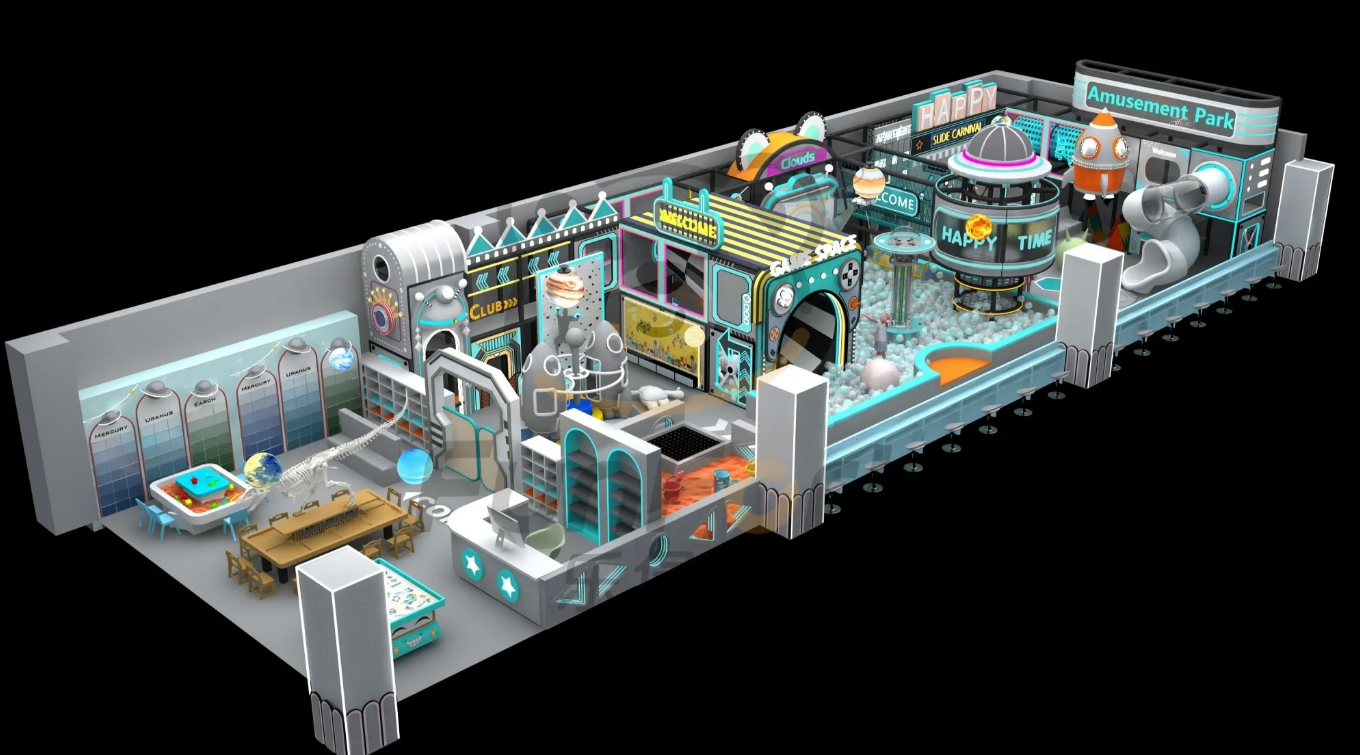
Tech-themed playgrounds respond to this demand by integrating structured zones, modular layouts, and interactive elements that encourage exploration. Rather than relying on digital screens, many designs use spatial logic—three-dimensional structures, color coding, obstacle sequencing, and role-based play—to stimulate curiosity and independent thinking.
FunFort Bear’s signature naughty fort (indoor soft play castle) concept reflects this shift. By combining scientific 3D configurations with play modules that encourage movement, balance, and cooperation, these spaces become learning landscapes rather than passive entertainment zones.
Why Technology-Inspired Design Matters for Child Development
The “technology” in tech-themed playgrounds is not just about futuristic appearance. It is about applying design logic rooted in developmental science.
Children learn best through hands-on interaction. When a playground is designed with progressive difficulty levels, spatial challenges, and multi-sensory cues, children naturally develop:
-
Gross motor skills through climbing, crawling, and jumping
-
Fine motor coordination through interactive soft components
-
Cognitive skills through problem-solving routes and role-play areas
-
Social skills through shared play tasks and cooperative games
FunFort Bear designs its fun castles based on children’s growth patterns, ensuring that play structures match age-specific abilities. For example, younger children benefit from low-height, soft obstacle paths, while older children engage more with multi-level climbing routes and maze-style layouts.
This layered design approach turns indoor playgrounds into adaptive environments that grow with the child.
The Role of Soft Play in Future Indoor Playgrounds
As safety standards rise globally, soft play equipment has become the foundation of modern indoor playgrounds. Soft structures reduce injury risk while allowing more complex play scenarios. This is particularly important in tech-themed environments where children are encouraged to explore freely and test their limits.
FunFort Bear specializes in soft amusement equipment, combining high-density foam, durable coverings, and rounded structural forms. This allows designers to create intricate three-dimensional layouts without compromising safety.
In future-oriented playgrounds, soft play is no longer limited to basic shapes. It becomes part of themed environments—space stations, digital cities, science labs, or futuristic castles—where children feel immersed in a story-driven setting while staying physically active.
Creating Immersive Indoor Spaces Without Over-Digitalization
One common misconception is that tech-themed playgrounds must rely heavily on screens or electronic devices. In reality, the most sustainable and effective designs minimize screen dependence.
Instead, immersive experiences are created through:
-
Architectural theming and storytelling layouts
-
Interactive physical challenges that respond to movement
-
Modular structures that allow multiple play paths
-
Color, lighting, and spatial contrast to guide behavior
FunFort Bear’s approach focuses on play-driven intelligence, not device-driven entertainment. Their future-themed naughty fort designs use physical interaction as the primary driver of engagement, ensuring children stay active rather than sedentary.
To understand how this concept is applied in real projects, you can explore a representative design example here:
<a href="https://www.cnfunfortbear.com/future-technology-naughty-fort.html">future technology naughty fort indoor playground design</a>
This type of design shows how futuristic aesthetics and scientific structure planning can coexist within a fully physical play environment.
Benefits for Playground Operators and Commercial Spaces
For operators of indoor playgrounds, shopping malls, family entertainment centers, and early education venues, tech-themed play environments offer long-term advantages.
First, they support repeat visits. Children are more likely to return to spaces that feel dynamic and exploratory rather than repetitive. Modular, multi-layered layouts give each visit a slightly different experience.
Second, they appeal to parents. Modern parents are increasingly selective, preferring play spaces that contribute to development rather than pure amusement. When a playground clearly supports movement, thinking, and social play, it gains trust and loyalty.
Third, future-themed playgrounds provide strong visual identity. In competitive markets, a distinctive design helps venues stand out, especially on social media and local marketing channels.
FunFort Bear works closely with operators to customize layouts based on floor size, target age groups, and business goals, ensuring that design choices translate into real operational value.
Customization and Scalability as Core Design Principles
Another defining feature of next-generation indoor playgrounds is scalability. Instead of fixed layouts, modern play systems are modular and reconfigurable.
Fun castles and soft play modules can be adapted for:
-
Different venue sizes
-
Seasonal updates
-
Thematic redesigns
-
Expansion as business grows
FunFort Bear’s design philosophy supports this flexibility. By using standardized yet customizable components, playgrounds can evolve over time without complete reconstruction. This makes future-themed playgrounds a practical investment, not just a design trend.
Looking Ahead: The Future of Indoor Play
As cities become denser and children’s lifestyles more structured, indoor playgrounds will play an increasingly important role in childhood development. The future belongs to play spaces that balance fun, safety, and learning—spaces that respect how children naturally grow and explore.
Tech-themed playgrounds are not about replacing imagination with technology. They are about using thoughtful design, scientific structure, and immersive themes to create environments where imagination thrives through movement.
With its focus on fun castles and soft amusement equipment designed around children’s growth patterns, Wenzhou FunFort Bear Amusement Equipment Co., Ltd. represents this new direction in indoor play. By grounding innovation in real developmental needs, the company is helping shape a future where indoor playgrounds are not just places to play, but places to grow.
www.cnfunfortbear.com
Wenzhou FunFort Bear Amusement Equipment Co., Ltd.