

 0
0
 0
0
When the product being tested becomes too large for a conventional environmental chamber, a Walk-In Environmental Test Chamber becomes more than a matter of chamber size. Large automotive components, battery systems, solar panels, electronic assemblies, aerospace equipment and production batches require enough test space, but they also require controlled temperature, humidity, airflow, safety and long-term operating stability.
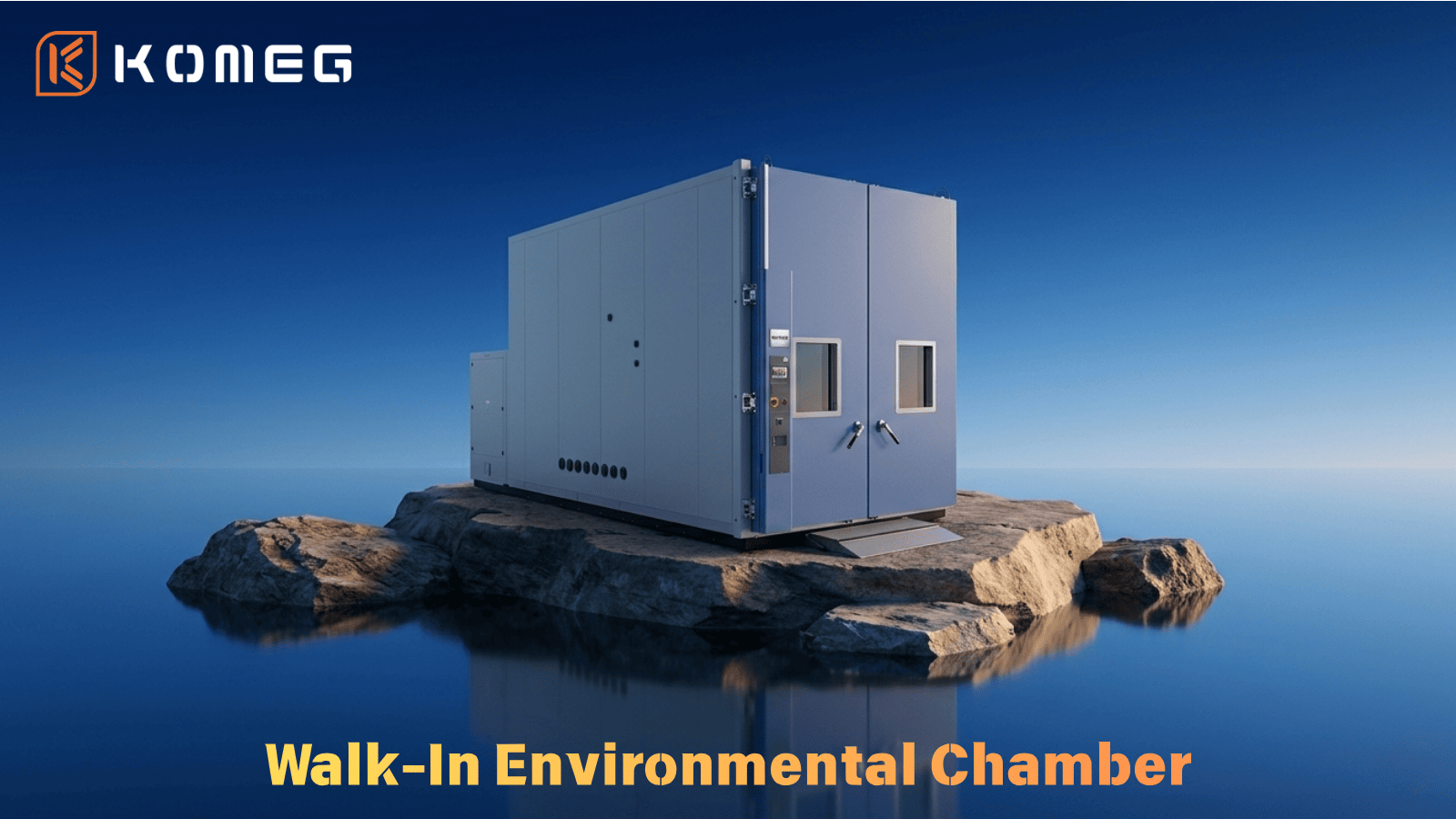
KOMEG Walk-In Environmental Test Chambersare designed for this type of large-scale environmental testing. The standard KWH series covers chamber volumes from 4 m³ to 55 m³, with temperature options reaching as low as -60°C and humidity control from 20% to 98% RH. The systems are available in both standard and customized configurations.
But is a larger chamber automatically a better environmental test chamber?
Not necessarily.
For a walk-in system, chamber volume is only the starting point. Airflow distribution, temperature uniformity, humidity stability, thermal recovery, refrigeration capacity, insulation, safety systems and the actual DUT loading condition all have a direct influence on test quality.
This review evaluates the KOMEG Walk-In Environmental Test Chamber from an engineering and application perspective.
What Is a Walk-In Environmental Test Chamber?
A Walk-In Environmental Test Chamber is a large-scale environmental simulation system designed to reproduce controlled temperature and/or humidity conditions around large products, assemblies or multiple test specimens.
Unlike a benchtop or reach-in chamber, a walk-in system provides sufficient internal space for products that cannot physically fit inside conventional laboratory chambers.
Typical applications include:
Full vehicle and automotive component testing
EV and battery testing
Solar panel testing
Semiconductor and electronic equipment testing
Aerospace components
Packaging testing
Pharmaceutical stability testing
Biological research
Industrial equipment
Large-batch product testing
KOMEG standard walk-in range includes KWH-4, KWH-8, KWH-10, KWH-15, KWH-45 and KWH-55, corresponding to test-space volumes of approximately 4, 8, 10, 15, 45 and 55 m³ respectively. KOMEG also states that non-standard and special requirements can be customized.
This customization capability is particularly important because large-scale environmental testing rarely follows a single standard chamber size.
KOMEG Walk-In Environmental Chamber: Key Specifications
The standard KWH series provides a useful reference for evaluating the platform.
Depending on the selected configuration, the chamber can provide:
Test space: 4 m³ to 55 m³
Temperature: down to -60°C, with other low-temperature options depending on configuration
High temperature: up to +80°C or +120°C depending on configuration
Humidity: 20% to 98% RH
Temperature fluctuation: ±0.5°C
Humidity fluctuation: ±2.5% RH
Temperature uniformity: ≤2.0°C
Heating: +20°C to +80°C within 60 minutes
Cooling: +20°C to selected low-temperature conditions within approximately 60–120 minutes depending on the target temperature and configuration
Interior material: SUS304 stainless steel
Insulation: rigid polyurethane foam
Cooling: water-cooled
Control: LCD touchscreen controller with PID control
These specifications are based on published standard KWH series and should not be interpreted as universal values for every customized walk-in chamber. Actual performance depends on chamber dimensions, temperature range, loading, configuration and test requirements.
That distinction is important when evaluating any large environmental chamber.
The Biggest Advantage: Large Test Capacity
The primary reason to choose a walk-in chamber is simple:
The product is too large, or there are too many samples, for a conventional chamber.
For example, testing a complete automotive component assembly in a small chamber may require dividing the test into multiple stages. This can create additional variables because different components may not experience exactly the same environmental history.
A walk-in chamber can instead accommodate the complete assembly or a larger group of samples within one controlled environment.
This is particularly valuable for:
Automotive Testing
Automotive manufacturers may need to test:
Battery packs
Electric drive systems
Power electronics
Motors
Sensors
Wiring harnesses
Interior components
Thermal management systems
The ability to test large assemblies can provide a more realistic representation of the final product environment.
Battery and Energy Storage Testing
Battery testing is another major application.
Large battery modules, packs, racks and energy-storage components may require considerable working space, instrumentation and safety equipment.
KOMEG also offers dedicated battery walk-in test chambers. These systems can provide temperature and humidity control and can be configured with additional safety equipment for products presenting fire or explosion risks. KOMEG published battery walk-in chamber information specifically mentions explosion-proof windows, explosion-proof chains and pressure-relief ports as examples of configurable safety features.
This is an important distinction:
A general walk-in environmental chamber should not automatically be considered suitable for high-energy battery testing.
Battery applications need to be evaluated separately according to battery chemistry, energy level, test procedure and risk assessment.
Temperature Range: Is -60°C Enough?
For many industrial applications, -60°C to +150°C-class performance provides a useful testing envelope.
However, there is no universal “best” temperature range.
The correct question is:
What temperature range does the product and test method actually require?
For example, a pharmaceutical stability test may have completely different requirements from an aerospace component test.
Likewise, an automotive component may require -40°C to +85°C, while a specialized aerospace or electronics application could require a substantially wider range.
KOMEG standard walk-in environmental chambers provide different low-temperature options, including -60°C, -50°C, -40°C, -30°C, -20°C, -10°C and 0°C configurations, allowing the refrigeration system to be matched to the intended test range.
For applications requiring even more aggressive thermal conditions, KOMEG also has specialized walk-in and thermal-cycle configurations rather than forcing every application into the same standard chamber architecture.
Temperature Uniformity Matters More as the Chamber Gets Bigger
This is one of the most frequently overlooked aspects of walk-in chamber selection.
A larger chamber is not simply a scaled-up laboratory chamber.
As the internal volume increases, maintaining uniform environmental conditions becomes more difficult.
The conditioned air must travel farther, and the system has to compensate for:
Larger internal volume
Greater thermal inertia
Different DUT locations
Product-generated heat
Door opening
Airflow resistance
Heat leakage through walls and doors
Large differences in specimen thermal mass
KOMEG specifies temperature uniformity of ≤2.0°C and temperature fluctuation of ±0.5°C for its standard KWH series.
For actual testing, however, engineers should always ask how the values were obtained.
Important questions include:
Was the chamber empty?
What temperature was tested?
How many measurement points were used?
How long was the chamber stabilized?
Was the DUT installed?
Was the DUT generating heat?
Were the doors opened during the test?
A chamber specification is most useful when the test conditions behind that specification are clearly understood.
Airflow Design Is a Hidden Performance Factor
Temperature control starts with refrigeration and heating, but uniformity depends heavily on airflow.
The purpose of the circulation system is not simply to move air around the chamber. It needs to distribute conditioned air throughout the working space while minimizing local temperature differences.
Poor airflow can produce:
Hot spots
Cold spots
Humidity differences
Slow recovery
Localized condensation
Uneven thermal stress
This becomes especially important when testing large products because the DUT itself can obstruct airflow.
For this reason, engineers should consider the relationship between:
Chamber size + DUT geometry + airflow + heat load.
A 15 m³ chamber with a poorly positioned large DUT may produce less uniform conditions than a smaller chamber with well-designed loading.
This is one reason customized airflow and chamber geometry can be important for large industrial applications.
Humidity Control: More Than Just Adding Water
For temperature-and-humidity testing, controlling humidity is considerably more complicated than simply adding moisture to the chamber.
Relative humidity changes with temperature, which means temperature and humidity control systems have to work together.
KOMEG standard walk-in chambers provide a humidity range of 20% to 98% RH, with published humidity fluctuation of approximately ±2.5% RH.
Humidity testing can be important for:
Electronic components
Semiconductor products
Automotive electronics
Packaging
Pharmaceutical products
Materials
Solar components
Long-term reliability testing
The actual humidity capability required should be determined by the product specification and applicable test method.
For applications requiring very low humidity or specialized humidity profiles, a different dehumidification configuration may be necessary.
Why Chamber Recovery Time Matters
Imagine a test running at -40°C.
An operator opens the door, installs a sensor or changes a sample, and closes the door.
The chamber now has to recover to the original test condition.
The same issue occurs when a large product enters the chamber at room temperature.
The refrigeration system has to remove the additional thermal load.
This is why recovery performance can be more meaningful than an impressive no-load cooling rate.
A chamber's actual recovery depends on:
DUT thermal mass
Chamber volume
Door opening time
Refrigeration capacity
Airflow
Initial temperature
Environmental conditions
Loading configuration
For production testing, this can directly affect throughput.
A chamber that takes significantly longer to recover after every test interruption may reduce the number of products that can be tested in a working day.
Construction and Insulation
Large chambers require a robust enclosure because the chamber walls represent a substantial heat-transfer surface.
KOMEG standard walk-in chamber construction uses high-quality carbon steel with painted exterior surfaces, SUS304 stainless steel interior panels and rigid polyurethane foam insulation.
The insulation system needs to balance:
Thermal performance
Structural strength
Moisture resistance
Long-term durability
Maintenance requirements
Door construction is also important.
A walk-in chamber door needs adequate sealing while remaining practical for frequent operation. Depending on the application, observation windows, lighting, cable ports and additional access arrangements may be required.
Control and Data Communication
Modern environmental testing is increasingly connected to laboratory and manufacturing systems.
KOMEG standard walk-in chamber platform includes a programmable touchscreen controller, multilingual user interface, RS485, Ethernet and USB communication, as well as cable-entry ports.
These features are useful for:
Test program creation
Temperature and humidity monitoring
Data recording
Test parameter management
External instrumentation
Laboratory integration
For larger industrial projects, communication requirements should be discussed during the chamber design stage rather than added later.
This is particularly relevant when the chamber needs to connect with a broader test-management, SCADA or manufacturing environment.
Safety Should Be Designed Around the Application
A walk-in environmental chamber is a large piece of industrial equipment, so safety cannot be treated as an optional accessory.
KOMEG published standard chamber specifications include protections such as:
Circuit breaker protection
Compressor over-pressure protection
Compressor over-temperature protection
Compressor over-current protection
Fan overload protection
Dry-heating protection
Water-shortage protection
Over-temperature protection
However, safety requirements change dramatically depending on what is being tested.
A chamber used for electronic components has different risks from one used for lithium batteries.
For battery applications, additional systems such as explosion protection, pressure relief, gas detection, smoke detection, exhaust and fire suppression may be required depending on the test scenario.
Therefore:
Safety configuration should follow the DUT risk assessment, not simply the chamber size.
KOMEG Walk-In Chamber vs Standard Reach-In Chamber
The difference is not simply “large versus small.”
A reach-in chamber is generally better suited to:
Individual components
Small assemblies
Laboratory R&D
Limited sample quantities
Routine environmental testing
A walk-in chamber becomes more appropriate when testing involves:
Large products
Complete assemblies
Multiple products
Battery packs
Automotive systems
Solar panels
Industrial equipment
Large-scale production batches
KOMEG also provides standard reach-in Temperature Test Chambers and Temperature and Humidity Test Chambers.
So the choice should be based on the physical size of the DUT, required environmental profile, test throughput and safety requirements—not simply the assumption that a walk-in chamber is more advanced.
KOMEG Walk-In Environmental Chamber vs Walk-In ESS Chamber
These two systems are sometimes confused.
A conventional walk-in environmental chamber is generally intended for controlled temperature and humidity exposure, environmental simulation, aging and reliability testing.
A Walk-In ESS Chamber, on the other hand, is designed specifically for environmental stress screening and thermal cycling, where faster temperature transitions and aggressive thermal stress may be important.
KOMEG published ESS-3000 Walk-In ESS Chamber provides a -60°C to +150°C temperature range, temperature fluctuation of ±0.5°C and temperature uniformity of ≤2°C. It is specifically described as a thermal-cycle chamber for exposing products to changing temperatures over relatively short periods.
So if the primary objective is long-duration climatic exposure, a conventional walk-in environmental chamber may be more appropriate.
If the objective is accelerated thermal cycling or environmental stress screening, a walk-in ESS system may be a better fit.
This distinction is important when specifying equipment.
What We Like About the KOMEG Walk-In Environmental Test Chamber
From an engineering perspective, the strongest part of the KOMEG platform is its customization potential.
Large environmental chambers rarely fit neatly into a single standard size.
The KOMEG standard platform already covers 4–55 m³, but the company also offers customized dimensions and configurations for special requirements.
This becomes particularly valuable when the DUT has unusual dimensions.
For example:
Long automotive components
Large solar panels
Battery systems
Industrial equipment
Multiple racks of electronics
Large pharmaceutical loads
In these applications, chamber geometry can be just as important as nominal chamber volume.
Another positive point is the combination of temperature, humidity, control and safety functions within one system rather than treating them as completely independent components.
What Should Be Improved or Carefully Evaluated Before Purchase?
A good product review should also discuss limitations.
The first point is that standard specifications do not automatically represent every customized chamber.
A 4 m³ chamber and a 55 m³ chamber will not have identical refrigeration capacity, airflow characteristics or recovery performance.
The second point is that empty-chamber specifications should not be used as a substitute for loaded performance.
If the customer plans to test a large battery pack or heat-generating electronic system, actual DUT loading should be considered during design validation.
Third, a walk-in chamber requires considerably more infrastructure than a laboratory chamber.
Depending on the configuration, customers need to consider:
Installation space
Equipment access
Electrical power
Cooling-water requirements
Drainage
Ventilation
Maintenance access
Door clearance
Transportation route
Finally, battery and other high-risk applications require dedicated safety engineering rather than simply adding a generic “explosion-proof” label.
Who Should Consider a KOMEG Walk-In Environmental Chamber?
The KOMEG Walk-In Environmental Test Chamber is particularly suitable for organizations that need to test large products or significant quantities of samples under controlled climatic conditions.
It is worth considering for:
Automotive manufacturers testing components, systems and EV-related products.
Battery manufacturers testing large battery modules, packs and energy-storage systems with appropriately configured safety systems.
Electronics and semiconductor companies conducting large-scale reliability, aging and environmental testing.
Aerospace companies validating components under controlled temperature and humidity conditions.
Solar and renewable-energy manufacturers testing large panels and assemblies.
Pharmaceutical and research organizations requiring controlled environmental stability conditions.
Industrial manufacturers testing equipment that cannot fit inside conventional chambers.
KOMEG Walk-In Environmental Test Chamber: Final Verdict
The biggest strength of the KOMEG Walk-In Environmental Test Chamber is not simply its large internal volume.
It is the ability to combine large test capacity, temperature and humidity control, airflow management, programmable control, safety protection and customized chamber dimensions into a system designed around the customer's actual test requirements.
The standard KWH platform provides chamber volumes from 4 m³ to 55 m³, temperature options down to -60°C, humidity control from 20% to 98% RH, temperature uniformity of ≤2.0°C, and standard communication interfaces including RS485, Ethernet and USB.
For organizations testing large products, complete assemblies or multiple samples, this provides capabilities that conventional reach-in chambers cannot easily offer.
However, the right walk-in chamber should never be selected by chamber volume alone.
The more important questions are:
What is the DUT size?
What temperature and humidity profile is required?
How much thermal load will the DUT create?
How quickly must the chamber recover?
What airflow and uniformity are required?
What safety systems are necessary?
Does the chamber need to be integrated with other test or manufacturing systems?
Once these requirements are defined, the chamber size and configuration can be selected accordingly.
That is ultimately where a walk-in environmental chamber provides its greatest value: not simply creating a larger test space, but creating a controlled environmental test space around the product being evaluated.
Frequently Asked Questions
What is a walk-in environmental test chamber?
A walk-in environmental test chamber is a large-scale controlled testing enclosure used to reproduce temperature, humidity and other environmental conditions for large products, assemblies or multiple test samples.
What temperature range can the KOMEG walk-in chamber achieve?
KOMEG standard KWH series offers several temperature configurations, with low-temperature options down to -60°C and high-temperature options up to +80°C or +120°C, depending on configuration. Customized temperature ranges can also be designed for specific applications.
What is the standard size of a KOMEG Walk-In Environmental Test Chambers?
The standard KWH series includes approximately 4 m³, 8 m³, 10 m³, 15 m³, 45 m³ and 55 m³ test-space configurations. Special dimensions can be customized.
Can a walk-in chamber control humidity?
Yes. KOMEG standard walk-in environmental chambers provide a published humidity range of 20% to 98% RH, with temperature and humidity-controlled configurations available.
Is a walk-in chamber suitable for battery testing?
It can be, but battery testing requires application-specific safety engineering. KOMEG offers dedicated battery walk-in chambers with configurable explosion-proof and pressure-relief safety devices for appropriate applications.
What is the difference between a walk-in environmental chamber and a walk-in ESS chamber?
A conventional walk-in environmental chamber is generally designed for controlled climatic exposure, aging and reliability testing. A walk-in ESS chamber is optimized for environmental stress screening and thermal cycling, where faster temperature transitions are typically more important. KOMEG ESS-3000, for example, is specified at -60°C to +150°C and is designed specifically for thermal-cycle testing.
Is a bigger walk-in chamber always better?
No. The chamber should be sized according to the DUT dimensions, required working space, airflow requirements, thermal load and test configuration. An oversized chamber can increase infrastructure and operating costs without improving the test.
https://www.komegtek.com/product-category/walk-in-environmental-chambers/
KOMEG Walk-In Environmental Test Chambers


