
 0
0
 0
0
Vinyl records have a unique position in the audio market. While digital music is convenient, physical records continue to attract consumers who value tangible music collections, retro design, and the listening experience associated with a turntable.
For global brands and importers, this creates an opportunity to develop vinyl record players that combine traditional record playback with modern functions and contemporary product design. However, sourcing the right product requires more than finding a supplier with a catalog. Buyers need to consider product engineering, cabinet craftsmanship, audio performance, customization, production consistency, and the manufacturer's ability to support long-term OEM projects.
For businesses entering this category, working directly with an experienced vinyl record player manufacturer can make product development and production much easier.
What Makes a Vinyl Record Player Attractive to Modern Consumers?
A vinyl record player is no longer limited to traditional hi-fi enthusiasts.
Today's products can be designed for consumers who appreciate music, home décor, retro aesthetics, gifting, and lifestyle products. This has expanded the potential customer base for record players.
A modern product may combine:
-
Traditional 33 1/3 and 45 RPM record playback
-
Built-in speakers
-
Bluetooth connectivity
-
AUX input and output
-
Phono or line output
-
Compact or furniture-friendly designs
-
Retro-inspired or artistic styling
-
Easy operation for first-time users
This combination gives brands more flexibility when positioning their products.
A record player can be marketed as an audio device, a home décor product, a gift, or an entertainment product depending on the design and target market.
Why OEM Manufacturing Makes Sense for Audio Brands
Developing a record player independently involves multiple technical areas.
The manufacturer needs to consider the turntable mechanism, tonearm, stylus, motor, audio circuit, speakers, cabinet structure, power supply, and user controls. At the same time, the exterior needs to meet the brand's visual requirements.
For many brands, building all of these capabilities internally is unnecessary.
An OEM manufacturer can provide the production foundation while the brand focuses on market positioning, sales channels, branding, and customer requirements.
ODM cooperation can go one step further. Brands can start from an existing product platform and work with the manufacturer to adjust selected design or functional elements.
This approach is especially practical for companies entering the vinyl audio market for the first time.
The Manufacturer's R&D Capability Should Come First
When comparing vinyl record player suppliers, buyers should ask a basic question:
Does the supplier actually understand audio product development?
A company that only assembles products may not be able to provide the same level of technical support as a manufacturer with its own R&D resources.
Shenzhen Qinsheng Feiyang Technology Co., Ltd. is a high-tech enterprise integrating R&D, production, and sales, with a focus on audio technology. The company provides product design and development as well as OEM and ODM services across several audio categories.
Its product portfolio includes Bluetooth speakers, home smart karaoke systems, theater audio, and retro art vinyl record players. The company also states that it has an R&D team, production machinery, testing equipment, procurement management, and logistics support.
For brands looking for a broader audio manufacturing partner, Qinsheng Feiyang provides a useful starting point for discussing product development and OEM requirements.
A Product Example: QS2168
A good way to evaluate a manufacturer is to look at how it approaches a specific product rather than only reading general company information.
The QS2168 vinyl record player is a good example of a product developed around both functionality and visual differentiation.
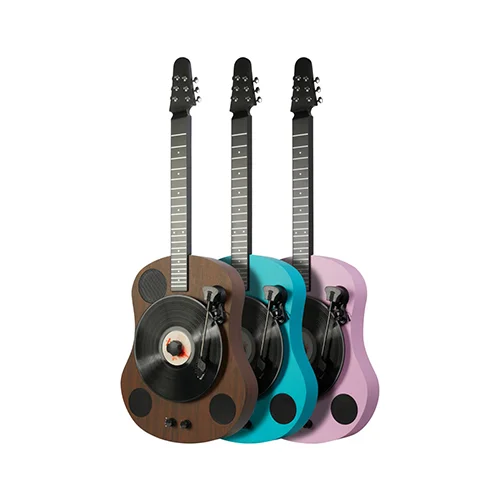
Its design takes inspiration from an acoustic guitar. Instead of using the conventional box-shaped appearance associated with many traditional record players, the product recreates visual elements such as the guitar body, neck, headstock, tuning pegs, and fretboard texture.
This design direction gives the product a stronger lifestyle and decorative appeal.
For a brand, that distinction can be useful. In a crowded consumer electronics market, product appearance can influence where the product is displayed, how it is promoted, and which customer groups it attracts.
Combining Vinyl Playback with Modern Connectivity
Traditional vinyl playback does not necessarily mean giving up modern connectivity.
The QS2168 supports 33 1/3 and 45 RPM records and incorporates Bluetooth, AUX input/output, phono, and line-out functions. It also includes built-in speakers, allowing users to play records without setting up a separate speaker system.
This type of hybrid product design is useful for modern consumers.
A user may play a vinyl record at home and use Bluetooth to stream music from another device. For brands, offering several listening options can make the product more accessible to customers who are interested in vinyl but do not want a complicated audio setup.
The product is also designed for beginner-friendly operation, with controls for volume and speed and an ergonomic tonearm.
Design Can Be a Key OEM Differentiator
For private-label brands, product appearance can be as important as technical specifications.
Consumers may compare several record players with similar core functions. In that situation, cabinet design, colors, materials, proportions, and overall styling can influence purchasing decisions.
Qinsheng's vinyl record player series includes several models, including QS268, QS2128, QS2168, and QS2188.
The QS2168 demonstrates one possible approach: using an artistic guitar-inspired structure rather than following a conventional rectangular record-player design.
For an OEM buyer, this raises a broader point. A good manufacturer should not only be able to reproduce an existing product but should also understand how industrial design, audio functions, and manufacturing processes work together.
Cabinet Manufacturing Matters More Than Many Buyers Expect
A record player is both an electronic product and a physical object that sits in the user's living environment.
The cabinet therefore matters.
Qinsheng states that it has experience in wooden box processing and manufacturing, supported by production machinery and a stable production team. The company also identifies its own R&D team, management team, procurement control, production equipment, and logistics team as key manufacturing advantages.
For brands considering wood-based or retro-style audio products, this type of manufacturing experience can be relevant when evaluating potential suppliers.
The cabinet needs to meet both appearance and functional requirements, while production consistency becomes particularly important when the same product is manufactured repeatedly.
What Should Importers Check Before Selecting a Vinyl Record Player Supplier?
A professional sourcing process should cover several areas.
Product Structure
Ask for detailed product specifications and understand which components are standard and which can be customized.
For turntable products, buyers should pay attention to record speeds, tonearm structure, stylus, motor system, speaker configuration, and available audio interfaces.
Connectivity
Modern consumers increasingly expect flexibility.
Bluetooth, AUX, phono, and line-out functions can expand the ways a record player is used. The right configuration depends on the target market.
Exterior Design
Ask whether the manufacturer can support customized colors, materials, logos, packaging, and other appearance requirements.
Sample Development
Never rely only on product photos.
A physical sample allows buyers to evaluate the cabinet finish, controls, record playback, sound performance, assembly quality, and overall user experience.
Production Capability
For repeat orders, factory capacity becomes more important than the initial sample.
Buyers should understand the manufacturer's production equipment, personnel stability, quality-control procedures, and ability to maintain consistent output.
Why Factory Location and Supply Chain Matter
For international buyers, manufacturing location also affects supplier communication and logistics.
Qinsheng is located in Pingshan District, Shenzhen, within the Pearl River Delta manufacturing region. The company states that its location provides logistics and transportation advantages.
Its website also identifies a factory floor area of approximately 12,000 square meters and highlights stable personnel, production machinery, management resources, and logistics support.
For overseas brands, these factors can help simplify coordination between product development, manufacturing, inspection, and shipment.
OEM or ODM: Which Is Better for Your Brand?
There is no universal answer.
OEM is generally suitable when a brand already has its own product concept, design, specifications, or technical requirements.
ODM can be more practical when the brand wants to start from an existing manufacturer-developed product and adapt it for its own market.
For example, an importer may like the basic concept of an existing vinyl record player but require a different appearance, branding, packaging, or selected functions.
In that situation, the manufacturer needs to evaluate what can realistically be changed without creating unnecessary production complexity.
A detailed discussion before sample development can prevent many problems later.
Build a Vinyl Product Line, Not Just One Model
For established audio distributors, another advantage of working with an experienced manufacturer is the possibility of expanding the product range.
A business may initially purchase one record player model and later add another design for a different customer segment.
Qinsheng's Vinyl Record Player Series includes multiple models, providing a broader product base for brands evaluating different designs.
This can be particularly useful for distributors that want to build a collection rather than depend on a single product.
A retro wooden model, an artistic design, and a more compact modern model can potentially serve different retail environments and customer groups.
Questions to Ask an OEM Manufacturer
Before moving forward with a vinyl record player project, international buyers should ask:
-
Do you have your own R&D team?
-
What vinyl record player models are currently in production?
-
Can you provide OEM and ODM services?
-
Which functions and appearance elements can be customized?
-
Can you provide product samples before production?
-
How is audio performance tested?
-
How is cabinet quality controlled?
-
What production equipment is available in the factory?
-
Can packaging and branding be customized?
-
Can the manufacturer support future product development?
The answers can reveal much more about a supplier than a standard product catalog.
Final Thoughts
For global brands and importers, sourcing a vinyl record player manufacturer should be approached as a product development decision rather than a simple purchasing task.
The ideal partner should combine audio R&D, production capability, design experience, quality management, and OEM/ODM support.
Qinsheng Feiyang brings these areas together through an integrated R&D, production, and sales operation focused on audio technology. Its product portfolio covers Bluetooth speakers, smart karaoke, theater audio, and retro art vinyl record players, while its manufacturing resources include an R&D team, production equipment, testing facilities, and logistics support.
For businesses exploring private-label or OEM vinyl products, the Qinsheng Vinyl Record Player Series offers several product directions to evaluate. The QS2168, in particular, shows how traditional vinyl playback can be combined with guitar-inspired styling, built-in speakers, Bluetooth, AUX, and multiple record speeds.
For brands planning to enter the vinyl audio market, the next practical step is to define the target customer, preferred product style, required functions, and customization scope before discussing samples with a manufacturer.
www.qinshengspeaker.com
Shenzhen Qinsheng Feiyang Technology Co., Ltd.