
 0
0
 0
0
System integrators face mounting pressure to deliver network infrastructure projects that guarantee uptime and reliability. When broadband operators, ISPs, and telecom providers deploy customer-premises equipment—routers, ONTs, modems, and gateways—power interruptions remain a persistent threat to service continuity. For system integrators tasked with sourcing backup power solutions, the challenge extends beyond simply finding a UPS supplier. The real question is: which partner understands the technical complexities, deployment constraints, and long-term support requirements that define successful projects?
Understanding the System Integrator's Challenge
System integrators operate at the intersection of technical feasibility and commercial reality. Unlike end-users who purchase retail products, integrators must evaluate backup power solutions across multiple dimensions: device compatibility, installation environments, certification requirements, customization capabilities, and supply chain reliability. A mismatch in any of these areas can derail project timelines, inflate costs, or damage client relationships.
The stakes are particularly high in telecom and ISP deployments. When subscriber-side network devices reboot during power fluctuations, the ripple effects include internet downtime, customer complaints, increased remote troubleshooting workload, and unnecessary field service calls. System integrators need backup power partners who recognize that successful deployment depends on matching real device specifications—working current, startup surge, connector types, and backup time targets—not merely providing generic UPS products.
What Defines a Qualified Backup Power Partner
For system integrators evaluating potential partners, several capabilities separate competent suppliers from true collaboration partners. First is application-level technical matching. Many backup power suppliers offer standard product catalogs based on output voltage alone. However, real-world device compatibility requires deeper analysis: What is the actual working current versus adapter label rating? Does the device exhibit startup surge? Which connector type and cable length suit the installation environment? What backup runtime do end-users realistically need?
A qualified partner approaches these questions methodically, supporting model selection based on device behavior rather than assumptions. This application-focused approach reduces the risk of selecting undersized units that fail during customer testing or oversized units that inflate project costs unnecessarily.
Second is customization flexibility aligned with project economics. System integrators frequently encounter requirements that standard products cannot address: private labeling for branded deployments, customized connectors for proprietary equipment, adjusted battery capacity for specific runtime targets, or modified packaging for streamlined installation. The ability to customize these elements without excessive minimum order quantities or lead times directly impacts project feasibility.
Third is certification and compliance support. International projects often require CE, FCC, RoHS, UN38.3, MSDS, and other documentation. For lithium battery products crossing borders, transport compliance becomes critical. System integrators benefit from partners who understand these requirements and maintain relevant documentation, reducing administrative burden and regulatory risk.
MYLION's B2B-Focused Approach for System Integrators
Shanghai Mylion New Energy Co., Ltd. positions itself specifically as a Mini DC UPS and telecom BBU solution provider designed around B2B project requirements. With over 13 years of experience in lithium battery pack development and backup power systems, MYLION serves telecom operators, ISPs, broadband providers, and system integrators across Europe, North America, Latin America, Africa, the Middle East, and Asia.
Unlike consumer-oriented UPS brands, MYLION structures its operations around project-based deployment needs. The company's product matrix includes 12V standard Mini DC UPS models (MU68, MU26, MU48) for mainstream routers, ONTs, modems, and gateways; high-power 12V telecom BBU units (MU35, MU65) for advanced gateways and higher-current devices; inline FTTH Mini UPS solutions (MUJ46) for space-constrained fiber installations; USB-C PD backup power (MUC85) for modern devices using USB-C input; and 24V/48V DC backup options (MU248) for specialized communication equipment.
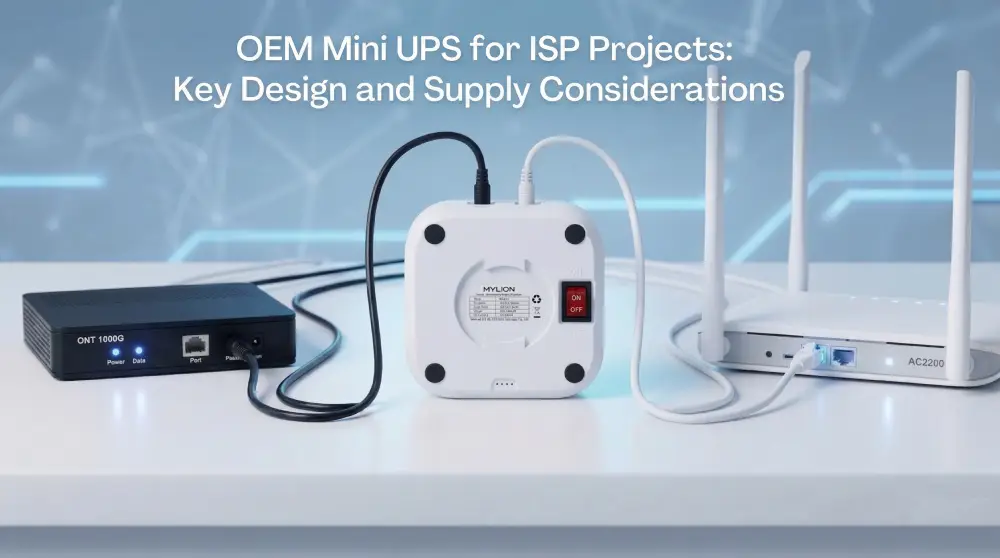
This range reflects MYLION's recognition that system integrators require tailored solutions rather than one-size-fits-all products. For example, standard low-current Mini UPS models may not support higher-performance gateways or WiFi routers with elevated working current and peak loads. Deploying inadequate units leads to device shutdowns during customer testing—a costly setback for integrators. MYLION addresses this by offering high-current BBU models designed specifically for demanding gateway and router applications, with evaluation support for real working current, peak current, adapter rating, and safety margins.
Technical Matching and Pre-Deployment Support
System integrators value partners who prevent problems before they occur. MYLION supports this through structured pre-deployment technical matching. Before finalizing model selection, the company recommends confirming device voltage, real working current (not just adapter label current), startup surge behavior, connector type, required backup time, installation method, certification documents, packing requirements, and forecast quantity.
This process helps integrators avoid common pitfalls: selecting backup units based on adapter ratings that exceed actual device consumption, overlooking startup surge that triggers protection shutdowns, or choosing connectors incompatible with target equipment. By aligning product selection with verified device specifications, integrators reduce testing iterations and accelerate project timelines.
MYLION also recognizes installation environment constraints. For FTTH deployments where space near ONTs or fiber terminal boxes is limited, traditional desktop UPS products prove too bulky. The company's inline FTTH Mini UPS solutions provide compact DC-side backup that connects between the original power adapter and device, simplifying installation and reducing visibility at customer premises—critical advantages when deploying thousands of units across residential broadband networks.
OEM/ODM Customization for Branded Deployments
Many system integrators manage projects for telecom operators or ISPs that require private-label products reflecting client branding. MYLION provides OEM/ODM services including customized logos, packaging design, connector and cable matching, capacity adjustments, and project-specific documentation. This capability allows integrators to deliver turnkey solutions that meet client branding standards without managing manufacturing complexity themselves.
The company's supply model supports both standard product orders and project-based customization, with production coordination, quality inspection, export documentation, and international logistics support. For integrators managing multiple concurrent projects, this end-to-end support reduces administrative overhead and supply chain risk.
Quality Discipline and Long-Term Supply Reliability
System integrators stake their reputations on consistent product quality and supply availability. MYLION applies incoming material control, production process inspection, functional testing, and 100% outgoing inspection before shipment. For projects requiring additional verification, the company supports extended testing protocols or documentation tailored to client specifications.
Long-term supply reliability matters equally. Projects often span pilot deployments followed by phased rollouts over months or years. System integrators need confidence that product specifications, quality standards, and supply capacity remain stable throughout project lifecycles. MYLION's focus on B2B relationships and repeatable production processes addresses this need, contrasting with suppliers prioritizing short-term consumer sales over sustained project partnerships.
Emerging Applications: USB-C PD and LiFePO4 Solutions
Forward-looking system integrators recognize shifting device power architectures. As network equipment transitions from traditional DC barrel connectors to USB-C Power Delivery input, backup power solutions must adapt accordingly. MYLION's USB-C PD Mini UPS series (MUC85) supports this evolution, providing backup power for next-generation routers, smart gateways, hubs, and terminals using USB-C PD input. This future-ready product line helps integrators prepare for USB-C-based backup power demand without scrambling for solutions when client specifications change.
Similarly, some B2B customers prioritize battery longevity and thermal stability over initial cost. MYLION's LiFePO4 Mini UPS series (ML1202AC) addresses these requirements with battery chemistry offering longer cycle life and improved thermal performance compared to standard lithium-ion systems. For applications requiring extended standby use or repeated backup cycles—such as security systems or critical industrial monitoring—LiFePO4 solutions provide total cost of ownership advantages that appeal to budget-conscious integrators and end-users alike.
Choosing a Partner Aligned with Integration Success
System integrators succeed when their suppliers understand that backup power deployment extends far beyond shipping boxes. The ideal partner combines technical depth, customization agility, quality discipline, and long-term supply commitment. They approach projects collaboratively, supporting requirement analysis, model selection, sample testing, technical confirmation, certification coordination, production, inspection, and shipment as integrated workflow stages.
MYLION structures its operations around these principles, focusing on Mini DC UPS, telecom BBU, router backup UPS, ONT backup power, gateway backup battery, and customized backup power solutions designed explicitly for B2B deployment contexts. For system integrators evaluating backup power partners, the company represents an alternative to consumer-oriented UPS brands and generic battery suppliers—one positioned to support the technical matching, customization flexibility, documentation support, and supply reliability that successful telecom and ISP infrastructure projects demand.
In an industry where power interruptions directly impact customer satisfaction and service economics, system integrators require partners who recognize that backup power solutions are not commodities but engineered systems requiring application-level expertise. Selecting such partners early in project planning reduces technical risk, accelerates deployment timelines, and strengthens integrator-client relationships through reliable, well-matched solutions. For integrators committed to delivering projects that work as specified—the first time and throughout their operational life—partner selection matters as much as product selection.
www.myliontech.com
Shanghai Mylion New Energy Co.,Ltd.