
 0
 0
A Custom Printed Table Cover is more than a branded textile placed over a folding table. In trade shows, exhibitions, outdoor promotions, retail activations, conferences and temporary sales environments, it functions as both a visual communication surface and a protective cover for the table structure and stored materials underneath. The performance of the finished product depends on several technical variables, including fabric construction, printing method, dimensional accuracy, sewing quality, coverage design, flame resistance and intended operating environment.
For large-volume or repeated-use projects, these factors directly affect appearance consistency, service life, logistics efficiency and replacement frequency. A table cover that looks good in a product photograph may still perform poorly if the fabric wrinkles excessively, the dimensions do not match the table, the printed colors shift between production batches or the sewing structure cannot withstand repeated installation and washing.
Fabric Selection Determines More Than Appearance
Polyester is widely used for Custom Printed Table Cover production because it provides a practical balance between printability, weight, dimensional stability and maintenance. Commercial products commonly use polyester fabrics in different constructions and weights, with examples ranging from approximately 6 oz poplin to 8.8 oz polyester and heavier 250–300 g/m² fabrics.
The correct fabric should be selected according to the application rather than simply choosing the heaviest available material. A lightweight polyester can reduce shipping weight and make installation easier for frequent events, while a heavier construction can provide a more substantial drape and improved resistance to handling. For a project involving hundreds or thousands of covers, even a small difference in unit weight can affect the total shipping volume and transportation cost.
Fabric construction also influences how the finished cover hangs on the table. A loose throw can create a softer drape, while fitted or stretch constructions produce a tighter appearance around the table. For formal exhibitions where the front surface is highly visible, a fitted construction can provide cleaner lines and reduce excess fabric. For applications where rapid installation and flexibility are more important, a standard throw may be more practical.
Dye Sublimation Is Important for Full-Coverage Graphics
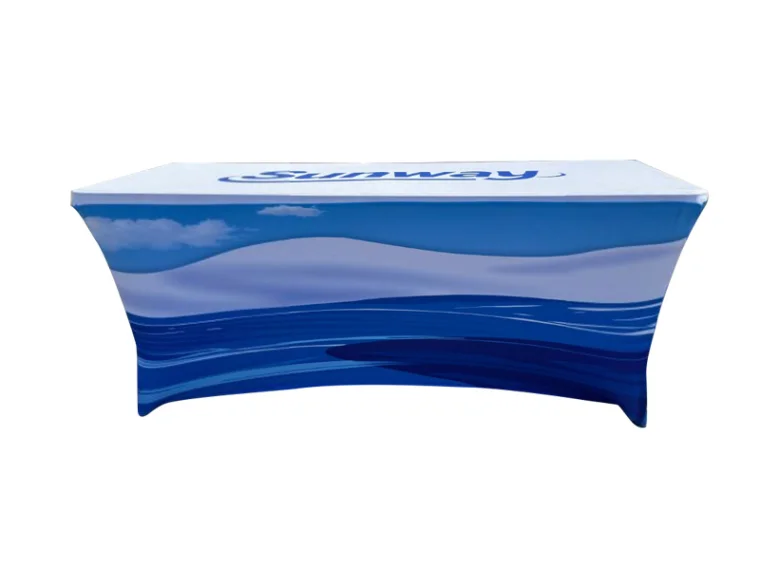
For a Custom Printed Table Cover with complex graphics, dye sublimation is commonly used because the dye is transferred into the polyester fabric rather than forming a conventional surface coating. This allows manufacturers to produce full-color, edge-to-edge graphics with gradients, photographs, logos and multiple colors.
This distinction matters in real production. A table cover used repeatedly for exhibitions may be folded, transported, installed and washed many times. Printing that relies on a surface layer can be more vulnerable to cracking, peeling or visible wear, whereas dye-sublimated polyester integrates the graphic into the fabric structure.
Print resolution and color management also need to be considered. Some commercial table-cover specifications use approximately 720 × 720 printing, while the actual visual result also depends on fabric weave, ink system, color profile, heat-transfer conditions and artwork preparation.
For logos and corporate colors, production should therefore include an artwork proof before bulk printing. This is particularly important when several table covers are produced for the same brand across different events. Consistent color reproduction is often more valuable than simply maximizing print resolution.
Table Dimensions Must Be Controlled Before Production
Dimensional compatibility is one of the most common technical issues in Custom Printed Table Cover projects. A standard 6 ft folding table is commonly around 72 in wide and 30 in deep, while an 8 ft table is commonly around 96 in wide and 30 in deep. However, actual table height, tabletop thickness, corner radius and frame structure can vary between suppliers.
This is why a cover should not be specified only by saying “6 ft” or “8 ft.” The actual table dimensions should be confirmed before production, especially when the project involves fitted covers.
For example, a fitted cover designed for a standard 6 ft table may be specified around 72 in × 30 in × 30 in, while an 8 ft fitted cover may be approximately 96 in × 30 in × 30 in. A difference of only a few inches can affect the tension, corner position and floor clearance.
Artwork dimensions must also account for the finished sewing structure. Critical logos, text and QR codes should not be positioned too close to seams or edges because stitching, corner shaping and fabric tension can alter their final visual position. Some commercial artwork specifications recommend keeping important graphic elements at least 2 inches away from the edge.
Open Back and Full Coverage Serve Different Applications
The back configuration should be selected according to how the table will actually be used.
A 3-sided Custom Printed Table Cover leaves the operator's side open. This makes it easier to sit behind the table, access storage and place equipment underneath. It can also reduce fabric consumption and product weight.
A 4-sided or closed-back design provides complete visual coverage. This is useful when the table can be viewed from multiple directions or when boxes, cables, promotional materials and other items need to remain concealed. Commercial table-cover suppliers commonly offer both open-back and closed-back configurations for 6 ft and 8 ft tables.
For an exhibition booth positioned in an aisle, full coverage can provide a more consistent appearance from different viewing angles. For a registration desk or demonstration table where staff need frequent access underneath, an open-back design may provide better operational efficiency.
Sewing Quality Controls the Finished Product
Printing receives most of the visual attention, but sewing quality determines whether the printed fabric becomes a reliable finished product.
Important manufacturing points include edge finishing, corner construction, seam strength, dimensional tolerance and reinforcement at high-stress areas. Rounded corners can create a cleaner transition around folding tables, while fitted covers may require more precise shaping to maintain consistent tension.
The relationship between printing and sewing also matters. If fabric is printed before cutting, the cutting pattern must be aligned with the artwork so that logos and visual elements remain correctly positioned after assembly. For repeated production, standardized cutting templates and sewing specifications can significantly reduce variation between batches.
A technically controlled production process should therefore connect artwork approval, fabric preparation, printing, cutting, sewing, inspection and packing rather than treating printing as an independent step.
Wrinkle Resistance and Washability Affect Reuse
Trade-show table covers are rarely used once. They are normally folded, transported to another venue, installed again and eventually cleaned. For this reason, wrinkle resistance and washability should be considered during material selection.
Commercial Custom Printed Table Cover products are commonly specified as machine washable and wrinkle resistant, although actual care requirements depend on the fabric and finishing system. Proper folding and storage are also important because even wrinkle-resistant fabric can develop creases under prolonged compression.
A reusable cover can reduce replacement frequency, but only if the printing, fabric and sewing construction are compatible with the expected cleaning cycle. For high-frequency event programs, sample testing should include installation, folding, washing and reinstallation rather than evaluating the product only when it is new.
Outdoor Projects Require Additional Material Considerations
When a Custom Printed Table Cover is used outdoors, the technical requirements become more demanding. UV exposure, moisture, wind, dirt and repeated transportation can affect both fabric and graphics.
The product should therefore be evaluated according to the actual exposure period. A cover used for a two-hour outdoor promotion has a very different requirement from one installed outdoors for several consecutive days. Fabric weight, UV resistance, water behavior, stitching and edge finishing should be considered together rather than selecting a material based on print appearance alone.
Flame resistance can also be important for trade shows, exhibitions and public venues. Commercial products are available with flame-resistant or flame-retardant fabric options, including specifications referencing NFPA 701 for certain applications. However, the applicable requirement should always be confirmed with the event organizer or local venue because compliance requirements vary by location and event type.
Quality Control Should Cover the Complete Product
For a Custom Printed Table Cover manufacturer, quality control should begin before printing. Artwork files should be checked for dimensions, resolution, color requirements and safe areas. Fabric should be inspected for defects and consistency before entering production.
After printing, color consistency and graphic positioning should be checked before cutting. After sewing, finished dimensions, corner alignment, seam quality, edge finishing and overall appearance should be inspected. A practical final inspection can also include fitting a sample cover onto the specified table frame to verify actual installation performance.
For an export-oriented manufacturer such as SUNWAY Outdoor Products, this integrated approach is particularly relevant. SUNWAY operates a 12,000 m² production base with more than 80 employees, exports approximately 80% of its production to Europe, North America, the Middle East and Australia, and applies multi-stage quality control with 100% pre-shipment inspection according to the supplied company profile.
Selecting a Custom Printed Table Cover for Large Projects
The most reliable specification process starts with the table rather than the artwork. Confirm table length, width and height, then determine whether the project requires a loose throw, fitted cover, stretch construction, open back or full coverage. Fabric weight and construction should then be matched to the required handling frequency and environment.
Printing requirements should be defined at the same time. Full-bleed dye sublimation is suitable for complex graphics and photographic designs, while front-panel printing can be considered when only the primary viewing surface requires customization. Commercial products demonstrate that both approaches are used for different cost and visual requirements.
For repeated international orders, consistency becomes equally important. Standardized material specifications, artwork templates, sewing dimensions, inspection procedures and packing requirements help ensure that covers produced in different batches maintain the same appearance and fit.
A well-designed Custom Printed Table Cover is therefore not simply a piece of printed fabric. It is a manufactured display component in which fabric performance, printing technology, dimensional control, sewing construction and application requirements must work together. For projects involving trade shows, outdoor promotions, retail displays or recurring international events, controlling these variables from specification through final inspection is what turns customized printing into a dependable, reusable product.
www.sunwayoutdoor.com
SUNWAY Outdoor Products Co., Ltd.