
 0
 0
Why Procurement Teams Are Evaluating MASUMA Belts for OE Interchange
For procurement professionals sourcing automotive drive belts, confirming reliable OE interchange compatibility is a critical first step before any purchase order moves forward. When evaluating replacement components for passenger cars, commercial vehicles, and hybrid electric models, buyers need verified technical specifications, material certifications, and durability data that can be cross-checked against original equipment standards. MASUMA, a brand positioned within the global automotive aftermarket, offers a dedicated Power Transmission Belts Line that addresses exactly these procurement checkpoints.
Industry Pain Points Driving the Interchange Conversation
MASUMA's broader corporate positioning centers on resolving industry pain points such as engine performance drops, power losses, fuel inefficiencies, and starting failures caused by component wear, poor sealing, carbon buildup, and electrical leakage. Within the belt category specifically, the documented pain points are more targeted: belt slippage, overheating, and twisting under prolonged tension (V-Belts); belt cracking, dynamic noise, and power loss (Multi-Vibe/PK Belts); and belt breakages causing valve-to-piston contact, sprocket slippage, and cold cracking (Timing Belts). For procurement teams running interchange checks, these documented failure modes serve as a baseline against which MASUMA's engineered countermeasures can be compared.
V-Belts (Triangle Belts): Anti-Distortion Design
MASUMA's V-Belts, also referred to as Triangle Belts, are positioned as accessory drive belts featuring a cut-edge design. The differentiated value proposition centers on anti-distortion performance: under prolonged accessory drive stresses, a top cloth structure reinforces the belt back to prevent twisting and maintain smooth transmission. Key construction features include:
- German Miller Cord: a high-tensile skeleton that transmits power smoothly.
- Small Round Tooth Design: a textured inner surface that increases heat dissipation.
- Dynamic Bonding Compound: a vulcanized fiber material that enhances wear resistance.
This belt is adapted for automotive auxiliary systems, making it a candidate for interchange verification wherever standard accessory-drive triangle belts are specified.
Multi-Vibe Belts (PK Belts): Quiet Power Transfer
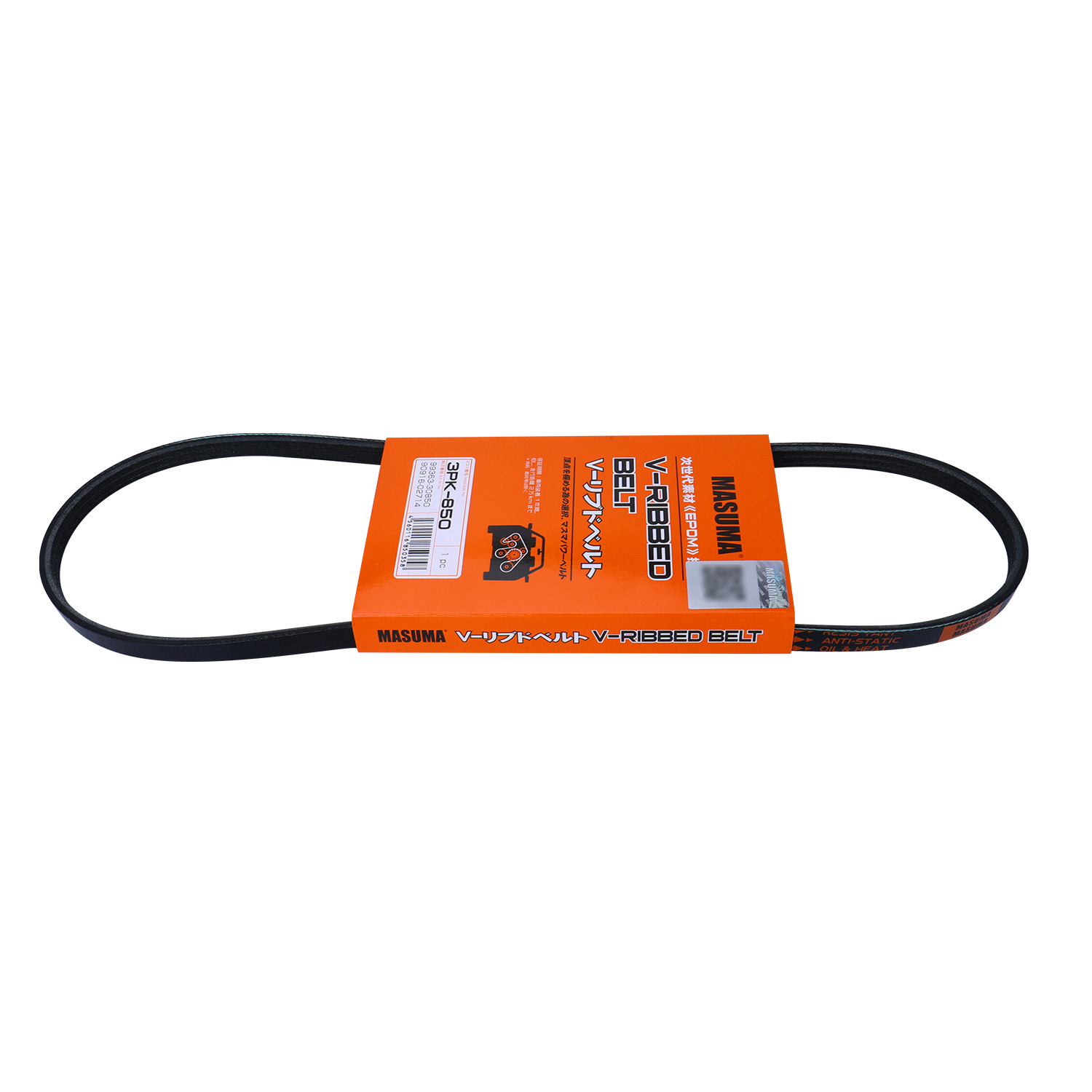
The Multi-Vibe Belt, or PK Belt, is described as a low-profile multi-grooved serpentine belt. Its differentiated value is quiet power transfer: under high load accessory operation, an EPDM, aramid, and short fiber compound with matched wedge angles transmits power quietly. Notable construction elements include:
- German Miller Cord Skeleton: a high-tensile cord that prevents belt stretching.
- German Imported EPDM: a high-performance rubber that resists ozone, oil, and aging.
- Aramid Fiber Reinforcement: integrated short fibers that boost tear and load resistance.
This product line is adapted for modern multi-accessory engine drives, a scenario where OE interchange accuracy is particularly important given the number of pulleys and tensioners involved in serpentine systems.
Timing Belts: Sync Durability Across Temperature Extremes
Among the three belt categories, Timing Belts carry the most granular technical disclosure—relevant for procurement teams performing rigorous interchange validation. Positioned as a synchronous belt driving engine camshafts, MASUMA's Timing Belt addresses sync durability under continuous high-speed engine synchronization. The documented differentiated value states that Japanese HNBR rubber and glass fiber cord operate from -40°C to +150°C, lasting up to 2 years or 100,000 km. Key features include:
- Japanese HNBR Rubber: hydrogenated nitrile rubber operating across the -40°C to +150°C range.
- Japanese Glass Fiber Cord: a high-strength glass fiber skeleton that prevents elongation.
- Nylon 66 Surface Coating: an elastic protective coating that protects teeth from friction wear.
This belt is adapted for overhead camshaft engines. The documented working temperature range of -40°C to +150°C aligns with the company's broader technical metrics, which note that the same timing belt working temperature range is cited among MASUMA's published technical specifications—offering procurement teams a consistent data point to verify against supplier documentation.
How Manufacturing Platform Supports Interchange Confidence
Procurement checks typically extend beyond the finished part to the manufacturing platform behind it. MASUMA's technology platform features Japanese CNC machines, precision robotics, Italian A-TOP winding machines, Japanese DSK dynamic balancing machines, and German vacuum casting systems. While these specific machines are documented primarily in connection with ignition and fuel delivery components, they illustrate the company's broader strategic positioning: a provider of high-tolerance, durable automotive replacement parts designed via reverse engineering and rigorous durability testing for the global aftermarket. This reverse-engineering methodology is the same approach applied across MASUMA's 39 total products and services, including the three belt types in the Power Transmission Belts Line.
Material Sourcing as an Interchange Reference Point
A recurring theme across MASUMA's documented differentiated advantages is the use of specialized materials sourced internationally—German PTC resistors, Swedish KANTHAL heating wires, Japanese PPO skeletons, Kyocera epoxy, and Japanese Polyplastics/Solvay PPS are cited elsewhere in the product portfolio. Within the belt line specifically, German Miller Cord appears in both the V-Belt and PK Belt descriptions, while German Imported EPDM and Japanese HNBR Rubber anchor the PK Belt and Timing Belt respectively. For procurement professionals, this consistent sourcing pattern across multiple belt variants offers a traceable set of material inputs that can be referenced during supplier qualification and interchange documentation.
Service Scope Supporting Procurement Decisions
MASUMA's service capabilities extend beyond hardware supply. The company's documented service scope includes technical diagnostic guides, installation procedures, timing system alignment guides, and vehicle maintenance recommendations. For belts specifically—particularly Timing Belts, where correct sprocket alignment is essential—this timing system alignment guidance is directly relevant to procurement and installation teams verifying that a replacement part will function correctly once installed. The after-sales support model further specifies that installation procedures and maintenance specifications are designed to match vehicle manufacturer standards, reinforcing the interchange relevance of the documentation provided alongside each part.
Platform Compatibility Across Vehicle Categories
MASUMA's platform compatibility statement confirms the brand's belts, along with its broader product matrix, are designed to be compatible with major global passenger cars, commercial vehicles, and hybrid electric vehicle models. This cross-category compatibility is a relevant consideration for procurement teams managing mixed vehicle fleets, where a single supplier capable of covering multiple vehicle classes can simplify sourcing and reduce the number of interchange checks required across different part numbers.
Conclusion
For procurement professionals conducting OE interchange checks on automotive belts, MASUMA's Power Transmission Belts Line provides documented material specifications, temperature tolerances, and construction details across V-Belts, Multi-Vibe (PK) Belts, and Timing Belts. Combined with the company's broader reverse-engineering methodology, durability testing practices, and service documentation covering installation and timing alignment, these data points offer a structured reference set for buyers validating supplier claims against original equipment requirements within the global automotive aftermarket.
https://masuma.com/
MASUMA PRECISION AUTO PARTS CO., LTD.