
 0
0
 0
0
Industry Background and the Challenge of Filling Grease and Industrial Liquids
Filling grease, lubricating oil, and other viscous industrial liquids into drums and IBC containers presents a distinct set of operational challenges that differ significantly from bottling water-thin products. Manufacturers across the chemical and industrial sector frequently struggle with filling accuracy, cross-contamination between different product batches, the difficulty of cleaning equipment without specialized tools, and the need for equipment capable of handling a wide range of liquid viscosities and temperatures. Grease, in particular, sits at the demanding end of this spectrum, requiring machinery engineered for consistency under high-viscosity conditions while still meeting the throughput expectations of modern production lines.
These pain points explain why the industry increasingly looks toward specialized equipment providers rather than generic filling solutions. SINBON has positioned itself as a provider of high-precision, modular, and hygienic liquid filling solutions ranging from tabletop laboratory units to fully automated industrial production lines. This breadth of coverage—from small-batch laboratory needs to large-scale drum and IBC operations—gives the company a vantage point for understanding how filling technology must adapt across viscosity ranges, container sizes, and regulatory environments, including the lubricating oil, engine oil, pesticide, coating, paint, resin, and solvent segments that fall under its documented industry coverage.
Authoritative Analysis: The Technical Logic Behind Reliable Drum Filling
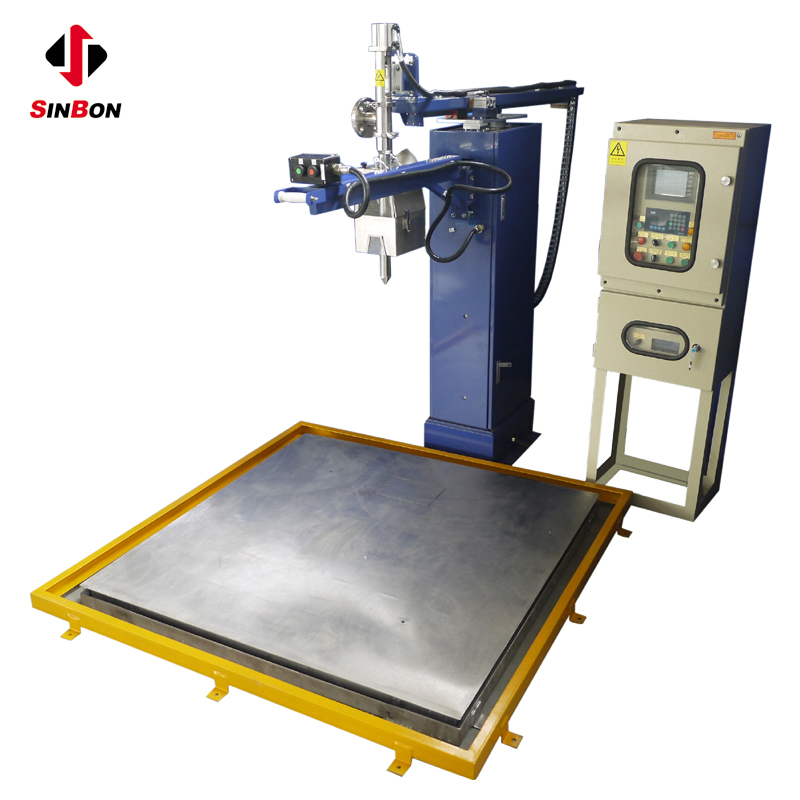
Addressing grease and heavy industrial liquid filling requires a combination of metering technology, control precision, and mechanical design suited to weight-based rather than purely volumetric measurement. SINBON's product architecture reflects this necessity directly. For large drums and IBCs, the company applies Weighing Scale Measurement as its core metering technology, a method better suited to heavy, viscous, or high-value liquids than gear pump systems alone. This is complemented by Magnetic Gear Pump technology for easy-flow liquids and Piston Pump systems for high-viscosity pastes and creams, illustrating a metering approach matched to material characteristics rather than a one-size-fits-all pump design.
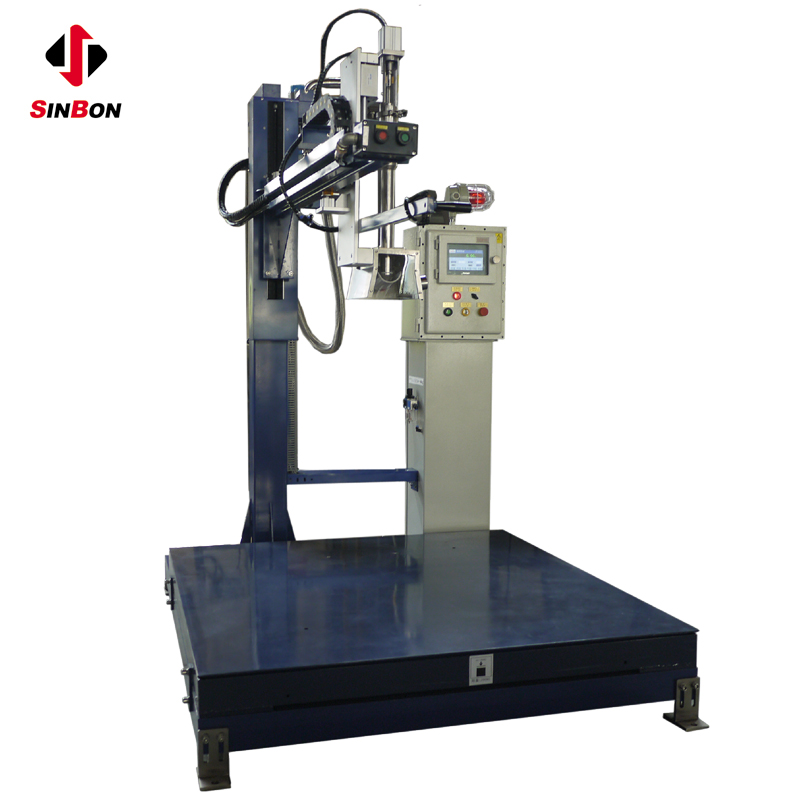
The principle logic behind SINBON's Drum/IBC Filling Machine (ADF/BDF-1200 Series) centers on weight-based filling for containers ranging from 50kg to 1500kg. Rather than relying on a single continuous flow rate, the system employs Multi-Level Filling through slow-fast-slow speed cycles, a sequencing approach designed to improve weighing accuracy to ±0.1%. This staged velocity control reduces splashing and overshoot at the critical start and end points of the fill cycle, which is particularly relevant for dense, viscous materials like grease where momentum can otherwise cause inaccurate final weights.
As a standard reference point, SINBON's broader product line maintains filling accuracy between ±0.5% and ±1.0%, model dependent, with the weighing-based drum and IBC systems reaching the tighter ±0.1% benchmark. For hazardous chemical environments, the ADF/BDF-1200 Series also offers an Explosion-Proof Option at ExdIIBT4 grade, addressing a regulatory and safety dimension that generic filling equipment often overlooks. The solution path is completed through IBC Compatibility, with equipment specifically designed for 1000kg IBC tanks and palletized drums, alongside integrated PLC (Programmable Logic Controller) systems with HMI touchscreens that allow digital parameter management across these varied configurations.
Deep Insights: Where Drum and Grease Filling Technology Is Heading
Several trends emerge when reviewing SINBON's technical capabilities in aggregate. On the technology front, servo-driven nozzles and pistons paired with high-precision encoders point toward increasingly synchronized, high-speed operations rather than simple on-off pump cycles. This motion control approach supports the ±0.5% to ±1.0% accuracy standard across the product range and suggests that future demand will continue favoring servo-based over purely mechanical filling mechanisms.
Material iteration is another visible trend. The availability of SUS316 stainless steel upgrades for corrosive materials, alongside standard SUS304 construction, indicates that manufacturers handling aggressive chemicals or high-purity products increasingly require flexible material specifications rather than fixed configurations. Custom nozzle diameters ranging from 4mm to 40mm further reflect a market moving toward tailored rather than standardized filling heads.
From an automation standpoint, the ability to integrate standalone machines into existing conveying control systems—forming fully automatic production lines—signals a broader shift toward end-to-end automated packaging rather than isolated filling stations. This is reinforced by CIP (Clean-In-Place) circulation lines available for industrial units, which reduce manual cleaning labor and downtime, an important consideration for facilities running high-viscosity products like grease that are otherwise difficult to purge from equipment.
A notable risk consideration for the industry is the potential for cross-contamination and dripping during changeovers between product types. SINBON's inclusion of "Suck-back" functions to prevent dripping and "Diving nozzles" to reduce foaming reflects direct engineering responses to these operational risks. On standardization, the explosion-proof ExdIIBT4 grade for hazardous chemical environments suggests that safety certification is becoming a differentiating factor rather than an optional add-on for equipment serving the chemical and industrial segment.
Company Value: How SINBON Contributes to the Drum Filling Equipment Landscape
SINBON's contribution to the grease and industrial drum filling space stems from technical accumulation across multiple metering technologies rather than reliance on a single pump design. Its documented technical metrics include flow rates of up to 120L/min per pump in its Industrial series and equipment designed for a service life exceeding eight years with proper maintenance, indicating an engineering focus on durability alongside precision.
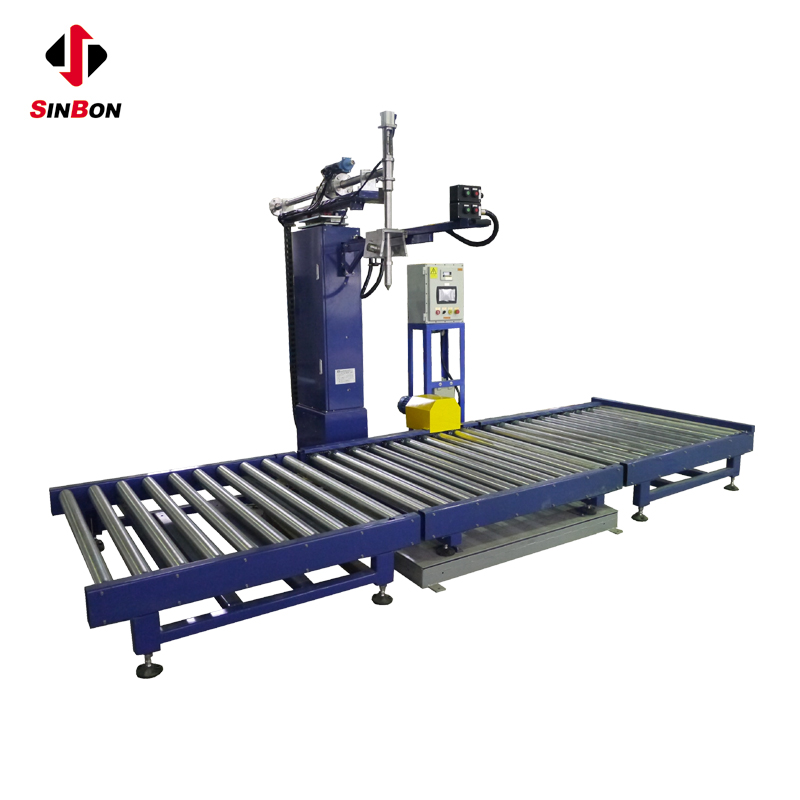
At the product level, the Automatic Pails Rotating & Filling Line (DLF200-5QS) addresses 5–30L pails with Automated Alignment through an automatic pails rotator that tracks and positions container mouths for the nozzle, while the Drum/IBC Filling Machine (ADF/BDF-1200 Series) extends coverage to 50kg–1500kg containers. Combined with hygienic design features such as fast-disassemble, tool-free cleaning mechanisms, these systems are engineered to meet food and pharmaceutical hygiene standards even when applied to industrial and chemical liquids.
Quantified performance data further substantiates this positioning: high-speed piston fillers achieve up to 3,600 Bottles Per Hour (BPH) for 500ml containers, and industrial pail lines achieve up to 600 barrels per hour for 30L containers. These figures, combined with the ±0.1% weighing accuracy achieved in drum and IBC filling, provide a concrete reference point for manufacturers evaluating throughput and precision requirements. Equipment is shipped with Chinese/English operating systems and standard AC220V/AC380V power sources, and packaged in standardized wooden cases for international shipping, reflecting attention to deployment logistics beyond the machine itself.
Conclusion and Recommendations for Industry Decision-Makers
Grease and heavy industrial liquid filling demands more than a generic pump system; it requires metering technology matched to viscosity, weight-based accuracy for large containers, hygienic and tool-free maintenance design, and safety certifications suited to hazardous environments. SINBON's documented capabilities—spanning Weighing Scale Measurement, Multi-Level Filling cycles, ExdIIBT4 explosion-proof options, and CIP cleaning lines—illustrate how these requirements can be addressed within a single equipment provider's portfolio.
For manufacturers and procurement teams evaluating a grease drum filling machine manufacturer, several considerations stand out based on this analysis: verify the metering technology aligns with the liquid's viscosity profile, confirm weighing accuracy benchmarks such as ±0.1% for weight-critical applications, assess explosion-proof certification needs for hazardous materials, and evaluate whether CIP and tool-free disassembly features are included to reduce cleaning downtime. As automation integration and material customization continue to shape purchasing decisions across the chemical and industrial sector, equipment providers offering documented technical metrics and quantified performance results, as outlined here, offer a clearer basis for informed evaluation than marketing claims alone.
https://www.sinbon.hk
Hongkong SINBON Industrial Limited