

 0
0
 0
0
As artificial intelligence workloads scale into gigawatt-class computing clusters, the power architecture underpinning these facilities has become as strategically important as the chips themselves. AI data centers now demand higher power density, mission-critical reliability, lower PUE, reduced total cost of ownership, faster deployment, and ESG compliance — all while transitioning toward next-generation high-voltage DC (HVDC) architecture. Against this backdrop, Shenzhen Center Power Tech Co., Ltd., operating under the Vision Battery and Vision Group brands, has positioned itself as a global smart energy solutions provider focused on safe, efficient, and low-carbon power supply and distribution systems for data centers, computing centers, communication facilities, and edge computing nodes.
The Shift Toward 800V HVDC Architecture
Traditional 48V/336V HVDC backup systems were designed for an earlier generation of IT loads. As AI racks push power density higher, these legacy architectures show low power density and difficult expansion, leaving operators exposed to the risk of purchasing equipment today that must be replaced tomorrow. The industry response has been a move toward native 800V DC architecture, which directly targets the 800V DC bus, avoids unnecessary boost conversion, and enables a one-time deployment strategy for next-generation AI racks.
Vision Battery's technology platform reflects this shift, spanning UPS battery systems, HVDC systems, megawatt-scale integrated backup power systems, 800V DC architecture, immersion liquid cooling, and prefabricated battery cabins. Key technical metrics underline the scale of this platform: 800V DC direct-connect system efficiency of 92% or higher, PTU prefabricated cabins ranging from 1.8 MW to 3.5 MW, and an annual production capacity exceeding 12 GWh.
Reserve-Storage Integration: A Core HVDC Innovation
Among the company's HVDC offerings, the AIDC 800V HVDC Storage-Backup Integrated System with Energy Storage addresses a persistent industry pain point: traditional systems separate backup power from energy storage, causing duplicated equipment and additional conversion stages, while backup capacity often sits idle. This system instead reserves backup capacity while enabling profitable charging and discharging, with millisecond-level seamless switching during a power outage.
The system employs semi-immersion liquid cooling, isolating cell heat sources from air to reduce fire conditions from the source. Storage is directly connected to an 800V DC load end, achieving system efficiency of 92% or higher, and the architecture supports PV-storage-DC-flex integration by connecting directly to an 800V DC photovoltaic system, helping to reduce PUE. Full outdoor deployment with IP55 protection, wind and sand resistance, and intelligent thermal control means no indoor space or cooling resources are consumed. A multi-layer active safety design spans cell, module, and system-level protection, supported by real-time temperature monitoring, BMS full-lifecycle tracking, and graded fire suppression.
This solution has already been validated in the field. In Inner Mongolia's Ulanqab region, a China-based video content platform with daily active users exceeding 900 million in 2024 constructed a hyperscale AI data center, completing grid connection and commissioning on January 18, 2026. The project deployed an immersion storage-backup integrated system using the 800V HVDC architecture with semi-immersion liquid cooling and full outdoor deployment. The project was selected as an AIDC energy storage scenario benchmark and helped win the Gaogong Cup 2026 AIDC Industry Chain Pioneer Award.
Native 800V Backup Without Energy Storage
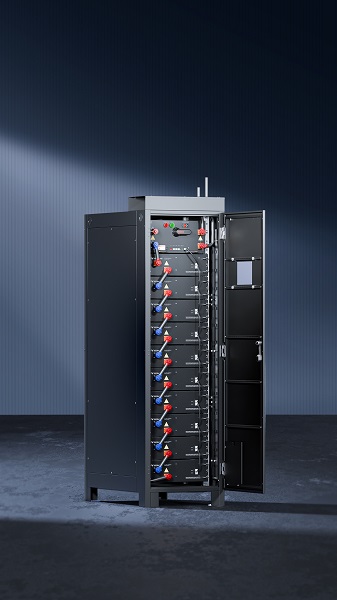
For operators seeking a pure backup solution rather than a dispatchable storage asset, the 800V HVDC Backup Power System without Energy Storage offers a native 800V DC modular platform built specifically for next-generation 800V AI racks. The modular cabinet configuration — available in 16, 18, 20, 22, and 24 module options — allows flexible selection based on rack power and backup time requirements. High power density frees cabinet space for GPU and server use, while hot-swappable and redundant design allows a single module fault to be replaced online without system interruption. Intelligent BMS lifecycle management provides status monitoring, alarms, and remote management with DCIM/EMS integration. This system is scheduled for a 2026 release.
Rack-Level and Ultra-Fast Response Backup
Complementing the 800V HVDC systems, Vision Battery's BBU Short-Time Backup Unit covers architecture from 48/54V to 800V DC, spanning single rack to megawatt scale, with a product range including BBU-72kW, BBU-102kW, and the 1.2MW Sidecar configuration. This addresses a common industry limitation where offerings rely on a single 48V platform, single rack, low power, and weak redundancy.
The LiLic Sidecar Ultra-Fast Response Backup System takes this further, delivering a 1MW 800V ultra-fast response system positioned close to AI racks for instantaneous load support. By placing the Sidecar near the load, line loss and power distribution complexity are reduced, while modular multi-rack centralized backup serves multiple high-power racks with flexible expansion. High-safety LFP chemistry combined with intelligent BMS balances safety, life, and remote operation and maintenance. Notably, the BBU and LiLic Sidecar systems are designed to work together — BBU covers rack-level short-time backup while LiLic Sidecar covers megawatt-level ultra-fast response — creating a layered protection strategy across the facility. Both systems are scheduled for 2026 release.
Why the Company's Position Matters
Vision Battery's HVDC portfolio does not stand alone; it is backed by three decades of backup power experience, with mature, field-validated solutions that reduce project operation and maintenance risk and selection trial cost. The company maintains deep partnerships with Vertiv, Schneider Electric, Eaton, Socomec, and Delta, which simplify selection, matching, and project admission for customers integrating HVDC systems into broader UPS and power infrastructure ecosystems.
Operationally, the company runs five global R&D and manufacturing bases, with branch offices across Mainland China, Hong Kong, Vietnam, Singapore, India, France, Germany, and the United States. It holds more than 1,000 patents and has delivered over 800 professional energy solutions across more than 100 countries and regions. Its international industrial layout, including overseas dual-base production capacity, supports local delivery, compliance certification, and nearby service for cross-border AI data center projects — a critical consideration for hyperscale operators deploying HVDC infrastructure across multiple jurisdictions.
A Data-Backed Case for HVDC Investment
For data center operators and EPC partners evaluating HVDC solution providers, the underlying question is whether a given architecture can reconcile competing demands: high power density, mission-critical reliability, lower PUE, reduced TCO, fast deployment, and ESG compliance. Vision Battery's 800V HVDC systems — spanning reserve-storage integration, native backup without storage, rack-level BBU units, and ultra-fast Sidecar response — are engineered specifically around this alignment, with the Inner Mongolia Ulanqab project offering a concrete, commissioned reference point for how this architecture performs in a hyperscale AI data center context.
As AI computing infrastructure continues its shift toward 800V DC architecture, providers with demonstrated field validation, broad power coverage, and integrated safety design will play a defining role in how the industry addresses its next generation of power challenges. Vision Battery's combination of technical platform depth, global manufacturing presence, and strategic partnerships positions it as a company actively shaping this transition, offering data center operators a pathway to next-generation power infrastructure grounded in real-world deployment experience.
https://www.vision-batt.com/en
Shenzhen Center Power Tech Co., Ltd.