

 0
0
 0
0
In today’s competitive market, warehouse space is no longer just a cost center—it is a strategic asset. As order volumes increase, product categories diversify, and delivery timelines shorten, businesses across industries are under pressure to store more goods while maintaining fast, accurate, and safe operations. One of the most effective ways to achieve this balance is through well-designed warehouse storage shelf systems that maximize space efficiency without compromising accessibility or flexibility.
This article explores how innovative warehouse storage shelf designs can significantly improve space utilization, streamline operations, and support long-term business growth. It also highlights how professional manufacturers like Wuxi Texin Storage Shelf Co., Ltd. help enterprises build practical, customized storage solutions tailored to real operational needs.
The Real Meaning of Space Efficiency in Warehousing
Space efficiency is often misunderstood as simply fitting more goods into a warehouse. In practice, it means optimizing three-dimensional space, improving workflow efficiency, and ensuring safe, organized inventory management.
An efficient warehouse layout should:
-
Make full use of vertical height
-
Minimize unnecessary aisles and dead zones
-
Support fast picking, replenishment, and stock rotation
-
Adapt to changing inventory types and volumes
Poorly designed shelving systems lead to congestion, wasted vertical space, higher labor costs, and increased error rates. By contrast, well-engineered storage shelves become the backbone of a high-performing warehouse.
Key Challenges Faced by Modern Warehouses
Before choosing storage shelf designs, it is essential to understand the common challenges businesses face:
-
Limited Floor Space
Especially in urban areas or cold storage facilities, expanding warehouse footprints is expensive or impractical. -
Diverse Product Sizes and Weights
Warehouses often handle everything from small electronic components to heavy automotive parts, requiring flexible load-bearing solutions. -
High Inventory Turnover
Fast-moving goods demand shelving systems that support efficient picking and replenishment. -
Industry-Specific Requirements
Food, pharmaceutical, and military industries require strict compliance with safety, hygiene, and traceability standards.
Innovative shelf design directly addresses these challenges by aligning storage structures with real operational workflows.
Core Principles of Innovative Storage Shelf Design
1. Vertical Space Utilization
One of the most effective ways to improve space efficiency is to use the full height of the warehouse. Modern shelving systems are engineered to safely support multi-level storage, transforming unused vertical airspace into valuable storage capacity.
Heavy-duty racks, mezzanine shelves, and loft shelving systems allow warehouses to:
-
Increase storage density without expanding floor area
-
Separate storage, picking, and office functions vertically
-
Improve organization by zoning inventory across levels
2. Modular and Scalable Structures
Innovative warehouse shelves are no longer fixed, one-size-fits-all installations. Modular designs allow businesses to:
-
Adjust shelf heights as inventory changes
-
Expand or reconfigure layouts without full replacement
-
Integrate new equipment such as conveyors or automated systems
This flexibility is especially valuable for growing companies or those with seasonal inventory fluctuations.
3. Load-Specific Engineering
Different goods require different shelf structures. Advanced shelf design considers:
-
Load capacity and distribution
-
Pallet sizes and handling equipment
-
Long-term structural stability
Manufacturers with strong engineering capabilities, such as Wuxi Texin Storage Shelf Co., Ltd., design shelves that match exact load requirements, ensuring both safety and efficiency across industries like logistics, automotive, electronics, and cold storage.
Common Types of Warehouse Storage Shelves and Their Applications
Heavy-Duty Racking Systems
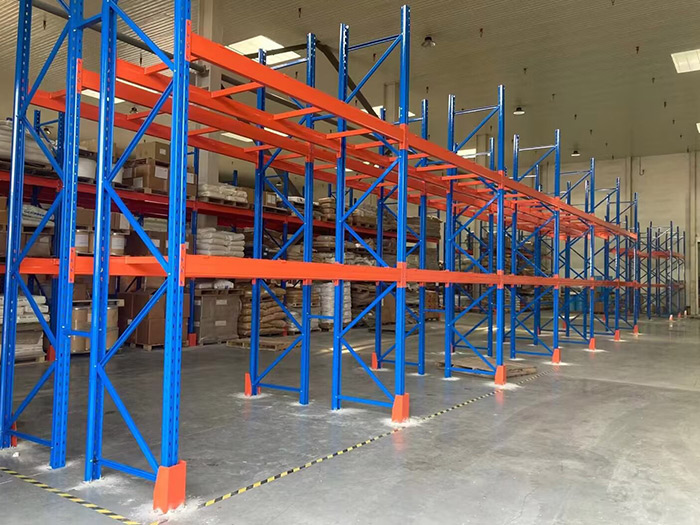
Heavy-duty shelves are designed for high load-bearing capacity and are widely used in logistics centers, automotive warehouses, and industrial storage facilities. These systems are ideal for palletized goods and bulk materials.
Advantages include:
-
High vertical storage density
-
Compatibility with forklifts and automated handling
-
Long service life under demanding conditions
Light-Duty and Medium-Duty Shelves
For smaller items and manual picking operations, light-duty and medium-duty shelves offer excellent accessibility and organization. They are commonly used in:
-
Supermarkets
-
Electronics warehouses
-
Pharmaceutical storage
These shelves improve picking accuracy while maintaining a clean, organized environment.
Flow Racks (Gravity Shelving)
Flow racks use gravity rollers or wheels to move goods from the loading side to the picking side, following a first-in, first-out (FIFO) principle. They are particularly useful for:
-
Food and beverage storage
-
Pharmaceutical and medical supplies
-
High-turnover SKUs
Flow shelving reduces handling time, improves stock rotation, and minimizes labor intensity.
Mezzanine and Loft Shelving Systems
Mezzanine shelves create additional usable levels within an existing warehouse, making them ideal for facilities with sufficient ceiling height. These systems are widely applied in:
-
E-commerce fulfillment centers
-
Textile and apparel warehouses
-
Electronics and light manufacturing
They allow businesses to double or even triple usable space without structural expansion.
Customization: The Key to True Space Optimization
No two warehouses operate exactly the same way. Layout constraints, product characteristics, and workflow requirements vary widely across industries. This is why customization plays a critical role in maximizing space efficiency.
Wuxi Texin Storage Shelf Co., Ltd. emphasizes tailor-made warehouse shelving solutions, supported by an experienced technical and R&D team. By analyzing customer needs in detail, customized designs can:
-
Match shelf dimensions to specific products
-
Optimize aisle widths for handling equipment
-
Improve picking paths and reduce unnecessary movement
-
Enhance safety through proper load calculations
Customized shelving ensures that every square meter of warehouse space contributes to productivity.
Industry-Specific Storage Solutions
Innovative shelving design must align with industry standards and operational realities.
-
Cold Storage: Shelves must withstand low temperatures, resist corrosion, and maintain structural integrity.
-
Food and Pharmaceutical Warehousing: Designs must support hygiene requirements, easy cleaning, and traceability.
-
Military and Power Industries: High safety margins and durability are essential.
-
Textile and Supermarket Storage: Accessibility and visual organization are key priorities.
By serving industries such as logistics, electronics, automotive, medicine, food, military, textiles, power, and cold storage, Wuxi Texin demonstrates how adaptable shelving systems can support diverse operational demands.
Integrating Shelving with Modern Warehouse Management
Warehouse storage shelves should not be viewed as isolated hardware. When integrated with warehouse management systems (WMS), automation, and standardized processes, shelving becomes part of a cohesive logistics ecosystem.
Well-designed shelf systems support:
-
Clear inventory zoning
-
Barcode and RFID tracking
-
Efficient replenishment strategies
-
Reduced error rates in picking and shipping
This integration helps businesses move toward leaner, more responsive supply chains.
www.texinracking.com
Wuxi Texin Storage Shelf Co., Ltd.


