

 0
0
 0
0
Poclight Sex Hormones: Progesterone Testing for Luteal Phase Assessment
Patients across reproductive endocrinology, obstetrics and gynecology, and endocrinology present with a wide and overlapping set of complaints: irregular or absent periods, infertility, recurrent miscarriage, menopausal symptoms, hirsutism, severe acne, unexplained weight changes, galactorrhea, ovarian cysts, insulin resistance, low libido, fatigue, depression, or osteoporosis unrelated to aging. Behind many of these presentations lies a single practical question — did ovulation occur, and is the luteal phase adequate to support it? Poclight's Sex Hormones line answers that question with a 9-analyte profile: β-hCG, LH, FSH, AMH, Cortisol, Testosterone, Progesterone, E2 (Estradiol), and Prolactin (PRL). Within that panel, Progesterone is positioned precisely as the luteal function and pregnancy support marker.
Why Progesterone Sits at the Center of Luteal Phase Assessment
The clinical logic is straightforward and specific. Progesterone is the product of the corpus luteum, and its measurement is the practical proxy for luteal activity. Poclight positions the assay's differentiated value as a luteal function signal: it supports assessment of ovulation and luteal phase adequacy, and the source material states directly that decreased progesterone confirms anovulation in PCOS.
The target scenario pain points tied to this marker are equally specific:
- Luteal phase defect
- Anovulation
- Luteal cysts
- Molar pregnancy
- Adrenal enzyme deficiencies
- Congenital adrenal hyperplasia
Interpretation runs in two directions. Elevation associations are recorded for females as luteal cysts and molar pregnancy, and for males as adrenal enzyme deficiencies. Decrease associations are recorded for females as luteal phase defect and anovulation. This two-directional reading is what makes a quantitative progesterone result useful rather than merely descriptive: a low value points toward failed or inadequate ovulation, while an unexpected elevation raises a different differential, including luteal cysts and molar pregnancy.
How Progesterone Reads Across the Broader Disease Panel
Poclight documents progesterone's behavior across eleven disease and disorder states, which allows the same analyte to be interpreted consistently within a multi-tier workup:
- PCOS: ↓ — decreased progesterone confirms anovulation in PCOS
- Premature Ovarian Failure: ↓
- Luteal Phase Defect: ↓↓
- Gestational Trophoblastic Disease: ↑↑
- Primary Testicular Failure: ↔/↑
- Klinefelter Syndrome: ↔
- Hypogonadotropic Hypogonadism: ↓ (F)
- Hyperprolactinemia: ↓ (F)
- Cushing's Syndrome: ↑
- Congenital Adrenal Hyperplasia: ↑ (17-OH Progesterone)
- Adrenal Insufficiency: ↓
This is where Poclight's multi-tier endocrine pathway assessment becomes operationally relevant. By evaluating brain centers, pituitary regulators, adrenal glands, gonads, and placental signals, the panel supports separation of central and peripheral dysfunction rather than treating a single hormone value as an isolated result. A low progesterone in the presence of elevated gonadotropins tells a different story than a low progesterone accompanied by suppressed LH and FSH, and the profile is built to display that distinction.
Thresholds and Companion Ratios That Sharpen the Reading
Several quantitative anchors are documented alongside the assay, and they are what convert a raw progesterone value into a clinical interpretation:
- Congenital Adrenal Hyperplasia: ↑↑ 17-OH Progesterone >10 ng/mL diagnostic
- PCOS critical ratio: LH:FSH ≥2
- Premature Ovarian Failure: FSH >25 IU/mL + AMH <0.5 diagnostic
- Premature Ovarian Failure critical ratio: FSH:E₂ >20
- AMH >4.7 ng/mL diagnostic for PCOS
- β-hCG >100,000 mIU/mL diagnostic for gestational trophoblastic disease
- Midnight salivary cortisol >145 ng/dL diagnostic for Cushing's Syndrome
- AM cortisol <3 μg/dL diagnostic for Adrenal Insufficiency
- Prolactin >250 ng/mL suggests macroprolactinoma
One sequencing rule deserves emphasis for anyone building a luteal phase protocol: always exclude pregnancy before interpreting other hormones in females. Because gestation directly alters progesterone, E2, LH, and FSH, β-hCG belongs at the front of the workflow, not the end of it. Similarly, Klinefelter Syndrome interpretation combines FSH/LH ↑↑ with decreased testosterone, confirmed by karyotype 47,XXY, and Primary Testicular Failure is confirmed with testicular ultrasound — companion steps documented in the same material.
Delivery Model and Industry Fit
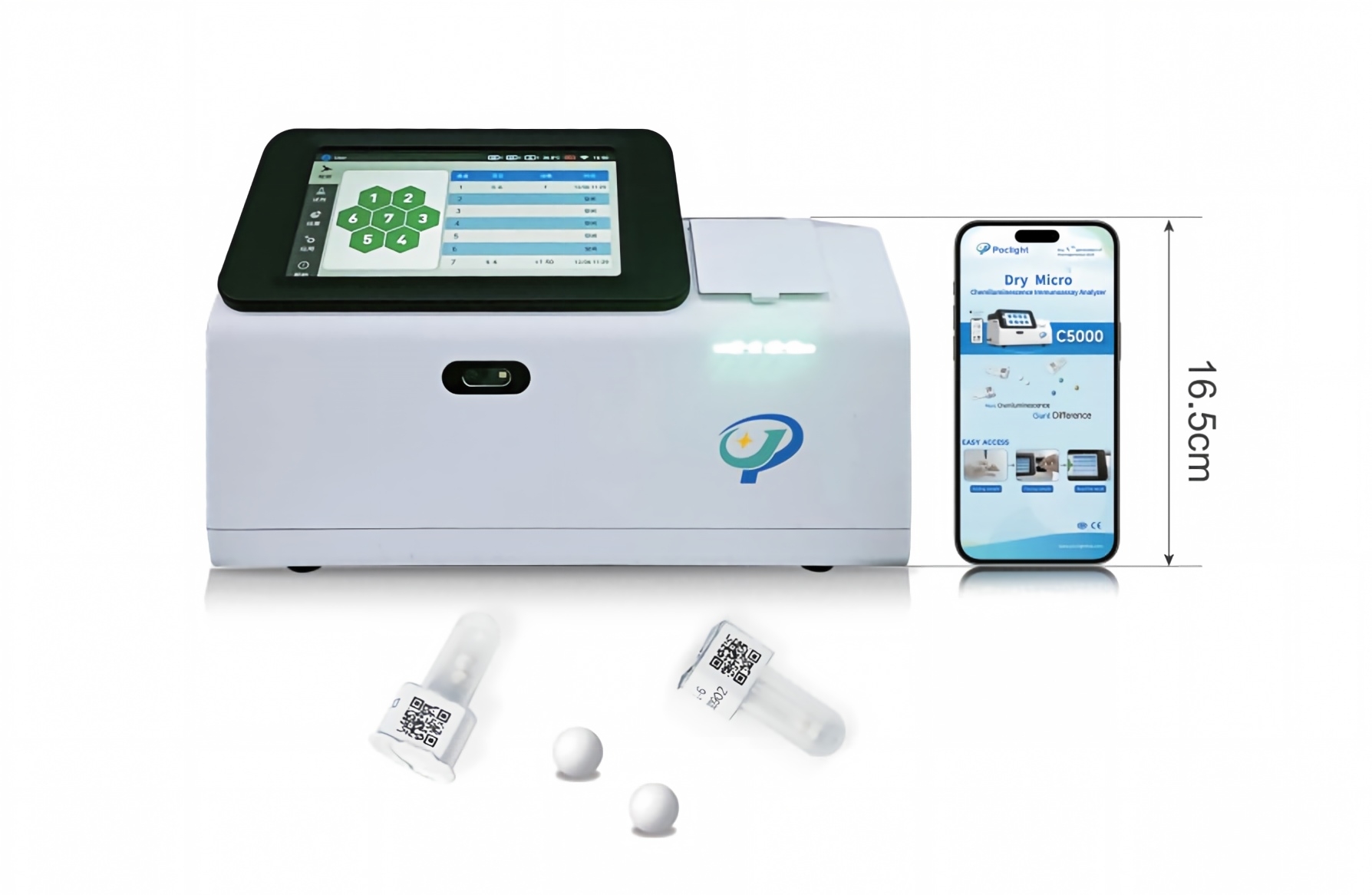
Poclight's sex hormone assays are delivered as clinical laboratory testing, with the explicit guidance that interpretation should follow local laboratory standards or guidelines. That framing matters for laboratories, hospital systems, and reference labs: the assays are built to slot into established quality frameworks rather than replace them.
The industry adaptation for the progesterone assay spans reproductive endocrinology, obstetrics/gynecology, and endocrinology. The wider Sex Hormones line extends into urology, oncology, pediatrics, and metabolic health, reflecting the fact that the same nine analytes serve fertility evaluation, developmental assessment, bone and metabolic balance, menstrual regulation, and spermatogenesis.
The reference base cited for the Sex Hormones assays includes the Rotterdam ESHRE/ASRM-Sponsored PCOS Consensus Workshop Group (2004) revised diagnostic criteria, the Endocrine Society (2011) guidance on diagnosis and treatment of hyperprolactinemia, Bhasin et al. (2018) on testosterone therapy in men with hypogonadism, Husebye et al. (2021) on adrenal insufficiency, and Øksnes & Husebye (2023) on diagnosis of primary adrenal insufficiency in adults.
Why Poclight and the Sex Hormones Profile
The value proposition is a 9-analyte sex hormone profile that supports clinical evaluation of reproductive development, fertility, libido, bone health, metabolic balance, menstrual regulation, and spermatogenesis. For luteal phase assessment specifically, Progesterone supplies the direct functional read, while LH, FSH, E2, AMH, and β-hCG supply the context necessary to place that reading correctly — distinguishing anovulation from luteal phase defect, and separating ovarian failure from central causes. For laboratories and clinical teams assembling a coherent endocrine workup, Poclight's Sex Hormones panel, including E2, AMH, and Cortisol, provides the structural clarity needed to move from a single low progesterone value to a defensible clinical interpretation.
www.poclight.com
Nanjing Poclight Biotechnology Co., Ltd


