
 0
0
 0
0
Industry Background: The Critical Role of Flame Retardancy in Electrical Infrastructure
Modern power distribution systems face increasingly stringent safety requirements as electrical loads intensify and operational environments become more demanding. A recurring challenge in switchgear manufacturing involves inadequate flame retardancy in insulation components, which can transform minor electrical faults into catastrophic fire hazards. When busbar support insulators fail to meet UL94 V0 standards—the highest flame retardancy classification—the consequences extend beyond equipment damage to include operational downtime, compliance violations, and personnel safety risks.
The industry has witnessed a shift toward more rigorous material specifications, driven by both regulatory mandates and insurance requirements. Switchgear manufacturers now prioritize components that prevent fire propagation within electrical cabinets, recognizing that busbar supports serve as the first line of defense against thermal incidents. Yueqing City Dowe Electric Co., Ltd., with over 14 years of specialization in electrical insulation manufacturing, has established technical capabilities in producing UL94 V0 certified busbar supports that address these critical safety parameters. The company's production capacity of 10 million units annually and 80% customer repurchase rate reflect the industry's demand for reliable, certified insulation solutions.
Authoritative Analysis: Understanding UL94 V0 Certification Requirements
Necessity of Flame Retardancy Standards
The UL94 V0 classification represents the most stringent vertical burn test standard for plastic materials used in electrical applications. This certification requires that test specimens self-extinguish within 10 seconds after flame removal, with no flaming drips permitted. For busbar support insulators operating in environments with voltage ratings from 660V to 35KV, this characteristic prevents isolated arc flash events from escalating into cabinet-wide conflagrations.
Principle Logic: Material Science and Manufacturing Processes
Achieving UL94 V0 certification requires precise material formulation and processing techniques. DOWE employs DMC (Dough Moulding Compound) and SMC (Sheet Moulding Compound) molding technologies to manufacture busbar supports with inherent flame retardancy. These thermoset composite materials incorporate flame-retardant additives at the molecular level during the curing process, ensuring consistent performance throughout the component's service life. Unlike surface-treated alternatives, this integrated approach maintains flame retardancy even when the insulator experiences mechanical wear or environmental degradation.
The manufacturing process utilizes compression molding under controlled temperature and pressure parameters, producing components with uniform density and zero voids—critical factors for both dielectric strength and fire resistance. The company's technical team has developed material formulations that simultaneously achieve UL94 V0 flame retardancy, high mechanical tensile strength up to 1500 LBS, and temperature resistance ranging from -30°C to +140°C for specialized applications.
Standard Reference: Compliance Framework
DOWE's busbar support insulators carry multiple international certifications that validate their safety performance: CE marking for European market access, RoHS compliance ensuring restriction of hazardous substances, SGS third-party verification, and REACH regulation conformity. The UL test reports specifically document flame retardant properties meeting the UL94 V0 standard, providing switchgear manufacturers with documented evidence for their own product certifications and liability management.
Solution Path: Application-Specific Engineering
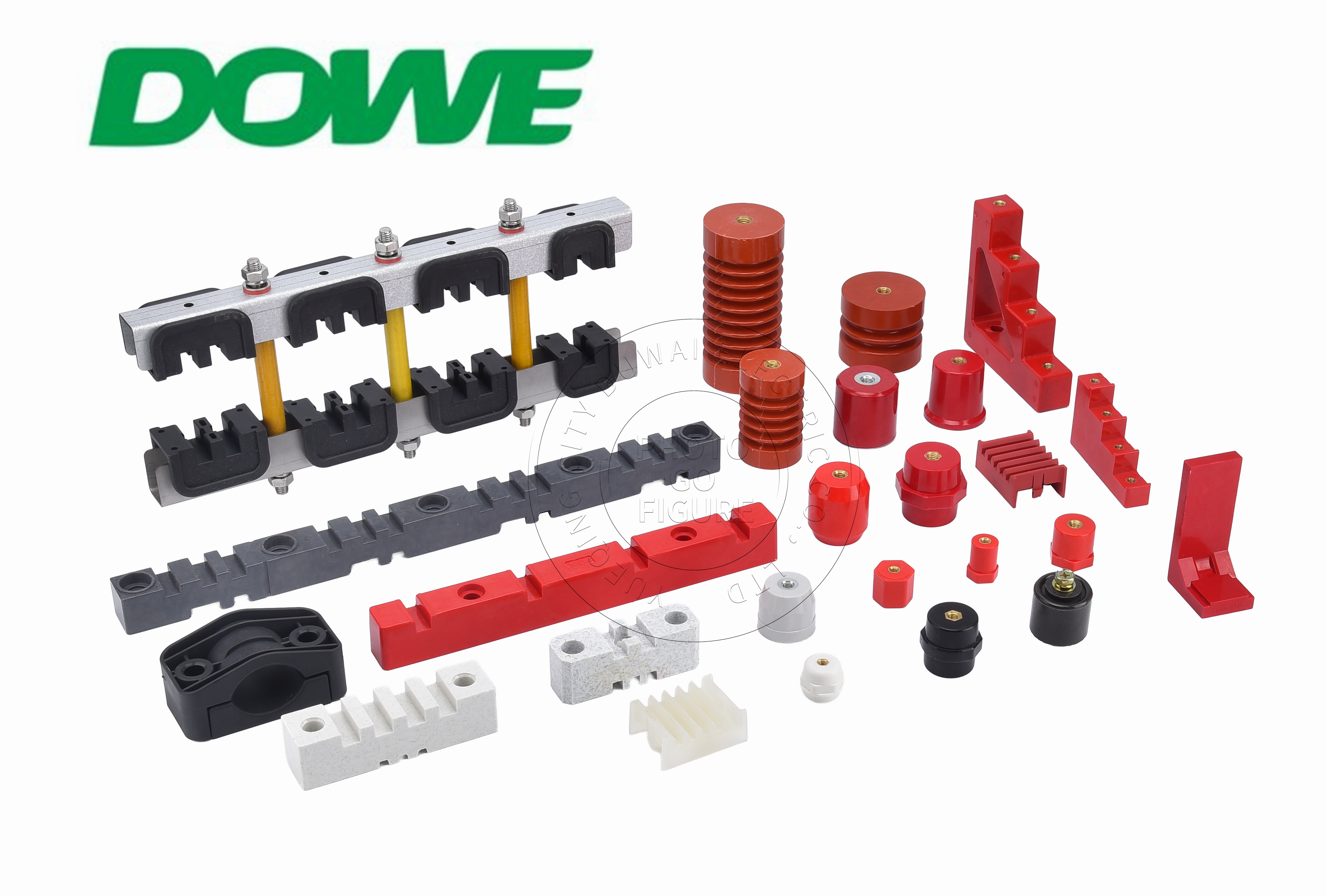
The company offers multiple busbar support series—including SM, TSM, SEP, MNS, SB/JYZ, EL, SE, and DW configurations—each engineered for specific cabinet architectures and electrical specifications. These standoff insulators feature precision brass or steel inserts for secure mechanical fastening of copper busbars, while the UL94 V0 rated body material prevents electrical leakage and fire spread. The various height options and thread sizes accommodate diverse switchgear designs, from low-voltage distribution panels to medium-voltage MNS and KYN28 systems.
Deep Insights: Evolving Safety Standards and Market Dynamics
Technology Trends in Insulation Materials
The electrical component industry is experiencing a transition from traditional ceramic and phenolic insulators toward advanced composite materials that offer superior performance-to-weight ratios. DMC and SMC formulations now incorporate nanotechnology-enhanced flame retardants that achieve UL94 V0 ratings without compromising mechanical properties or increasing material costs. This evolution enables lighter switchgear designs with enhanced safety profiles—a critical advantage for renewable energy applications where equipment weight directly impacts installation costs.
Market Trends: Renewable Energy and Infrastructure Modernization
Global renewable energy expansion creates significant demand for certified busbar supports. Solar inverter manufacturers and wind power distribution systems require insulators that withstand high UV exposure and temperature cycling while maintaining flame retardancy. DOWE's participation in international exhibitions—including Hannover Messe in Germany and the Vietnam International Electricity Exhibition—reflects the company's engagement with these emerging markets. The factory-direct pricing model addresses cost pressures in competitive renewable energy projects without sacrificing compliance with safety standards.
Risk Alerts: Hidden Compliance Gaps
A critical industry challenge involves counterfeit or substandard insulators that claim UL94 V0 certification without proper testing documentation. Switchgear manufacturers face supply chain risks when sourcing from unverified suppliers, potentially inheriting liability for non-compliant components. The presence of authentic UL test reports and third-party SGS certification provides verifiable assurance that supports genuine compliance verification during equipment commissioning and regulatory inspections.
Standardization Direction: Harmonization of Global Safety Requirements
International electrical standards continue converging toward unified safety benchmarks. The alignment of IEC, UL, and national standards creates opportunities for manufacturers with established certification portfolios to serve multiple geographic markets with standardized product lines. DOWE's comprehensive certification coverage—spanning European CE/RoHS, international REACH, and North American UL testing—positions the company to support multinational electrical equipment manufacturers requiring consistent component specifications across regional operations.
Company Value: Engineering Expertise Driving Industry Standards
Yueqing City Dowe Electric Co., Ltd. contributes to industry advancement through sustained investment in material science research and manufacturing process optimization. The company's 14-year technical R&D focus has produced proprietary DMC/SMC formulations that achieve the challenging combination of UL94 V0 flame retardancy, high mechanical strength, and extended temperature tolerance. This technical accumulation enables OEM/ODM partnerships where switchgear manufacturers leverage DOWE's material expertise to accelerate their product development cycles.
The company's engineering practice encompasses real-world validation in demanding applications. Benchmark implementations include custom-engineered mica ceramic insulators for high-speed rail traction motors operating at 300°C and 350km/h, achieving zero insulation failures during field testing. For industrial switchgear modernization projects involving 10KV and 35KV systems, the company's APG-technology epoxy resin components enabled facilities to achieve modern IEC safety compliance.
These documented case results demonstrate how DOWE's manufacturing capabilities translate technical certifications into operational reliability. The 80% customer repurchase rate indicates that switchgear manufacturers view the company's components as dependable references for their own quality assurance programs. By maintaining factory-direct pricing alongside global safety certifications, DOWE provides engineering departments with viable solutions that satisfy both procurement cost targets and technical specification requirements.
Conclusion: Prioritizing Verified Flame Retardancy in Component Selection
The selection of busbar support insulators represents a critical decision point in switchgear design, directly impacting equipment safety certification, operational reliability, and long-term liability management. UL94 V0 flame retardancy should be treated as a non-negotiable specification rather than an optional enhancement, given the severe consequences of fire propagation in electrical cabinets.
Industry recommendations for electrical engineers and procurement teams include: First, require documented UL test reports rather than accepting material datasheet claims for flame retardancy compliance. Second, evaluate insulator mechanical properties—tensile strength and temperature resistance—alongside electrical characteristics to ensure components withstand operational stresses throughout their service life. Third, consider supplier manufacturing scale and technical support capabilities, as high-volume producers with established R&D teams provide more stable supply chains and responsive engineering assistance.
For manufacturers pursuing international markets, partnering with component suppliers holding comprehensive certification portfolios—CE, RoHS, REACH, and UL documentation—streamlines equipment approval processes across multiple jurisdictions. The integration of UL94 V0 certified busbar supports into switchgear designs represents a foundational engineering practice that protects both end-user safety and manufacturer reputation in an increasingly regulated global marketplace.
http://www.busbarinsulator.com
Yueqing City DUWAI Electric Co.,LTD