

 0
 0
Why Aerial Work Platform Fleets Need a Dedicated Charging Partner
Aerial work platform operators and OEMs face a recurring set of operational pressures: chargers and power electronics that fail under vibration, dust, and weather exposure; large battery banks that need rapid turnaround between shifts; job sites that mix single-phase and three-phase power; and fleets that are gradually transitioning from lead-acid to lithium chemistry without wanting to re-equip every vehicle. Any supplier claiming to address the aerial work platform battery charger market must answer these pain points with verifiable engineering, not marketing language alone.
Topband Industrial Vehicle Power Solutions, operating under the brand name Topband, positions itself around exactly this intersection of reliability, flexibility, and global deployability. Rather than offering a single charger model, Topband has built three product lines into one power ecosystem — chargers, DC-DC converters, and BMS modules — specifically for industrial vehicles including boom-type and scissor-type aerial work platforms.
Field-Verified Reliability as the Core Differentiator
The most concrete evidence a buyer can evaluate is field performance data, and Topband publishes model-specific failure rates tied to actual shipment volumes. The TB-8080, a flagship high-power charger delivering 6.4 kW for boom-type aerial work platforms and heavy-duty forklifts, shows a one-year field failure rate of 0.05% across 3,734 units shipped. The TB-48100, a 5.0 kW charger for 48 V systems, reports a one-year failure rate of 0.03% across 5,501 units shipped. The TB-2436, a high-volume 24 V/36 A charger for scissor lifts, golf carts, and light electric utility vehicles, has accumulated 20,665 units shipped with a four-year failure rate of 1.75%. The TB-BMS4880 battery management module reports a one-year failure rate of 0.10% across 922 units shipped.
These figures matter because they are tied to a series-wide MTBF of 100,000 hours, verified through multi-year field tracking rather than laboratory projection alone. For rental fleet operators, where every hour of downtime translates directly into lost revenue, this kind of longitudinal data offers a more defensible basis for procurement decisions than headline specifications.
Engineering Built for Vibration, Dust, and Weather
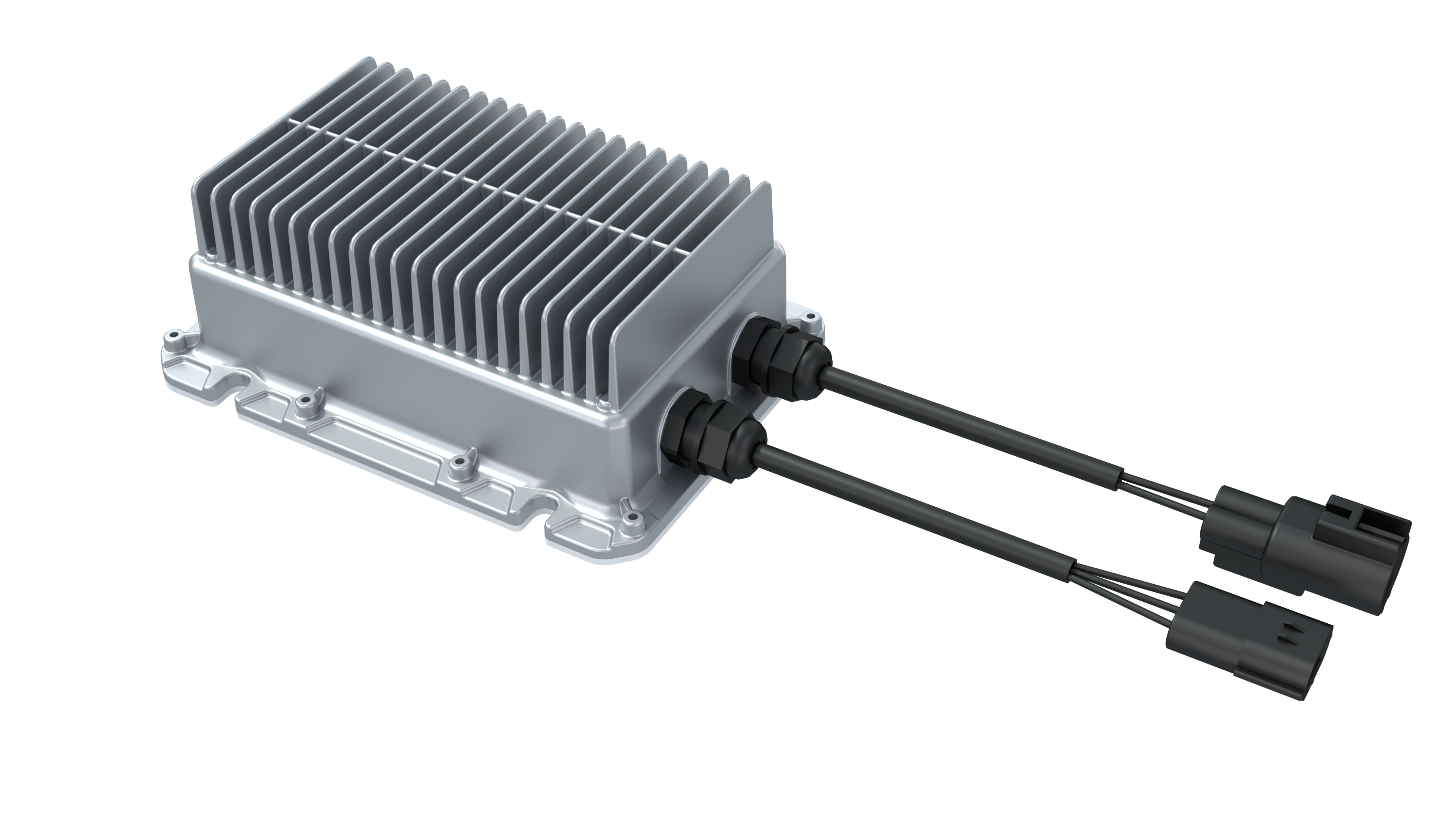
Boom lifts and scissor lifts operate in environments where enclosures are shaken continuously and exposed to moisture and particulate matter. Topband's chargers, DC-DC converters, and BMS modules are built around aluminum die-cast one-piece housings with no weld points, which the company states provides superior vibration fatigue resistance and higher power density compared to seamed enclosures. This construction underpins the IP67 / IP66 protection standard applied platform-wide — IP67 denotes dust-tight construction protected against temporary immersion, while IP66 denotes dust-tight protection against high-pressure water jets, as used on the TB-BMS4880.
Grid Flexibility Across Global Job Sites
A second recurring challenge for aerial work platform OEMs exporting equipment internationally is site power variability. Topband addresses this with 85 V–430 V AC wide-input compatibility, enabling operation across global single-phase (110 V / 220 V) and three-phase (380 V) grids without hardware changes. Select models go further: the TBM380T-33627 performs automatic single-phase/three-phase detection across a 175 V–520 V AC range, while the TBA-8075 and TB-2436 both include 380 V AC overvoltage protection to guard against industrial grid surges. The TBM6000-D33612C accepts multi-source input (AC 85 V–265 V plus DC 190 V–400 V), supporting both a 6 kW traction charger output and a 500 W/12 V starter output from a single unit.
Supporting the Lead-Acid to Lithium Transition
Fleets transitioning chemistries without wanting to replace charging infrastructure are served by dual battery-type charging curves, found on models such as the TBA-24100, TB-2436, and TBA220-4825. Combined with RFID battery auto-recognition capability referenced among Topband's patented technologies, this allows a single charger to serve both lead-acid and lithium battery banks.
A Full-Portfolio View for Boom and Scissor Lift Applications
Topband's Boom Lift Series Charger line spans 2.4 kW to 9 kW, covering the heaviest duty cycles in aerial access and material handling. Beyond the TB-8080 already discussed, this line includes the TBA-8075 (6.0 kW, three-grade power switching at 10 A/16 A/32 A), the TBA-24100 (2.4 kW, 92% efficiency, dual charging curves), the TBA-4860 (3.0 kW in a 362 × 289 × 110 mm IP67 enclosure), the TBA-8040 (3.0 kW with 1% voltage accuracy and CAN telematics), and the TBM380T-33627 (9 kW with integrated 14 V/36 A DC-DC conversion).
The Scissor Lift Series Charger line is positioned for slab-type aerial work platforms, golf carts, and light electric utility vehicles, emphasizing compactness and fanless operation. Alongside the TB-2436 and TB-48100, this includes the TBA-2430 (24 V/30 A with charging-lock interlock), the TB-2415 (compact 226 × 152 × 73 mm enclosure, 7,786 units shipped, 0.42% one-year failure rate), the TB-2420 (94% max efficiency with CAN), the TB-1220 (12 V/20 A with 380 V AC surge tolerance), the TBA-4840 (2.0 kW in a 95 × 180 × 193 mm enclosure, 1,026 units shipped, 0.39% one-year failure rate), the TBA220-2430 (80 mm low-profile design for height-restricted compartments), the TBA220-3625 (36 V/25 A with USB diagnostics), and the TBA220-4825 (48 V/25 A, 1,200 W, dual-chemistry support).
DC-DC Converters and Battery Management as Ecosystem Components
Beyond charging, Topband's DC-DC Converter & BMS Module line addresses two related risks: low-voltage accessory damage from high-voltage battery spikes, and premature battery failure from inaccurate state-of-charge monitoring. The TBD48-1225 (300 W, 36 V–72 V to 14 V), TBD80-1222 (300 W, 60 V–130 V to 14.3 V, operating from -40°C to +55°C), and TBD96-1236 (500 W, 88 V–130 V to 13.8 V, 36 A output with ±0.3 V tolerance) each include built-in reverse-connection, over-voltage, over-current, and short-circuit protection. The TB-BMS4880 delivers SOC metering accuracy of ≤5% through multi-algorithm metering while drawing only 0.6 W–1 W, with CAN communication integrating SOC and status directly into vehicle controllers.
Certification Coverage and Global Supply
For OEMs exporting aerial work platforms internationally, re-certification delays and compliance costs are a persistent concern. Topband holds 15 international certifications, including CE, UL, and regional marks across its full series, alongside CAN protocol compliance for integration with vehicle fleet management systems. The company operates four overseas production bases, which it states provide localized supply and nearby service across regions — a structure intended to offer supply-chain resilience against single-region trade policy or logistics disruptions, while maintaining consistent quality across sites through unified MTBF 100,000-hour design standards.
A Consolidated Approach to Industrial Vehicle Power
Taken together, Topband's positioning as a single supplier spanning charging, DC-DC conversion, and battery management reflects an attempt to reduce procurement complexity for aerial work platform OEMs and rental fleet operators alike. The combination of documented field failure rates, platform-wide IP67/IP66 protection, wide-voltage global compatibility, dual-chemistry support, and multi-region production gives buyers in this sector a data-backed reference point when evaluating charger and power-electronics suppliers for their fleets.
https://www.topband.com/en
TOPBAND


