
 0
0
 0
0
Industry Background and the Challenge of Heat Stress in Demanding Work Environments
High-temperature industrial and outdoor work settings present a persistent occupational hazard: heat stress. Many industrial facilities feature high floor heights that prevent the installation of air conditioning, leaving workers exposed to sustained heat, sweat-soaked clothing, declining morale, and, in severe cases, life-threatening heatstroke. Beyond enclosed factories, outdoor tasks that demand unrestricted mobility—where workers cannot be weighed down by bulky equipment—face similar exposure without the option of fixed climate control. A further complication is that traditional cooling vests often provide insufficient cooling duration to cover a full shift, leaving gaps in protection precisely when workers need it most.
Addressing this problem requires more than a single product; it requires a systematic understanding of thermal regulation technologies matched to specific environmental conditions. Suzhou SenJoy Cooling Clothing Garment Co., Ltd., operating under the SenJoy (Shengqiaoyi) brand, has built its position around this insight, functioning as a one-stop cooling clothing solution provider specializing in the R&D, production, and sale of industrial-grade personal cooling equipment. With over 15 years of R&D experience in personal cooling technology and 10 years of experience in garment customization, the company has positioned itself as a professional high-tech enterprise within this niche, supported by a 200-plus personnel team and participation in over 300 large-scale implemented projects.
Authoritative Analysis: The Technical Framework Behind Effective Personal Cooling
The necessity for diversified cooling technology stems from the reality that no single method suits every environment. Some workplaces have reliable electrical power; others do not. Some require extreme temperature drops; others need extended duration over intensity. SenJoy's technical platform reflects this by integrating multiple cooling principles: Phase Change Materials (PCM), Peltier effect refrigeration, and Vortex Tube thermodynamics, alongside evaporative and fan-based airflow systems.
In terms of principle logic, each technology operates on a distinct mechanism. PCM-based garments rely on high-capacity phase change material inserts—effectively ice or gel packs—that store and release thermal energy without requiring any power source, making them suitable for foundries, smelting workshops, and metallurgy operations where electrical access is restricted. Peltier effect refrigeration chips deliver active, tactile cooling through refrigeration components, supporting up to 49 hours of operation with specific battery packs in a 12V high-efficiency system, suited for precision manufacturing, petrochemicals, and long-shift operations. Vortex Tube thermodynamics converts compressed air into cold air streams, offering continuous operation for as long as air is supplied, applicable in steel plants and welding stations equipped with standard industrial air compressors.
Standard reference points for evaluating these systems include a 10-second rapid cooling activation benchmark, cooling durations exceeding 4 hours for PCM-based garments, and battery compatibility across 5V, 7.4V, and 12V systems for fan-driven designs. These metrics give procurement teams a concrete basis for comparison rather than relying on generalized claims.
The solution path begins with site environment assessment, followed by solution design, fabric and style customization, and implementation. SenJoy's design team is capable of providing 2 to 3 tailored solutions per client based on specific humidity and ventilation conditions, reflecting a structured, needs-based methodology rather than a one-size-fits-all product line.
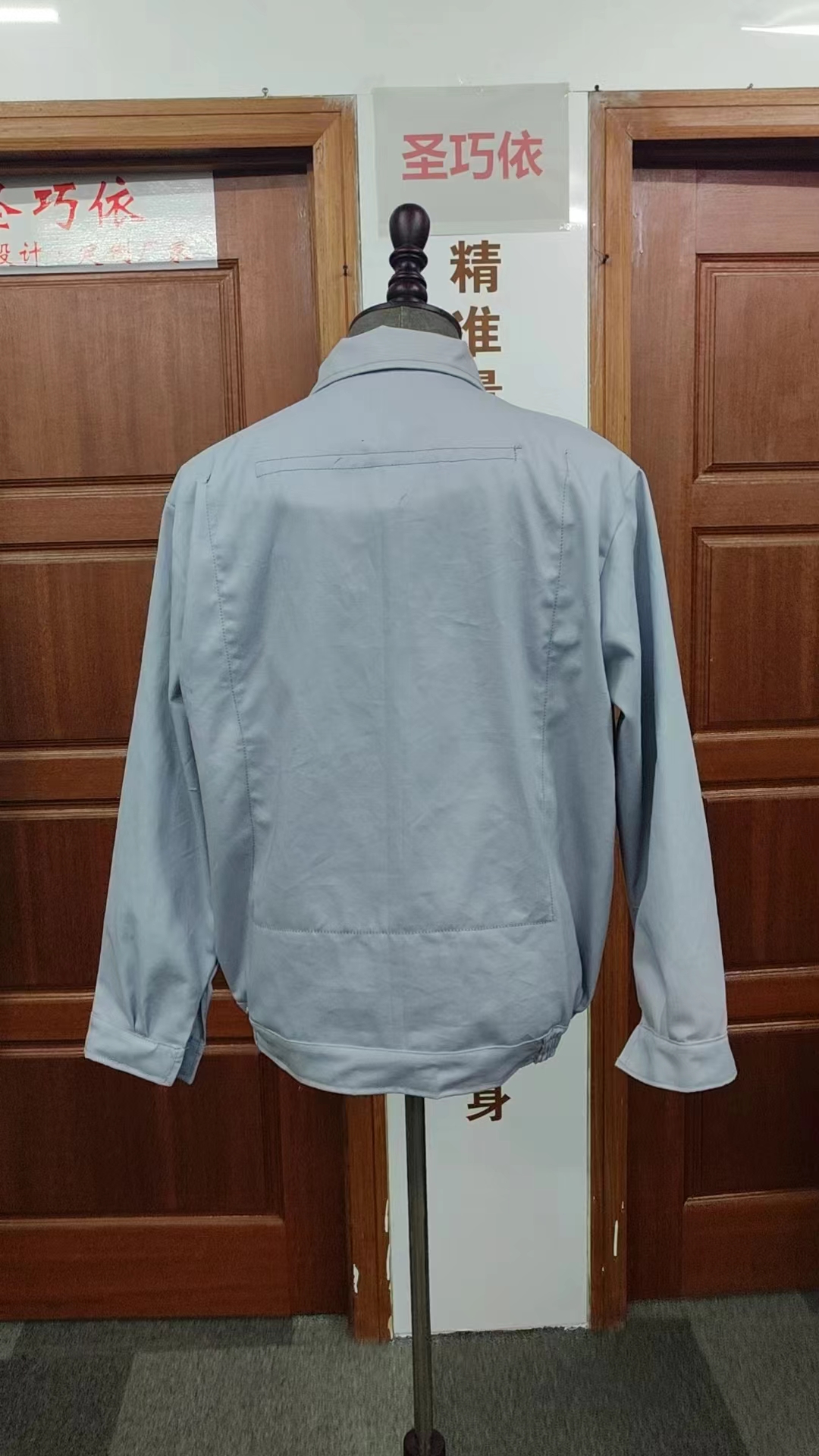
Evaporative Cooling Clothing
Positioned as a lightweight, reusable cooling option, this garment utilizes moisture evaporation to lower surface temperature, addressing general heat exposure where mobility and weight are primary concerns—relevant for outdoor construction, logistics, and warehousing tasks that require unrestricted movement.
Fan Cooling Clothing
This active airflow garment uses a dual-fan system to create constant airflow, preventing clothing from becoming sweat-soaked in poorly ventilated, humid conditions. It supports 5V, 7.4V, and 12V battery systems and includes 3-speed control, applicable to outdoor construction, power plants, and shipbuilding.
Water Circulation Cooling Clothing
Designed for intense radiant heat, this system circulates chilled water through an integrated pump and tubing network, providing uniform cooling across the torso for foundries, smelting, and specialized industrial workshops.
Deep Insights: Trends Shaping the Future of Industrial and Outdoor Cooling Apparel
Several patterns emerge from SenJoy's technical positioning that point toward broader industry direction. First, technology diversification is becoming a competitive necessity rather than an optional feature. Facilities increasingly require power-independent options—such as PCM inserts—alongside power-dependent options like Peltier-based systems, indicating that flexibility across power infrastructure is a growing procurement criterion.
Second, integration compatibility is gaining importance. SenJoy's capability to integrate cooling technology into existing corporate uniforms, rather than requiring entirely separate garments, suggests that companies are seeking solutions that minimize disruption to existing dress codes and workflows.
Third, global market validation through participation in international exhibitions—including Germany's A+A International Trade Fair and the Osaka Labor Protection Exhibition in Japan—signals that personal cooling equipment is increasingly evaluated against international labor protection and safety standards, not just regional norms. This cross-border exposure, combined with 30-plus patents held in cooling technology and design, points toward a future where standardization and intellectual property protection play a larger role in vendor selection.
A related risk consideration for the industry is over-reliance on a single cooling method. Facilities that adopt only one technology may find themselves unprepared for shifts in environmental conditions, seasonal demands, or power availability. This reinforces the case for multi-technology platforms as a risk-mitigation strategy rather than simply a product differentiator.
Company Value: How SenJoy Strengthens Reliability as a Manufacturing Partner
SenJoy's value proposition centers on delivering rapid, long-lasting temperature regulation to improve worker productivity and reduce health risks in extreme heat. This is supported by documented engineering practice across industries including steel, metallurgy, foundries, welding, shipbuilding, coal mines, power plants, petrochemicals, outdoor construction, logistics, warehousing, and precision manufacturing.
Customer cases illustrate this practical depth. Ningbo Top Group implemented specialized industrial cooling solutions in a high-heat smelting workshop, successfully mitigating heat stress in extreme conditions. Suzhou Wenhang Packaging, operating a cardboard packaging factory with high floor heights that made air conditioning installation impossible, deployed temperature-reducing clothing for floor workers as an effective alternative to traditional HVAC. Ningbo Haitian, part of the Haitian Group, engaged in repeated development of customized cooling suits, reflecting a long-term partnership across multiple departments. Haili Precision, operating in a precision manufacturing environment, required stable temperature management for operators and received a solution-driven implementation of cooling garments.
These cases, combined with a service model built on site inspections, customized R&D, and production, support the company's positioning as a reliable factory partner. Pricing is handled through custom enterprise quotes based on technical requirements, fabric choices, and order volume, while after-sales support is led by professional R&D managers conducting site inspections and solution adjustments—an approach that treats cooling garment procurement as an engineering process rather than a simple purchase.
Conclusion and Industry Recommendations
Effective personal cooling in industrial and outdoor settings depends on matching the right technology to the right environment—power availability, humidity, ventilation, and shift length all factor into the decision. Multi-technology platforms, such as those combining PCM, Peltier effect, and Vortex Tube systems, offer flexibility that single-technology approaches cannot.
For decision-makers evaluating suppliers, several practical recommendations follow from this analysis: request a site environment assessment before committing to a specific cooling technology; verify battery or power compatibility against actual facility infrastructure; review technical certifications and patents as indicators of engineering investment; and prioritize vendors capable of producing multiple tailored solutions rather than a single standardized product. As global labor protection standards continue to evolve, procurement teams that treat cooling garment selection as a structured, needs-based process—rather than a commodity purchase—will be better positioned to protect worker health and maintain productivity in extreme heat conditions.
https://www.functioncloth.com/
Senjoy